


The movie Project Hail Mary is enjoying well-deserved critical and commercial success. Ryan Gosling makes you believe a man could love a being with five legs and no face. Directors Phil Lord and Chris Miller and screenwriter Drew Goddard (Buffy the Vampire Slayer and Angel) masterfully adapt author Andy Weir’s book to the big screen (and you should definitely see this on a big screen).
Andy Weir’s first book was 2011’s The Martian, which was made into a 2015 movie starring Matt Damon. Both The Martian and Project Hail Mary are about extraordinary, yet relatable, people achieving extraordinary feats through perseverance, team work, and intelligence. There’s a consistent theme there, but Weir has resisted the suggestion that his work offers more than simple entertainment. In a 2018 interview with Futurism, Weir states:
I dislike social commentary. Like… I really hate it. When I’m reading a book, I just want to be entertained, not preached at by the author. Plus, it ruins the wonder of the story if I know the author has a political or social axe to grind. I no longer speculate about all possible outcomes of the story because I know for a fact that the universe of that book will conspire to ensure that the author’s political agenda is validated. I hate that.
I put no politics or social commentary into my stories at all. Anyone who thinks they see something like that is reading it in on their own. I have no point to make, and I’m not trying to affect the reader’s opinion on anything. My sole job is to entertain, and I stick to that.
Although Weir has described himself as “fiscally conservative and socially liberal,” which usually means a Republican who smokes weed, he’s said he makes a point of never discussing his own personal beliefs and political views. (J.K. Rowling should have considered this advice). However, it’s not as simple as keeping your mouth shut. Art is inherently political, because our politics reflect how we view the world. They are how we shape the future in which we wish to live.
In Project Hail Mary, school teacher and former biologist Ryland Grace (Gosling) , wakes up on a spaceship in a distant solar system with very convenient plot-driven amnesia. Flashbacks slowly reveal to both us and Grace that he was part of a crew of astronauts sent on desperate mission into deep space to save humanity. The sun has become “infected” by alien microbes that’s dimming its light, which is bad news for anyone who doesn’t enjoy ice ages and other extinction-level events.
Already, Weir takes a political position, as the story doesn’t focus on a vocal segment of the population who insists the whole “dimming of the sun” is a big hoax. The world seems to collectively take this climate crisis seriously. Former European Space Agency administrator Eva Stratt (Sandra Hüller) leads the global task force of scientists and other smart people assigned to solve the problem. What Weir presents as a simple backstory, right-wing podcasters and Republican politicians would decry as “woke.” A woman is in charge, and she’s not even American. Stratt works outside any elected office. She’s not President Franklin Roosevelt rousing Americans during World War II or Winston Churchill helping Britain maintain its stiff upper lip during the Blitz. She operates with almost tyrannical authority — sort of a sci-fi version of how right-wingers viewed Dr. Anthony Fauci.
Thomas Brodey shares a revealing passage from Project Hail Mary in his essay, The Illiberalism of Project Hail Mary.
“I assure you, Ms. Stratt, you will comply with the law,” said the justice.
“Only when I want to.” Stratt held up a sheet of paper. “According to this international treaty, I am personally immune from prosecution for any crime, anywhere on Earth. The United States Senate ratified that treaty two months ago.”
She held up a second piece of paper.
“And to streamline situations like this, I also have a preemptive pardon from the president of the United States for any and all crimes I am accused of within U.S. jurisdictions.”
This is objectively “social commentary.” Weir presents a scenario where humanity owes its salvation to someone whose governing philosophy is “the ends justify the means.” Grace and adorable alien Rocky save their worlds by trusting each other and working together, but Stratt’s actions are what makes it possible for Grace and Rocky to meet.
In the same 2018 interview, Weir says, “I deeply dislike social commentary. For instance, as a lifelong Star Trek fan, it’s always bothered me that there is a presumed ‘responsibility’ within Star Trek shows to talk about social issues. I just want to watch Romulans and the Federation shoot at each other.”
This seems almost purposely flippant, as any Star Trek episode featuring the Romulans is about far more than just two warring societies “shooting at each other.”
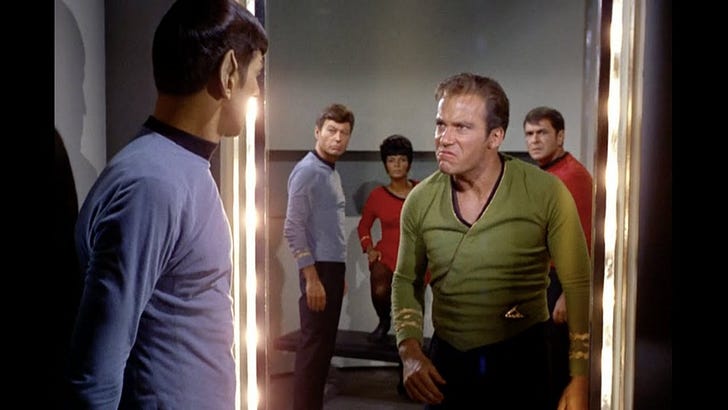
In the Romulans’ first appearance, 1966’s “Balance of Terror,” the Enterprise discovers that the Federation’s longtime foes physically resemble the Vulcans. Barely 25 years after the U.S. government forcibly relocated and incarcerated Americans for the crime of looking like our enemies, Star Trek challenges this prejudice head on. There are no “both sides” here. When Lt. Stiles (Paul Comi) tells Kirk that his ancestors had died in the previous Earth/Romulan war, Kirk stresses: “Their war, Mister Stiles. Not yours. Don’t forget it.” That line had to resonate at a time when Americans would openly express contempt for Japanese people because of the nation’s past actions in World War II.
Later, when Stiles can’t hide his contempt for Spock, Kirk warns him, “Well, here’s one thing you can be sure of, Mister. Leave any bigotry in your quarters. There’s no room for it on the bridge. Do I make myself clear?”
“Romulans and the Federation shooting at each other” is merely the backdrop for this pointed social commentary. Writer Paul Schneider’s script is overtly anti-war. The Romulan commander laments that if his mission succeeds, it will only lead to needless destruction. (Watch below.)
CENTURION: We've seen a hundred campaigns together, and still I do not understand you.
COMMANDER: I think you do. No need to tell you what happens when we reach home with proof of the Earthmen's weakness. And we will have proof. The Earth commander will follow. He must. When he attacks, we will destroy him. Our gift to the homeland, another war.
CENTURION: If we are the strong, isn't this the signal for war?
COMMANDER: Must it always be so? How many comrades have we lost in this way?
CENTURION: Our portion, Commander, is obedience.
COMMANDER: Obedience. Duty. Death and more death. Soon even enough for the Praetor's taste. Centurion, I find myself wishing for destruction before we can return. Worry not. Like you, I am too well-trained in my duty to permit it.
Two decades later, in The Next Generation episode “The Defector,” Romulan Admiral Jarok (James J. Sloyan Jr.) with a storied military career sacrifices everything — his position, his home, even his family — so that he can potentially prevent another war. Unlike Donald Trump or Benjamin Netanyahu, he no longer sees glory or any useful purpose in warfare. A single event changed his outlook. (Watch below.)
“There comes a time in a man’s life that you cannot know,” Jarok tells Picard. “When he looks down at the first smile of his baby girl and realizes he must change the world for her. For all children. It is for her that I am here. Not to destroy the Romulan Empire, but to save it. For months, I tried desperately to persuade the High Command that another war would destroy the Empire. They got tired of my arguments. Finally I was censured, sent off to command some distant sector. This was my only recourse. I will never see my child smile again. She will grow up believing that her father is a traitor, but she will grow up. If you act, Picard. If we stop the war before it begins.”
Yes, “The Defector,” with its overt anti-war message, is a political story brimming with social commentary, but I don’t think Romulan and Federation ships shooting at each other until the superior Dirty Harry in space prevails is somehow better television. “She will grow up believing that her father is a traitor, but she will grow up” is a gut punch that still resonates, especially considering the tragic ending.
At the end of “Balance of Terror,” the defeated Romulan commander rejects Kirk’s offer of help — that’s not the Romulan way — but before destroying his ship and himself, he says, “I regret that we meet in this way. You and I are of a kind. In a different reality, I could have called you friend.”
Grace and Rocky are friends who make personal sacrifices for each other, and in the process, they save both their worlds without sacrificing their humanity. Survival is not presented as a zero sum game, and violence is never the answer. Weir chose to depict a different reality from our current one, and that makes Project Hail Mary an explicitly political work.
Only people embarrassed by their own politics balk at being seen as 'political'
Great piece, as usual!
As a DS9 fan, I often think of Damar, who saw what the war was doing and decided to switch sides. I have a screenshot somewhere of him saying "what kind of state tolerates the murder of innocent women and children?" (and kira's rebuttal)
all art is political indeed because it is a mirror of us