


Now that the Supreme Court has rendered the Voting Rights Act just so many words on crumbling paper, few Democrats are certain about what to do next. However, many have ideas about who’s to blame. Former Democratic National Committee Chair Jaime Harrison, who famously set $100 million on fire in his South Carolina Senate campaign against Lindsey Graham, posted a lengthy diatribe last week against former Democratic Senators Joe Manchin and Kyrsten Sinema.
“[Joe Manchin] and [Kysten Sinema] will go down in history as two of the people who stood at the doorway and blocked the passage of the John Lewis Voting Rights Advancement Act when democracy and Black political power were under assault,” Harrison wrote.
“History teaches us what happens when leaders choose political comfort over moral courage. The Hayes Tilden Compromise ended Reconstruction and unleashed nearly a century of disenfranchisement, terror, and the systematic destruction of Black political power across the South.
Different era. Different names. Same devastating consequences.
When people ask how we got here, their failure to lead and act in that moment will be part of the answer.”
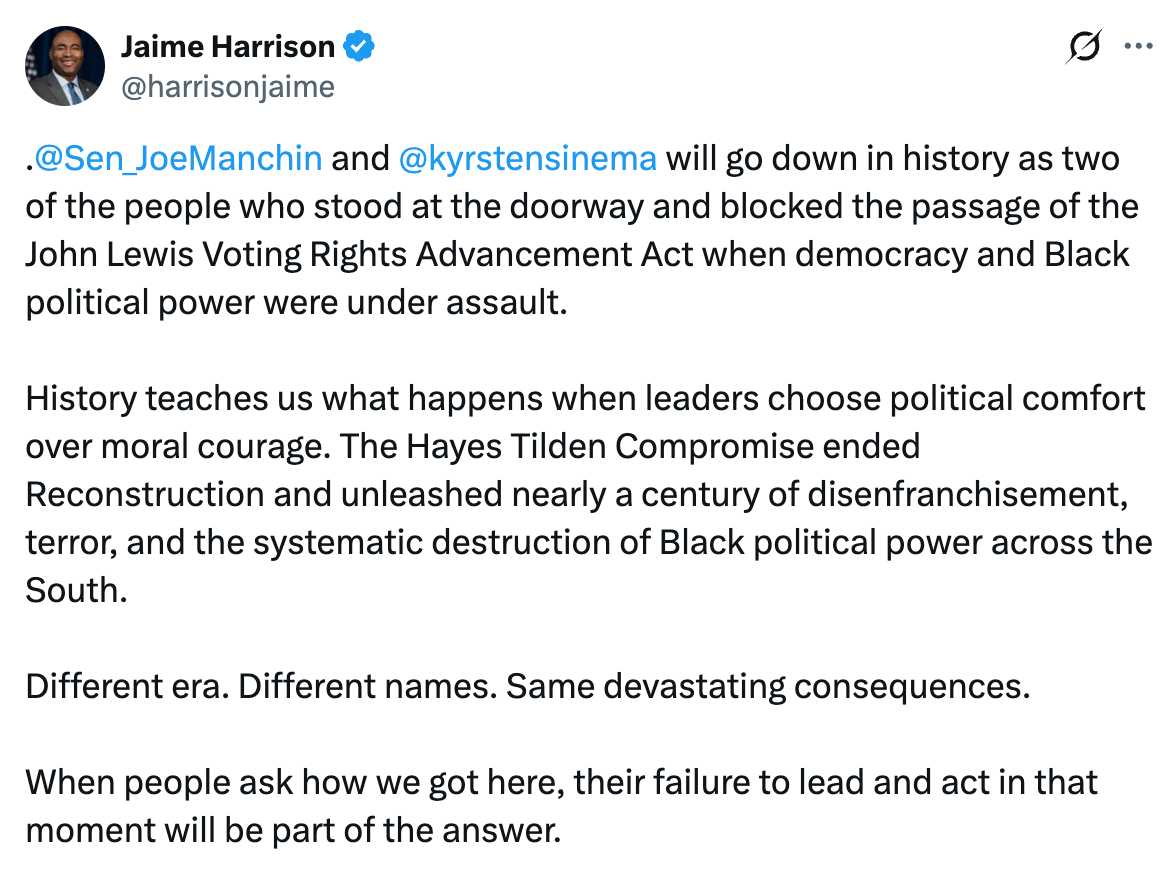
This is pretty intense, and it seems as though Harrison has personally forgotten some recent history: Although Manchin opposed the For The People Act, he did support the John Lewis Voting Rights Advancement Act, which he considered a “bipartisan compromise.” Sinema also supported the bill. She posted on August 6, 2021, “56 years ago today, the #VotingRightsAct was signed into law. This year, we’re cosponsoring the John Lewis Voting Rights Advancement Act to restore the VRA. I strongly encourage my colleagues to put aside partisan politics and protect the right to vote.”
The problem was that both Manchin and Sinema steadfastly refused to kill the filibuster in order to pass it — no matter how much Black Democrats pleaded with them. They insisted on believing that some of their “reasonable (white) Republican” friends would actually ever support a “Stop Republicans From Cheating Bill” no matter how “bipartisan” they made it.
However, Manchin and Sinema’s obsessive institutionalism, while maddening, is nothing like the notorious Hayes Tilden Compromise. The actual history is far more complicated than what Harrison presents.

In the 1876 presidential election, 185 electoral votes were necessary for a majority. Democratic Samuel J. Tilden received 184 uncontested electoral votes and moderate Republican Rutherford B. Hayes received 165. (Fun footnote: the Democratic-controlled Congress granted statehood to Colorado during the campaign, but Colorado ended up backing Hayes.)
Florida, Louisiana, Oregon, and South Carolina returned disputed slates of presidential electors that totaled 20 electoral votes. Tilden would win the presidency if any one of the disputed slates went his way, while Hayes would need to run the table.
A politically divided Congress passed the Electoral Commission Act to resolve the disputes. The 15-member commission contained eight Republicans and seven Democrats. The commission broke among party line to effectively hand the presidency to Hayes. The decision was arguably just as corrupt as Bush v. Gore 124 years later. (Like George W. Bush, Hayes had also lost the popular vote.)
However, here is where history might confuse Harrison: The Republicans of 1876 were still the party of Lincoln. Hayes was a staunch abolitionist who had defended refugee slaves as Cincinnati’s city solicitor. Hayes believed that the former Confederacy shouldn’t rejoin the Union without adequate protections for Black southerners. Along with other congressional Republicans, Hayes helped pass the Civil Rights Act of 1866, overriding President Andrew Johnson’s veto.
Although Tilden was a “War Democrat” who’d opposed slavery and secession, the 1876 Democratic Party’s platform was still openly hostile to civil rights for Black people, specifically denouncing Reconstruction. Tilden primarily focused on civil service reform, the gold standard, and lowering taxes (like today’s Republicans), but most of his supporters cared more about ending southern Reconstruction (like today’s Republicans).
So, yes, Hayes was the actual “pro-Reconstruction” candidate. That’s why the “compromise” was necessary. Democrats objected to the obviously rigged election and filibustered the certified election results. There were also some very real threats of political violence rather than impassioned fundraising emails (unlike today’s Democrats). Armed civil conflict was ultimately avoided, but no written evidence of a deal exists so it’s truly a “Room Where It Happens” situation. (Watch below.)

What we do know is that Hayes was peacefully inaugurated, and upon taking office, he withdrew federal troops from southern states, effectively ending Reconstruction. What’s perhaps hard for folks to accept is that Reconstruction was probably already doomed, regardless of this “compromise.” Public opinion in northern states had soured on the cost of maintaining troops in the South, and congressional Democrats had already blocked appropriations. Hayes defenders have argued that he was still a better choice for Black southerners than Tilden, whose party wanted Reconstruction ended immediately. Hayes did demand that white conservative governments in Louisiana and South Carolina promise to guarantee voting and civil rights for Black citizens. (We all know how that turned out.)
Hayes successfully blocked Democratic attempts to weaken voting rights protections in the Fourteenth and Fifteenth Amendments. He devoted much of his later life to helping educate Black Americans across the nation. It’s far too simple to say that Hayes chose “political comfort over moral courage,” but we often hear similar condemnation of Democrats who sometimes have to settle for mere harm reduction rather than chest-thumping triumph.
I’m hardly a fan of Joe Manchin or Kyrsten Sinema, but I don’t think they shoulder all the blame for our current dire predicament. At worst, they are a symptom of Democratic Party failures. After all, Chuck Schumer backed Sinema over Phoenix Mayor Greg Stanton, who was more liberal than Sinema but hardly a Mamdani figure. No, Schumer thought the centrist Sinema was a safer bet to flip the Arizona Senate seat. As usual, Schumer picked the wrong political Holy Grail.
However, Manchin held a seat in West Virginia, a state no Democratic presidential candidate has won since 1996. Bill Clinton defeated Bob Dole in West Virginia 51.5 to 36 percent, which you probably think is a typo. Just four years later, Al Gore would lose the state to George W. Bush by six points. This margin would only continue to grow in favor of Republicans.
Nonetheless, Manchin remained a Democrat during this major political realignment. Manchin was even an early supporter of Hillary Clinton’s 2016 campaign. He said in 2014, “I don’t know if there’s anyone more qualified.” Clinton’s approval in West Virginia was probably lower than solar energy, but Manchin still supported center-left Democrats at a time when many white Southern Democrats in now-solidly Republican states had abandoned the party. This includes Sen. John Kennedy from Louisiana, who’d endorsed John Kerry as a Democrat in his 2004 campaign before adopting his current Foghorn Leghorn act. (Watch below.)
Manchin at least understood the importance of electing Hillary Clinton in 2016. That alone would have prevented the current 6-3 Supreme Court that operates as a right-wing Calvinball referee. The MAGA justices pointed and laughed at the 60-year-old Voting Rights Act, so I’m not sure why Harrison thinks they’d show more deference to another piece of civil rights legislation passed just a few years ago.
When Democrats imagined a Biden-led rout in 2020, they didn’t consider that Manchin and Sinema would prove decisive votes and frustrating obstacles for any liberal agenda. Just days before the election, FiveThirtyEight gave Democrats a 75 percent chance at flipping the Senate. The GOP’s chances of holding the Senate were “as likely as drawing a spade from a deck of cards,” which I presume is difficult. North Carolina and Maine in particular were considered almost in the bag for Democrats. Unfortunately, Cal Cunningham’s very dull sexting scandal tanked his campaign at the worst moment, and Susan Collins managed to defeat the charisma-less Sara Gideon, which wasn’t much of a shock in hindsight.
It looked like all was lost until Georgia Democrats Raphael Warnock and Jon Ossoff performed the political equivalent of blowing up the Death Star. That gave Democrats the narrowest possible majority. Of course, Manchin and Sinema’s obstinance, especially when it came to the filibuster for voting rights, was especially infuriating considering that Black voters fueled those Georgia runoff victories. Yet, Manchin and Sinema seemed to seize the power Black voters granted them and prioritized literally building bridges with Republicans.
Still, Manchin and Sinema helped keep the Senate out of Republican control. They voted to confirm Justice Ketanji Brown Jackson, when it’s not a given that McConnell would’ve even allowed hearings. They voted for a lot of Democratic legislation, even if it was bowdlerized to their satisfaction. No, they aren’t heroes, but they helped get Democrats to 50 Senate seats. Harrison obviously didn’t.
Interesting history, thank you.
I defend Joe Manchin on the regular because he *never* pretended to be anything other than what he was, a conservative Democrat-admittedly a dying breed. He himself, towards the end, admitted he and the party were no longer a good fit. His were never going to be the shoulders upon which a new progressive era proudly stood-Joe Biden knew that. And people forget the Senate majority is powerful, even if some members are not going to support your every progressive pipe dream (big tent means big divergence on a lot of hot button issues). Do I wish Manchin had been more supportive of progressive priorities? Of course. But drumming him out means we now have loony Jim Justice in that seat.
Sinema I feel differently about. She was recruited for her "moderate" credentials, but that went to a whole different level when she got to the Senate and decided she was personally going to take an ax to priorities one would have expected her to support, given her earlier stances. She's a poser and a liar IMO, not to mention a failure. Arizona was duped, like PA has been. Good riddance to bad rubbish.
It's a good, and sad history lesson. But it does show again that in this country, injustice is baked into its DNA and that means you have to ground out every little bit of progress over long odds.
I'll say this about Jaime Harrison; at least he tried running...$100 million thrown away or not. People yell at Democrats all the time about not contesting seats and he did it in a hostile place.