


“The Man Trap” is the first episode of Star Trek ever aired but the sixth filmed. Back when TV was more episodic, the pilots used to sell a series to a network weren’t always the first episode shown to viewers.
Star Trek actually had two pilots. The first was 1965’s “The Cage,” which feels like a different series. The captain of the Enterprise is Christopher Pike, played by Jeffrey Hunter who was well known for his starring roles in The Searchers and The King of Kings. There’s no Doctor McCoy, and Spock isn’t second in command. That’s Number One (Majel Barrett), who’s the stoic, reserved officer on the bridge. (Spock actually smiles in one scene). NBC rejected the pilot as “too slow,” “too cerebral,” and “too intellectual,” which is basically the same as the second note. Pike and Number One, who’d eventually get a name, would gain a second life on the series Strange New Worlds.
Star Trek creator Gene Roddenberry would try again with a second pilot, 1965’s “Where No Man Has Gone Before.” Lucille Ball, who owned Desilu Studios, convinced NBC to give Roddenberry’s project a second chance (this is yet another reason I love Lucy). Hunter declined to return, but instead of recasting Captain Pike, Roddenberry created a new character entirely, Captain James Kirk, and eventually cast William Shatner, who makes Kirk a dynamic, confident leader in contrast to Pike’s brooding self-doubt.
The second pilot introduces Montgomery Scott (James Doohan) and Lt. Sulu (George Takei). There’s still no McCoy, so it’s not quite Star Trek yet. However, Spock (Leonard Nimoy) is now second in command and fully the coldly logical Vulcan audiences would come to love. When Kirk asks Spock if he could at least “act like he has a heart,” you realize how important McCoy is as the emotional counterweight to Spock, allowing Kirk to function as the synthesis of both perspectives. (Watch below.)
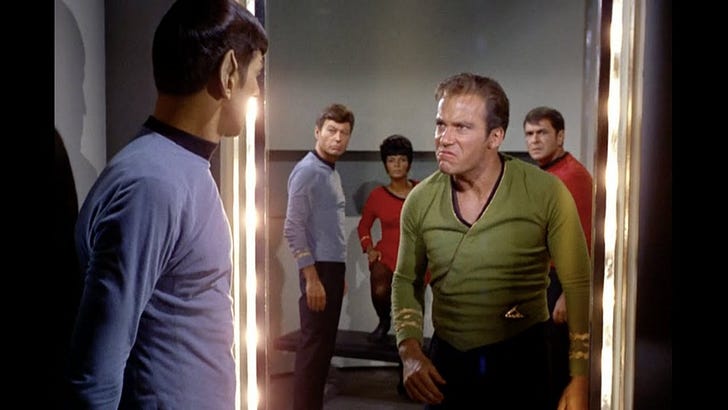
Although arguably just as intellectual and philosophical as “The Cage,” “Where No Man Has Gone Before” features a classic Kirk fist fight in the climax, which sold NBC on the series. However, NBC considered “The Man Trap” a more accessible episode to launch Star Trek. It’s a straight-forward “monster of the week” installment, with horror elements that were familiar to audiences who enjoyed The Outer Limits and The Twilight Zone. George Clayton Johnson, who wrote the script for “The Man Trap,” also wrote some of my favorite Twilight Zone episodes, such as “The Four of Us Are Dying,” “Nothing In The Dark,” and “Kick The Can.”
“The Man Trap” also looks like Star Trek. The Enterprise crew were all in their classic uniforms, compared to the somewhat drab versions from “Where No Man Has Gone Before.” Lt. Uhuru (Nichelle Nichols) is now on the bridge. While “The Corbomite Maneuver” was the first episode Deforest Kelley filmed as Dr. Leonard “Bones” McCoy, “The Man Trap” features him extensively and offers more backstory for the character than we get for Spock or even Kirk himself.
Kirk and McCoy beam down to the planet M-113, which like everywhere else they visit on the show is apparently Space San Diego because they’re just wearing their indoor uniforms. My Aunt Birdie would’ve been waiting for the crew in the transporter room with an armful of thick coats. Forget the “class M planet” explanation, I need a full environmental suit when visiting New York in the winter.
Kirk describes the mission in his opening captain’s log as “a routine medical examination of routine medical examination of archaeologist Robert Crater and his wife Nancy. Routine but for the fact that Nancy Crater is that one woman in Doctor McCoy’s past.” This is a sci-fi adventure series, so McCoy’s romantic life is not the primary conflict. No, Nancy (Jeanne Bal) is actually a shape-shifting monster who sucks the salt out of poor saps.

Next on the menu is our first “red shirt” (though he’s wearing blue). Nancy appears differently to the men present. McCoy sees her as the young woman he loved years earlier, but "Yeoman Johnson" (Michael Zaslow) blurts out that that Nancy looks just like a woman he met on Wrigley’s Pleasure Planet, which sounds like someplace where you do more than just chew gum. Nancy later invites Yeoman Johnson to take a walk with her. You’d think Starfleet training would cover such diplomatic basics as “don’t fool around with a married woman while on duty.”
When Kirk and McCoy discover Yeoman Johnson’s mangled corpse, McCoy delivers his now-classic, “He’s dead, Jim” diagnosis. It’s later revealed that Crater has a sick relationship with the salt monster, who killed the real Nancy Crater years earlier, but now Crater provides the monster with salt and in return receives “companionship.” Crater says the salt monster is the last of its kind and compares it to the buffalo, which while delicious is not a sentient killing machine. This analogy makes no sense, but that’s what happens when you shack up with a salt monster.
The salt monster kills another red shirt (this one wearing a gold uniform) and infiltrates the Enterprise. It eventually turns on Crater, proving that he probably shouldn’t have trusted the monster that killed his wife. The salt monster, disguised as Nancy, tries to trick McCoy into helping it and almost murders Kirk until Spock intervenes. There’s a hilarious moment when Spock tries to prove to McCoy that this isn’t the real Nancy by smacking her in the face : “If she were Nancy, could she take this?” Spock’s never met Nancy, though, so he’s possibly underestimating her tolerance for two-fisted punches. (Watch below.)
Shatner’s performance as Kirk is confident and layered, nothing at all like the sketch comedy parodies. He’s a firm leader but also compassionate. Kirk snaps at McCoy for rambling on about his “lost love” when he should focus on discovering what killed Yeoman Johnson — “You could learn something from Mr. Spock, Doctor. Stop thinking with your glands!” — but he later apologizes with a self-effacing smile that makes you believe these are old friends.
“The Man Trap” is a solid introduction to Star Trek, and it recalls the days when you could discover a TV series at almost any part of its run and not feel confused, as if you’d wandered into a movie mid-way. All the classic Star Trek elements are present — though McCoy is obviously more vulnerable and doesn’t outright challenge Kirk or Spock, as he’ll often do in other episodes.
Star Trek didn’t have a traditional first episode. There is no “origin story” for the crew or its mission. Everything is explained in Kirk’s famous narration during the opening credits: “Space: the final frontier. These are the voyages of the starship Enterprise. Its five-year mission: to explore strange new worlds; to seek out new life and new civilizations; to boldly go where no man has gone before!”
Technically, the Enterprise crew doesn’t really explore strange new worlds in “The Man Trap.” Its mission is relatively mundane, and the crew doesn’t seek out “new life” so much as survive it. The episode ends somberly, with McCoy killing the image of her beloved and delivering extinction to an intelligent, if slightly murderous, life form. Even Kirk is left thinking about the buffalo. In that sense, it does feel more like an extended Twilight Zone than what will soon come afterward.
Still, 60 years later, we’re still watching and enjoying Star Trek, and it all started with “The Man Trap.”
Star Trek is the future we need but likely won't get as long as greed and bigotry grant so much power.
Loved this! I write about the TZ so this is right up my alley!