


There was a heated online discourse last week over the seeming generational divide regarding how we feed ourselves. Alina Voss from the American Conservation Coalition shared a graph on social media that broke down the food budget for each generation, including my own, Gen X, which is often forgotten.
Voss wrote, “The younger and poorer the generation, the more they eat out and DoorDash. This is part of the problem.”
I suppose the problem is that Gen Z is broke. I don’t think this is a novel circumstance for early adulthood. I was in my 20s throughout the run of Friends, whose theme song declared, “Your job’s a joke. You’re broke. Your love life’s DOA.” (The series depicted the exact opposite for its characters.)
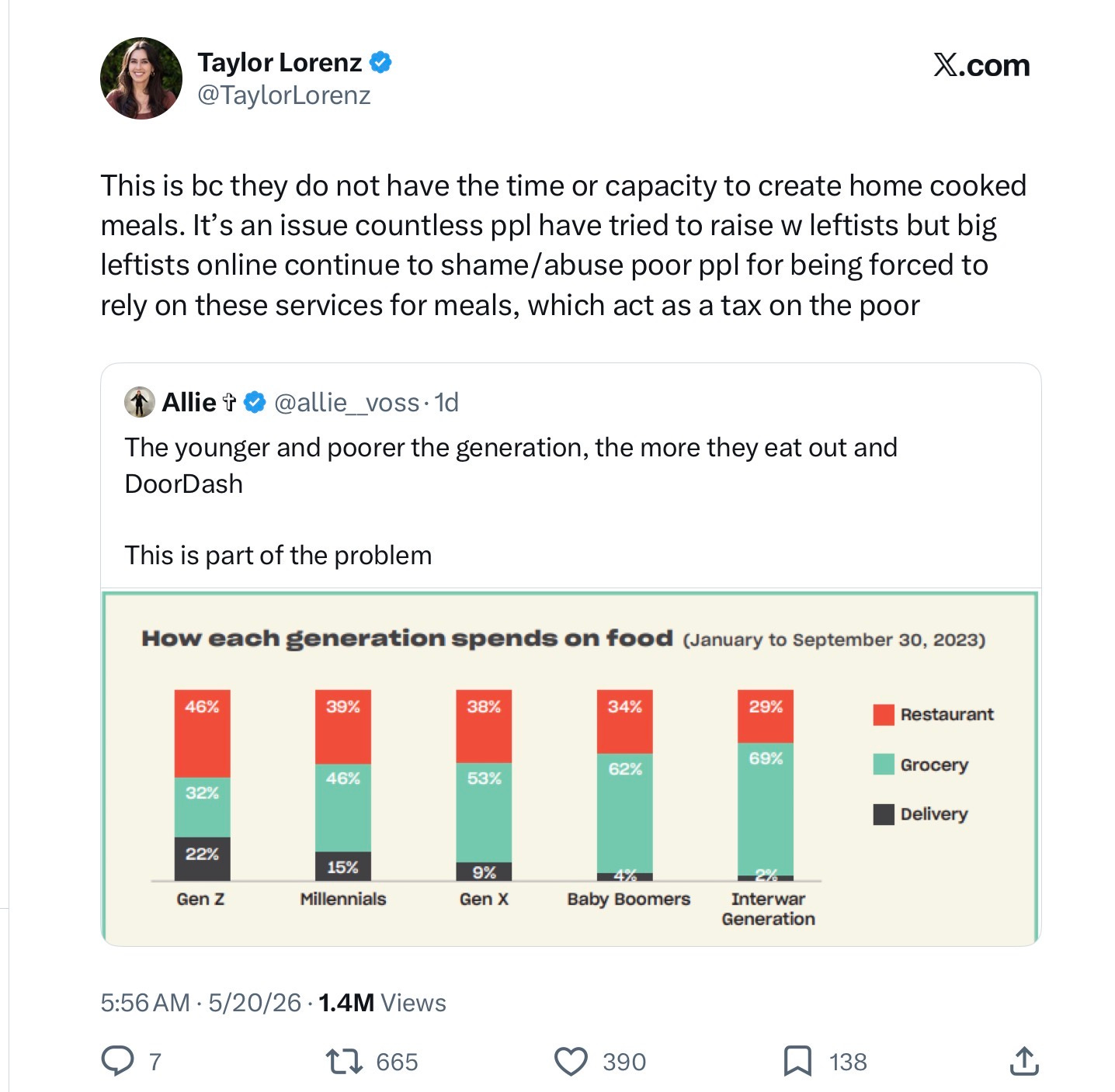
According to Voss’s graph, Gen Z spends 46 percent of its food budget on restaurant meals and 22 percent on food delivery. The combined 68 percent is far more than older generations spend.
However, Millennial journalist Taylor Lorenz defended Gen Z’s economic honor. She posted in response:
This is bc they do not have the time or capacity to create home cooked meals. It’s an issue countless ppl have tried to raise w leftists but big leftists online continue to shame/abuse poor ppl for being forced to rely on these services for meals, which act as a tax on the poor
So, I must say, with all respect, “Huh?” A “tax” is a compulsory contribution to state revenue, imposed by the government on your income. You won’t get audited if you refuse to use DoorDash.
I don’t judge or even care that much how people spend their money, but I do object to this excessive hyperbole. Maybe it was all those philosophy courses I took in college but I believe everyone must fully own the choices they make as a free individual. You choose DoorDash. You choose a $17 Chipotle lunch. There’s nothing inherently wrong with those choices, but they aren’t forced upon you.
Let’s unpack Taylor Lorenz’s statement that Gen Z lacks “the time or capacity to create home cooked meals.” I spent my early adulthood in New York City, where people famously don’t cook — though I didn’t always order out. Like Jerry Seinfeld, I considered cereal a prepared dish. I remember many Raisin Bran dinners with Cracklin’ Oat Bran for dessert (actual crack might’ve been better for my health).
I also ate a lot of pasta: A box of spaghetti and a jar of Ragu or Newman’s Own if I felt charitable cost a combined $5 and could last for two or three meals. I made a lot of “breakfast for dinner” because scrambled eggs and raisin toast were straightforward. There was also canned vegetarian chili that only gave me food poisoning every once in a while. Still, I probably ate out more than my friends outside New York who had full-sized refrigerators.
Back then, there was no DoorDash, but most restaurants offered free delivery (you of course were rightly expected to tip the person who biked your food to you at Flash-like speed). If I want to feel really old, I check the current prices for some of my go-to orders. Shrimp fried rice (sometimes with a free egg roll) from Ollie’s was also around $5. Now it’s close to $15 — an increase that’s outpaced the rate of inflation.
During the summer of 2001, my girlfriend at the time suddenly decided that we were spending too much money on takeout and restaurants. She announced that she’d make dinner for us at home for a change. Of course, she wasn’t interested in spaghetti and Ragu or even that pasta sauce that made you an opera singer. (Watch below.)
No, my ex wanted to make something from her favorite Boston restaurant’s cookbook. The recipe she picked involved obscure, gourmet ingredients that sent me to every corner of Manhattan. I think I had to get a dragon’s tooth. It took three hours to prepare, used up every dish in the apartment, and cost far more per meal than takeout.
This is what I’ve called the Alton Brown Effect, where people define “home cooking” as a process far more complex and time-consuming than anything your grandmother did when feeding a family of 12.
I love Alton Brown — a fellow University of Georgia alum — but his show Good Eats made cooking at home look impossible for the casual person who’s not interesting in cooking as a pastime. They just want to eat dinner eventually. (Watch below.)
Yes, Brown’s macaroni and cheese recipe is far superior to anything cheap from a box, but it’s also not ready in few minutes. Brown would often say “Your patience will be rewarded,” but that’s not always true. What I appreciate about Rachael Ray’s 30 Minute Meals is that she acknowledged that most people have full-time jobs and hectic schedules.
In the above clip, Rachael Ray makes Mexican lasagna, which is technically a casserole. Someone posted on social media — I assume in jest because really: “We don’t eat casseroles. We like freshly cooked stuff, if I am out of time/energy to cook/clean (it’s 2nd shift) then it’s takeout. If you feel that this should be a luxury for families with 2 working parents or young ppl working long hours, you are simping for the ‘master class.’”
Ray’s dish is “freshly cooked.” Casseroles, which is not just for serfs anymore, has the benefit of offering days of tasty leftovers that reheat well. With some bare minimum planning, you can avoid cooking every day while not needing to eat out or rely on DoorDash.
As I’ve said, I don’t judge anyone who orders a lot of takeout, even if there are more financially viable (and nutritious) options. However, growing up in rural Greenville, South Carolina, takeout was usually Kentucky Fried Chicken, McDonald’s, or Waffle House. (Our regular Saturday night “takeout treat” was a meal from a chain called Carolina Fine Foods, which was more commonly known as “Carolina Fried Foods.” It wasn’t for dieters.)
These places were significantly less expensive than most modern takeout: A working parent coming home from a double shift could pull into a drive-through and have a hot meal within minutes. At least here in Portland, takeout takes forever. You’re waiting at least 45 minutes to an hour. I could make dinner myself in less time, even if I had to swing by the grocery store first. And the added fees and upcharges on the menu prices all add up.
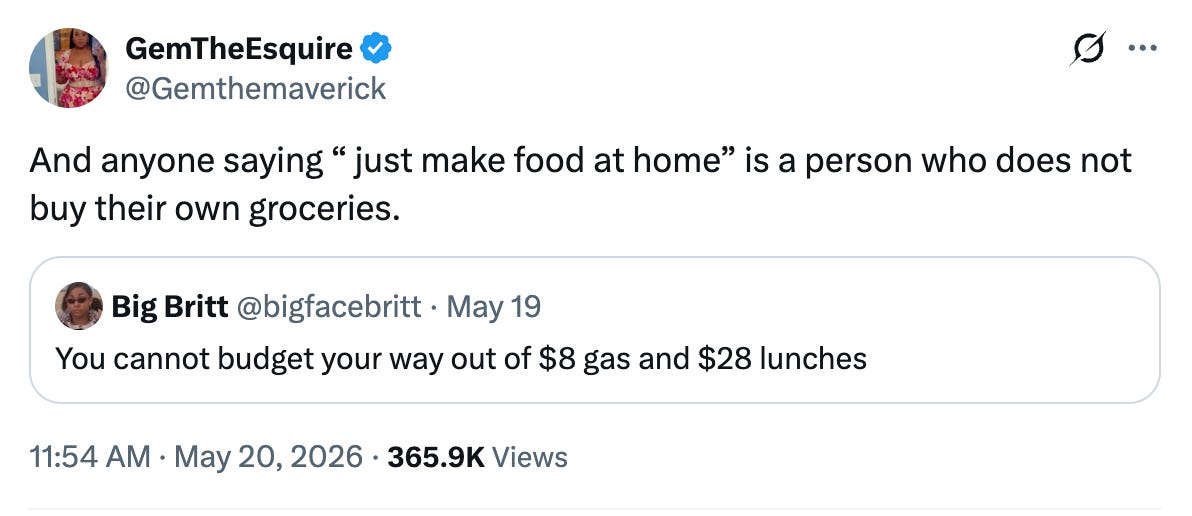
Someone else online who I assume is joking posted: “And anyone saying ‘just make food at home’ is a person who does not buy their own groceries.”
I do buy my own groceries, ever since my butler quit. While I still use Instacart for large Costco orders, I prefer to shop for everyday groceries myself. I tired of paying the excessive fees for often inconsistent service: So many botched orders from shoppers (usually men) who just weren’t even trying to find my items. (No, this store is not out of olives. They just are on a different aisle from canned vegetables.) The constant notifications that my order was delayed far beyond the requested window, so I’d hope I could get back from picking my son up from school before my food spoils while waiting on the front porch.
I confess I once thought Instacart was a time saver, especially when I’m on deadline, but it turns out it wasn’t! It’s more efficient (and cheaper) to do it myself.
Everyone’s life is different, so it’s up to the individual to make the choices that work for them, but if those choices lead to bad outcomes, there’s no harm in choosing something else. Self-reflection has served me well in middle-age. I recommend it for the younger generations, as well.
Ramen was my go-to. As were $1 hot dogs from Circle K. (Haven't looked lately, but they're probably $3 now.)
If I need a cheap meal now, it's Chorizo, Potatoes, eggs, and spinach. If I feel like splurging, I can turn it into a breakfast burrito with a tortilla and cheese.
But yeah, that doesn't excuse any of the bullshit us peasants have to deal with in predatory capitalism that is making the price of living and simply existing unaffordable. And there are very real concerns like food deserts and the constant reshuffling of what your $150 EBT card will actually get you because poor people should never know joy. Suffering brings them closer to Jeebus, donchaknow?
Anyway... I'm fucking tired. Seems like the media always wants to foist blame for corporate greed and predatory tactics on the folks most victimized by their actions.
A can of beans, some cheese, hot sauce, a pack of tortillas and sour cream might set you back $15 but you’ll have burritos for days. Even cheaper if you make your own beans. We meal plan every week and grocery shop for just what we need (except for the occasional box of ding dongs). I used DoorDash once in the height of the pandemic and never again.