


Just before Christmas, Donald Trump targeted vulnerable children who have done nothing to him but exist. His administration accelerated its efforts to ban gender-affirming care for trans youth . This is all under the pretense of protecting children but they quickly revealed their hand when they actively deny the existence of trans people.
Health and Human Services Deputy Secretary Jim O’Neill declared, “Men are men. Men can never become women. Women are women. Women can never become men.” He’s factually wrong and somewhat hypocritical, considering that his own gender identity is hard to pin down from looking at him. (Watch below.)
Meanwhile, the House of Representatives passed Marjorie Taylor Greene’s bill that would make it a felony for doctors to provide gender-affirming care to minors, even with parental approval. Republicans Mike Lawler from New York, Brian Fitzpatrick from Pennsylvania, Gabe Evans from Colorado, and Mike Kennedy from Utah voted with most Democrats against it, which would’ve been enough to sink the bill if three Democrats hadn’t willingly signed onto Greene’s hate bill. They are Don Davis from North Carolina, Vincente Gonzalez from Texas, and compromised, Trump pardon recipient Henry Cuellar, also from Texas.

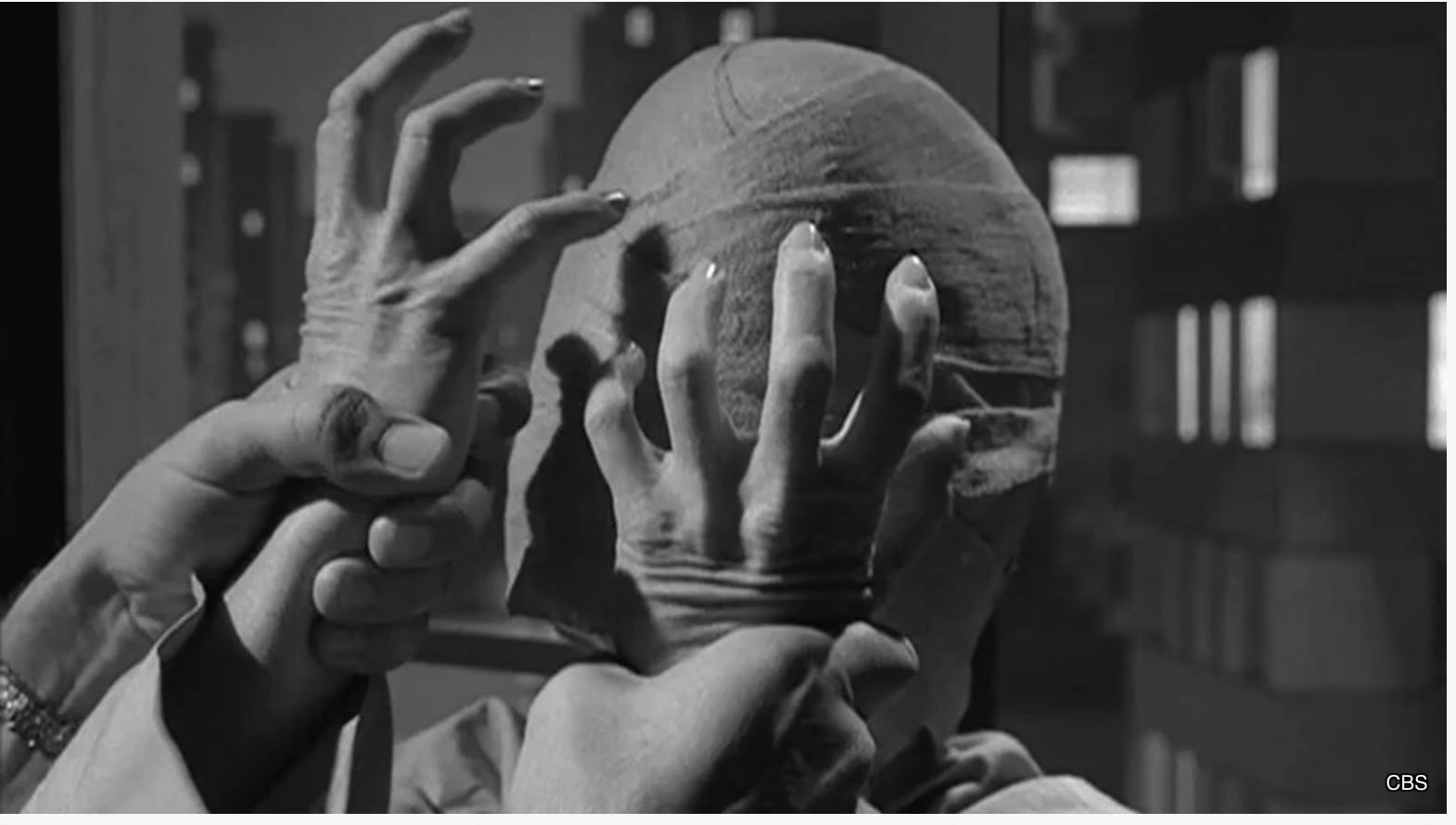
Many prominent Democrats insisted during the 2024 presidential campaign that Trump’s anti-trans rhetoric was just a “distraction” from his lack of actual policies. This was a willfully naive position. Trump promoted anti-trans positions because he intended to impose anti-trans policies. Whenever you hear him speak about trans people, he sounds like the fascist Leader from The Twilight Zone episode “The Eye of the Beholder.”
‘A Private World Of Darkness’
Even people who’ve never seen a Twilight Zone episode can recall the overall plot to “The Eye of the Beholder”: Janet Tyler has undergone medical treatment — her eleventh! — in a desperate attempt to look normal. Janet’s face is fully covered in bandages throughout the episode — what Serling describes as her “private world of darkness.” She’s consistently described as hideous underneath her shroud — a “pitiful twisted lump of flesh.” When the bandages are removed, the attending physician and nurses declare the results a failure, but the audience sees that Janet is beautiful, by our standards. Even her blonde hair is perfectly styled! (Donna Douglas plays Janet for her cover girl reveal, but a bandaged Maxine Stuart delivers a truly gut-wrenching performance.)
The classic twist is that everyone else looks monstrous, again by our standards — sunken eyes, twisted lips, and pig-like snouts. It’s like that first glimpse in the mirror on New Year’s Day. You see, beauty is in “the eye of the beholder,” but Serling’s message is much deeper and more provocative than this simple truism.
“The Eye of the Beholder” isn’t an early version of Nip/Tuck, which satirized our culture’s unhealthy obsession with an imagined physical ideal. Janet doesn’t suffer from body dysmorphic disorder. The “flaws” in her appearance aren’t imagined. She is objectively different and that difference makes it almost impossible for her to live a normal life. Janet says, “The very first thing I can remember is a little child screaming when she looked at me. I never wanted to be beautiful. I never wanted to look like a painting. I never even wanted to be loved.I just wanted ... I just wanted people not to scream when they looked at me.”
It was a child who reacted in genuine horror to Janet’s face, not a bully shouting cruel insults at her. Yet, Janet doesn’t want to leave this society. She’s still a person who needs to live among other people. “I could try,” she tells her doctor. “I could wear a mask or this bandage. I wouldn’t bother anyone. I’d just go my own way. I’d take a job. Any job.”
Janet would willingly condemn herself to her “private world of darkness,”permanently, but that’s not good enough for the state, which considers her very existence offensive. Janet must conform or society will remove her entirely.
We learn that the state has “generously” provided free medical intervention for Janet, but 11 treatments are the limit. This is not due to any actual concern for Janet’ well-being. That’s just how this society’s health care system works. I can imagine it having come up for a vote, with the 11 treatment maximum a necessary concession to gain the deciding vote from this society’s John Fetterman.
Vanity doesn’t drive Janet. She wants to look “normal” because that’s the only way she can literally survive. People with anti-trans views might compare this to gender-affirming care. They claim that vulnerable children are manipulated into seeking needless surgery. However, there is no “mandatory transgender” legislation, and the doctors aren’t enabling a “delusional” Janet for their own profit.
No, the more apt comparison is to conversion therapy, which is intended to “repair” someone’s sexual or gender identity. The metaphor works even better than plastic surgery when the doctor cries out, “No change at all!”
“Up to now you haven’t responded to the medication or to the shots or any of the proven techniques,” the doctor explains to Janet prior to removing her bandages. “Frankly, you've stumped us, Miss Tyler. Nothing we've done so far has made any difference at all.”
Janet still looks like Marilyn Monroe (no offense to Donna Douglas but that’s probably what they were going for in 1960) because this was never really about giving someone a new nose and more flattering cheekbones. You can’t forcibly change someone’s identity.
And it’s clear that deep down, Janet doesn’t want to change.
“Who are you people anyway?” she angrily demands. “What is this State? Who makes up all the rules and the statutes and the traditions? The people who are different have to stay away from other people who are normal. The State isn’t God, doctor. The State is not God. It hasn’t the right to penalize people for an accident of birth. It hasn't the right to make ugliness a crime.”

‘A single morality! A single frame of reference! A single philosophy of government!’
Serling, in 1960, uses “ugliness” as the metaphor for any difference a tyrannical society deemed unacceptable. In his closing narration, he says:
Now the questions that come to mind: “Where is this place and when is it?” “What kind of world where ugliness is the norm and beauty the deviation from that norm?" You want an answer? The answer is it doesn't make any difference, because the old saying happens to be true. Beauty is in the eye of the beholder, in this year or a hundred years hence. On this planet or wherever there is human life – perhaps out amongst the stars — beauty is in the eye of the beholder. Lesson to be learned in the Twilight Zone.”
Yet, Serling’s script contains extensive world building. This is a society that once embraced freedom and diversity but has now willingly rejected it. Janet’s doctor believes in the state’s bigoted policies, even if he rationalizes them in a soothing tone.
“You realize, of course, Miss Tyler, why these rules are in effect?” he says. “Each of us is afforded as much opportunity as possible to fit in with society. In your case, think of the time and money and effort expended to make you look …. normal….. the way you’d like to look.”
The gaslighting is insidious: Janet wants to look “normal” because society won’t permit her the dignity to look like anything else.
“The State is not unsympathetic,” the doctor insists. “Your presence here in this hospital attests to this. It’s doing all it can for you. But you’re not being rational, Miss Tyler. You can’t expect to live any kind of life amongst normal people.”
The so-called “normal” people don’t recognize Janet’s humanity. Even her attending nurse, who calls her “honey” and holds her hand, drops her veneer of kindness like a mask once she leaves the room. “If it were [my face], I'd bury myself in a grave someplace,” she tells another nurse. “Poor thing. Some people want to live no matter what!” She doesn’t find Janet’s perseverance admirable, just pathetic.
The Leader’s televised broadcast was probably intended to recall George Orwell’s 1984, but now you can hear words very much like his own on any major right-wing podcast.
Good evening, ladies and gentlemen. Tonight I shall talk to you about glorious conformity ... about the delight and the ultimate pleasure of our unified society.
The Leader’s full speech in Serling’s original script is especially prescient.
You recall, of course, that directionless, unproductive, over-sentimentalized era of man's history when it was assumed that dissent was some kind of natural and healthy adjunct to society. We also recall that during this period of time there was a strange oversentimentalized concept that it mattered not that people were different, that ideas were at variance with one another, that a world could exist in some kind of crazy, patchwork kind of makeup, with foreign elements glued together in a crazy quilt.

Author J.K. Rowling has said, “There are no trans kids. No child is ‘born in the wrong body.’” She sounds like this society’s Leader, who in Serling’s original script denounces the “permissiveness” of a past age that respected difference rather than exterminating it:
They will scream at you and rant and rave and conjure up some dead and decadent picture of an ancient time when they said that all men are created equal! But to them equality was an equality of opportunity, an equality of status, an equality of aspiration! And then, in what must surely be the pinnacle of insanity, the absolute in inconsistency, they would have had us believe that this equality did not apply to form, to creed. They permitted a polyglot, accidentbred, mongrellike mass of diversification to blanket the earth, to infiltrate and weaken.
There’s no evidence that the Leader is a dictator or that a free society didn’t willingly put him into power. When the doctor briefly wonders why Janet can’t live freely as herself, the nurse warns him that he’s talking “treason.”
“This case has upset your balance, your sense of values!” she says.
It’s very much like Jim Crow America, and while Janet responds violently to the Leader’s MAGA rally rant, the “normal” people don’t seem bothered or even surprised. They don’t act as if they’re personally living under the boot of a fascist regime. No, it’s quite possible the Leader fully represents them in body and soul. He’s harsher, more overtly cruel, than the otherwise gentle doctor, but the doctor might’ve still voted for him to lower his taxes or impose the type of society he prefers.
Janet leaves the hospital with someone who shares her “disability,” and many viewers in 1960 and even today might’ve considered this a “happy ending.” Earlier, Janet’s doctor tells her that if her final surgery doesn’t achieve the “desired result,” she’d be sent to live with her own “kind,” and she immediately rejects the inherent lie behind “separate but equal.”
“Congregated, doctor? You don’t mean congregated, you mean segregated. You mean imprisoned. You’re talking about a ghetto now. A ghetto designed for freaks!”
We can only imagine how this society would treat people who live in this “special area.” Serling, a World War II veteran, knew firsthand where such marginalization eventually led.
And it wouldn’t stop with Janet and others of her “kind.” This is a state, after all, that exterminates “undesirables.” The doctor claims this occurs only in extreme cases, but the Leader revels in his extremism:
Well, we know now that there must be a single purpose! A single norm! A single approach! A single entity of peoples! A single virtue! A single morality! A single frame of reference! A single philosophy of government!
Although the overwhelmingly majority might’ve once agreed that “pig snouts good, Marilyn Monroe face bad,” there are still minute differences among them and the Leader has vowed to “cut out all that is different like a cancerous growth!” Soon, perhaps even Janet’s nurse or doctor will find themselves imprisoned in bandages or shipped away.
It is essential in this society that we not only have a norm, but that we conform to that norm. Differences weaken us. Variations destroy us. An incredible permissiveness to deviation from this norm is what has ended nations and brought them to their knees. Conformity we must worship and hold sacred. Conformity is the key to survival.
It’s easy to dehumanize a small group — say, just 1.1 percent of the population, but it doesn’t end there. The “out” group only grows, while the oppressor class might shrink but steadily grows in force so that numbers no longer matter. What was once a democracy has become a single state of tyranny.
Along with the other episode where the avid reader had all the time in the world to read but had no glasses this episode is also well remembered. Great post today SER. As usual I should say!
Happy New Year to all here.
excellent analysis of this wrenching cry from 1960, thank you Stephen, and a Happy New Year to you and yours!