


It’s been 40 years since the release of John Byrne’s new origin for Superman, Man of Steel. The 1986 miniseries redefined Superman for the modern age and is credited with inspiring the character’s depiction in ABC’s Lois & Clark: The New Adventures Of Superman, the WB’s Superman: The Animated Series, and the WB/CW prequel series Smallville. Byrne’s dynamic art work impressed my 12-year-old self, but over the years, I’ve found Man of Steel’s overall story less compelling than 2003’s Superman: Birthright (Mark Waid and Leinil Francis Yu) and 2005’s All-Star Superman (Grant Morrison and Frank Quitely).
Although George Reeves and Christopher Reeve had played a version of Superman who disguised himself as “Clark Kent, mild-mannered reporter for a great metropolitan newspaper,” Man of Steel famously established that Clark Kent was the real person and his Superman the disguise. Thus, the first time we see a young Clark Kent, he’s scoring the winning touchdown in a football game.
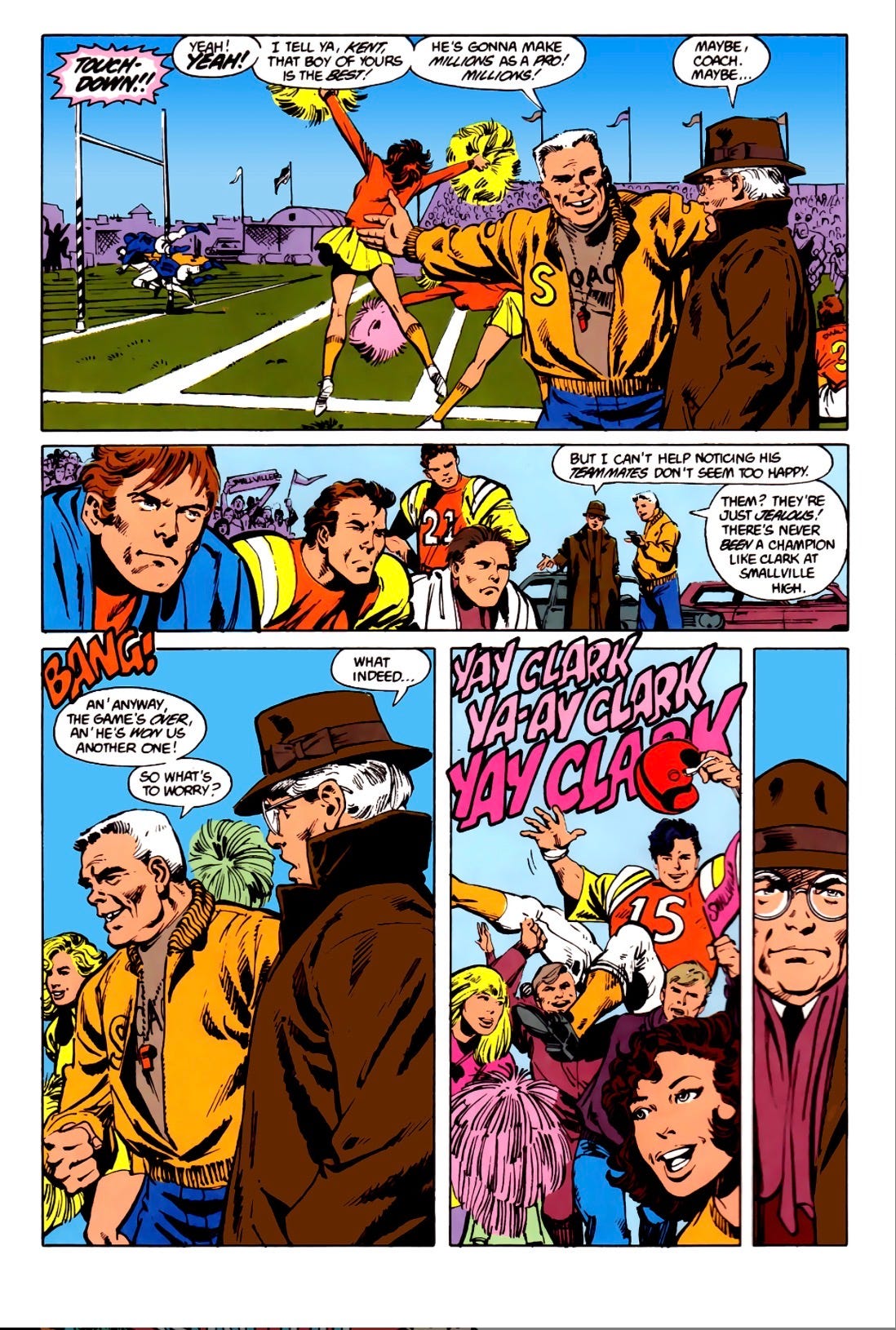
Apparently, Byrne could only imagine a “real” Clark Kent as a jock, not someone who was genuinely a little awkward and shy. What I love about David Corenswet’s Superman is that his slightly geeky Clark Kent doesn’t feel like a performance. He’s adorkable but with a strong moral conviction that takes center stage when he’s Superman. Byrne’s Clark is not even shown to have an early interest in his chosen profession, journalism. This is an issue I had with both Smallville and Zack Snyder’s Man of Steel movie. When Lex Luthor won’t accept the fact that Superman is Clark Kent, it would make more sense if Byrne’s Clark was truly the unassuming mild-mannered reporter, like he is in All-Star Superman, but Byrne’s Clark — like Smallville’s Tom Welling and Snyder’s Henry Cavill — is a male model who women swoon over. The Samantha Jones-like Cat Grant takes an overt sexual interest in Clark — not Superman.
Young Clark Kent isn’t just a football star. He’s an insufferable show off who’s seemingly oblivious to winning the big game single-handedly while his annoyed teammates observe from the sidelines. My Superman possesses basic empathy and can read obvious social cues.
There’s no evidence that the almost 18-year-old Clark Kent is using his powers to actually help anyone. Byrne had considered the very concept of Superboy silly, but this results in what I call the Spider-Man Conundrum. Peter Parker is a teenager who understands that with “great power there must also come great responsibility.” Clark Kent can literally fly but thinks his highest obligation is scoring touchdowns.
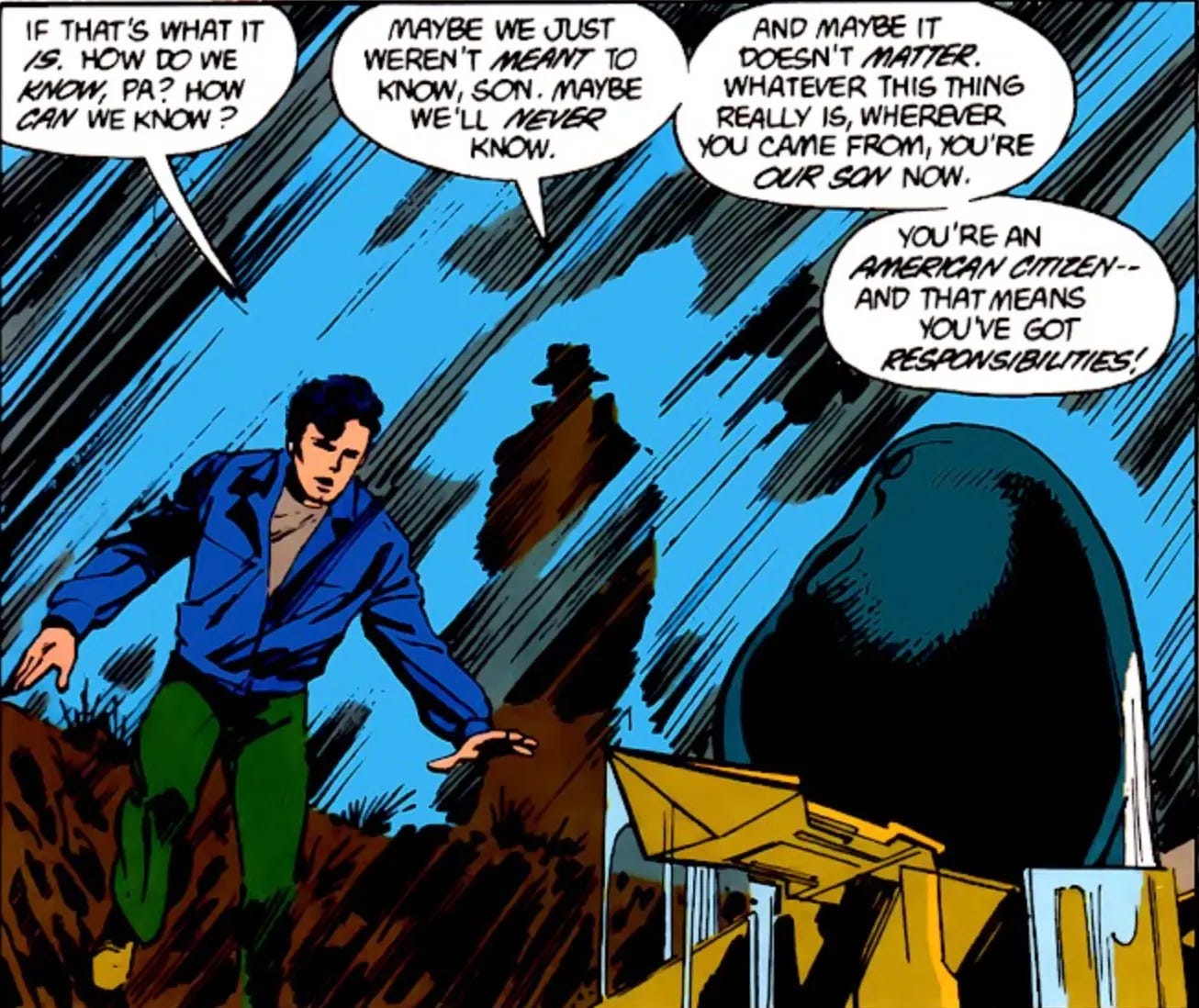
True, Byrne’s Clark is finally convinced to do the right thing when his adoptive father Jonathan Kent shows him the rocket ship that brought him to Earth and that they store illegally on their farm. There’s no affirmative obligation to report an undocumented immigrant child to ICE, but you can’t just harbor advanced alien technology on your property. This isn’t a finders, keepers situation. The rocket ship somehow is what makes Clark realize he’s not truly normal, not the whole defying gravity deal.
Jonathan tells Clark it doesn’t matter where he came from, he’s “an American citizen and that means you’ve got responsibilities.” This doesn’t pack the same emotional weight as Peter Parker failing to stop the burglar who later murdered his Uncle Ben. That was a hard lesson. Clark presumably had his whole life to accept that he was stronger and faster than everyone around him.
Byrne’s Clark eventually leaves home and becomes the world’s greatest hero, because that’s how he’s described on the cover. Byrne doesn’t convincingly depict a compassionate, selfless Clark before he puts on the costume. There is no “jump on the grenade” moment like Steve Rogers has in 2011’s Captain America movie. Byrne frequently states that what makes Superman fundamentally heroic is his traditional upbringing in rural Kansas. We’re told repeatedly that the Kents are midwestern “salt of the Earth” folk, with their demographic background as the only textual evidence provided for their supposed moral greatness. I’m sick of hearing from Republicans and Democrats alike that the “best” Americans are exclusive to the Midwest. I appreciate that Captain America was a working-class kid from Brooklyn, and Spider-Man is a working-class kid from Queens.

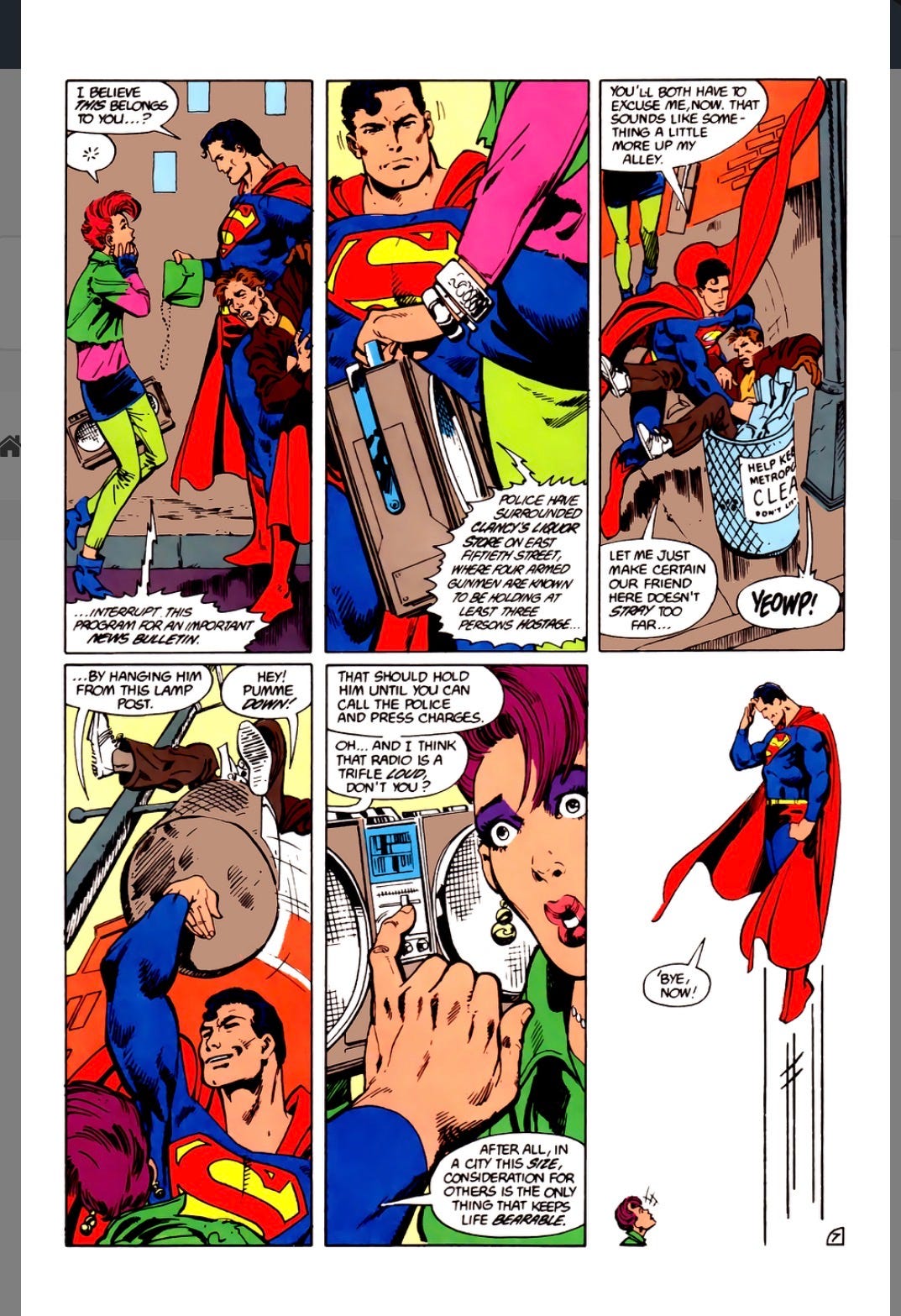
I personally find Byrne’s Superman dull and somewhat full of himself. When he stops a purse snatching, he lectures the victim about playing her music too loud and the forcibly lowers the volume on her boombox. The young woman is very 1980s punk rocker or at least how a middle-aged conservative might envision her.
Byrne’s Superman is quite the Reaganite. When Lois Lane offers him Brie cheese, he makes a point of saying he never acquired a taste for the French cheese. If he can swallow poison gas, he could politely consume the cheese. It’s not Kryptonite. David Corenswet’s Superman would eat the Brie and then make a funny face when Lois wasn’t looking.
This Superman has no interest in his Kryptonian heritage. He doesn’t even consider himself an immigrant. When Byrne revamped Superman during the height of the Reagan era, he changed Kal-El’s rocket ship into a Kryptonian “birthing matrix,” which opened when he landed in Kansas, so he technically was born in America. His skin was white so there was no concern about Clark eating Brie cheese or dogs.
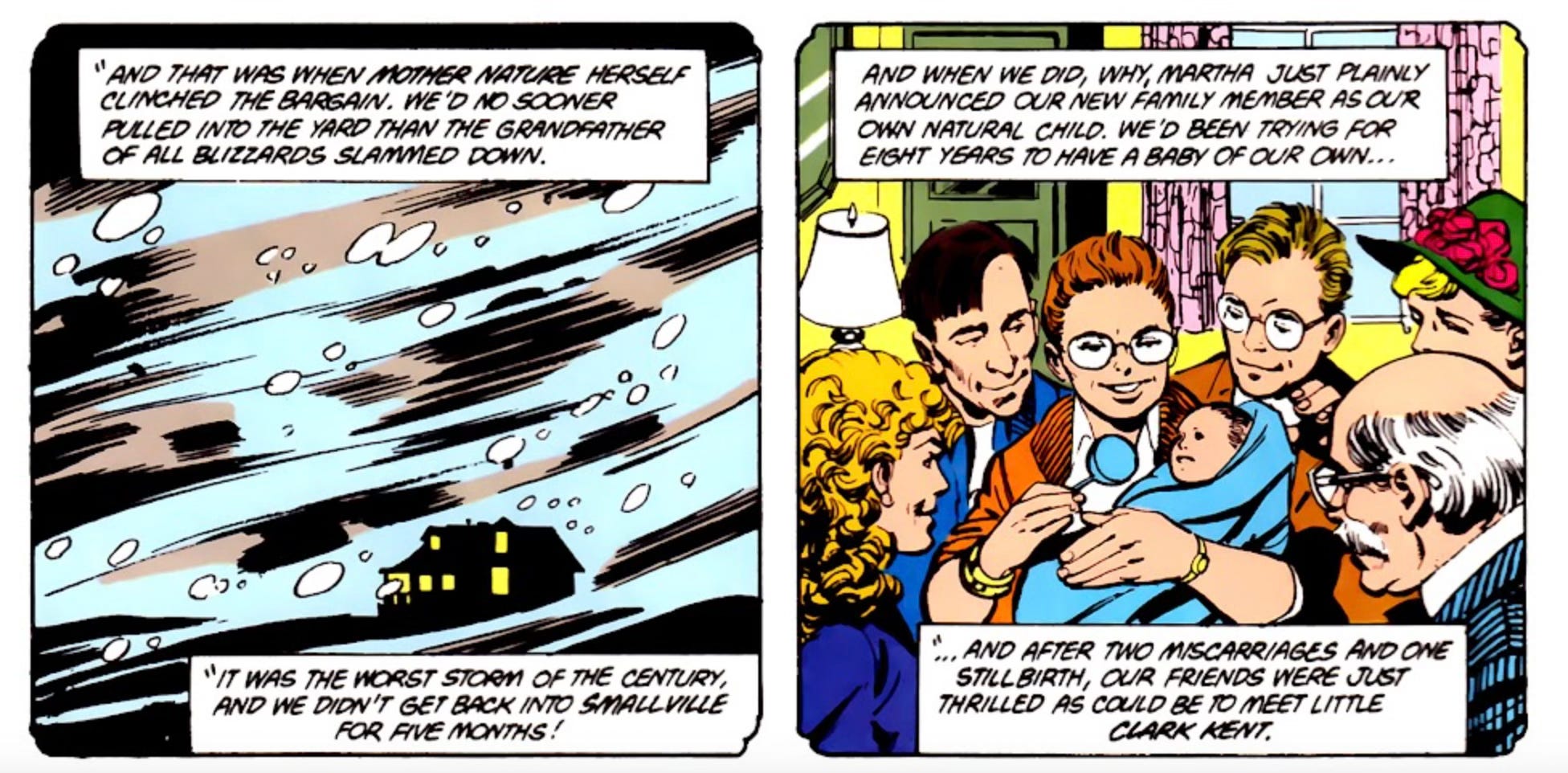
Now, the “birthing matrix” might’ve proven an interesting legal matter for the courts to decide, but instead Byrne has the Kents openly commit immigration fraud. They pass off Clark as their biological child, claiming that Martha Kent had been pregnant but shy about telling people after past miscarriages. Fortunately for the Kents, their friends are idiots.

In Man of Steel, Superman tells Lois Lane, “I don’t know exactly where I’m from. I guess it really doesn’t matter. What maters is that I think and feel as an American.” But what does it mean to “think and feel as an American”? Lex Luthor was born in America and thinks and feels like Donald Trump, who’s currently the U.S. president. Superman presumes without knowledge that his heroism and basic decency are American traits that his adoptive parents graciously bestowed upon him. Even when he discovers that his Kryptonian father sent him to Earth for a chance at a better life — proving that parental love and self-sacrifice exists across the universe — he dismisses his Kryptonian heritage as “ultimately meaningless.”
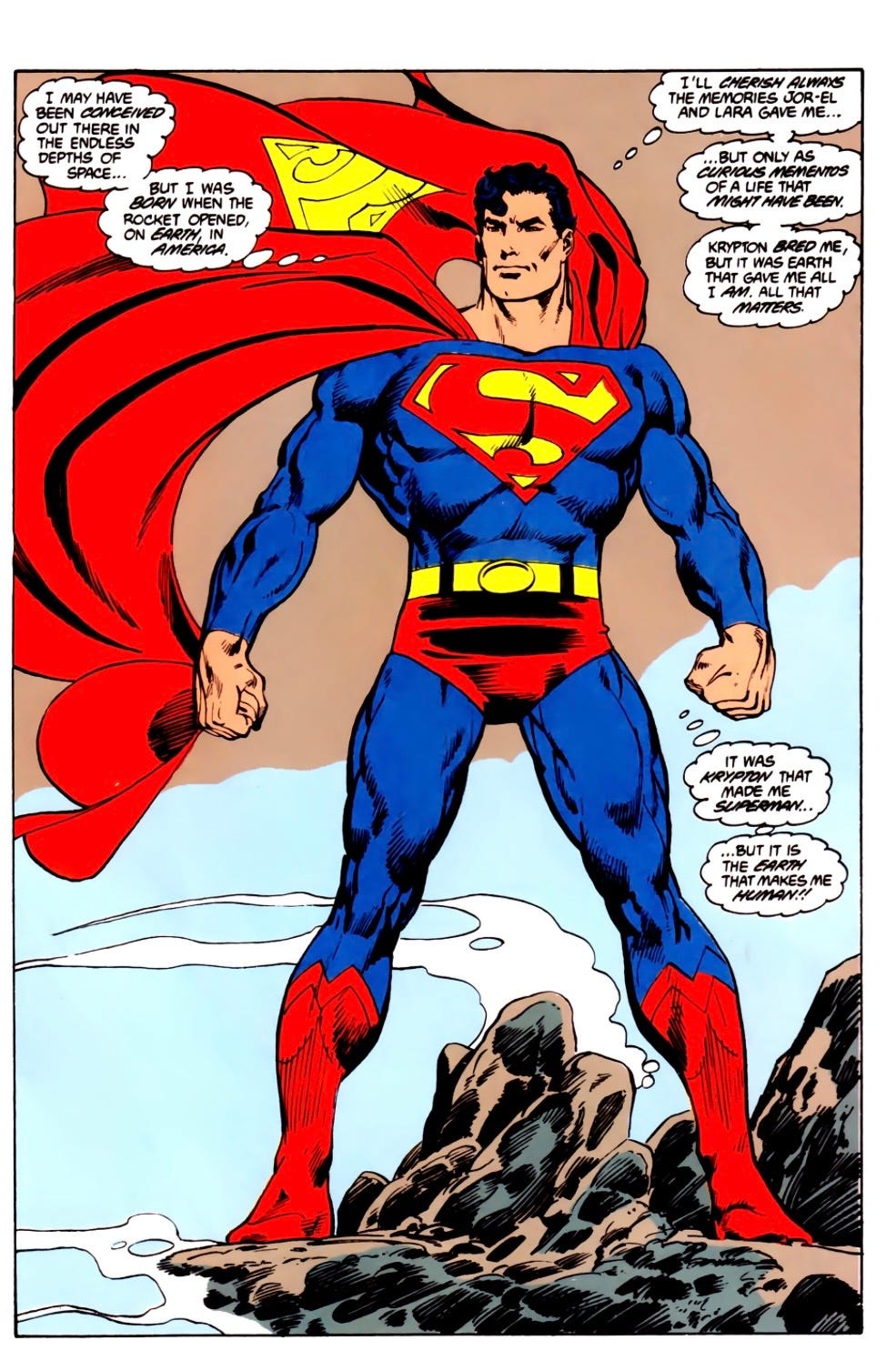
His Kryptonian parents left him a legacy of his home world’s accumulated knowledge, which Superman rejects as “curious mementos of a life that might have been.” John Byrne wanted to reinforce Superman’s humanity, but he defined humanity as uniquely American, specifically the American “heartland.” I know nature vs nurture is a big debate, but I don’t think Superman’s essential humanity is entirely due to the Kents and their Smallville church’s Sunday School. His humanity also comes from his Kryptonian heritage. Some Kryptonians might have been despots like General Zod, but America has produced its own share of despots. Krypton also likely contained countless people with Superman’s potential. That, after all, is the tragedy of its destruction, one John Byrne overlooked.
"I’m sick of hearing from Republicans and Democrats alike that the “best” Americans are exclusive to the Midwest. I appreciate that Captain America was a working-class kid from Brooklyn, and Spider-Man is a working-class kid from Queens."
Thank you!
We thought about going to see Supergirl this weekend but we already bought presale tickets for The Odyssey and I didn't feel like shelling out another $40 for two tickets for a matinee showing. I remember when matinees were like $5 and that wasn't that long ago.