


Center-left journalist Matt Yglesias has relentlessly pushed the Democratic Party to embrace socially conservative positions (specifically on trans rights, immigration, and even abortion) as the best way for the party to perform well in “red” states. New York Times columnist Ezra Klein has made similar arguments — once again framed as prioritizing “winning” over rigid ideology. I’ve long argued that this self-proclaimed “common sense” centrism — what David Shor has called “popularism” — is a cynical form of politics that doesn’t actually believe in anything beyond getting elected and remaining in office for as long as the checks clear.
Last week, my friend Noah Berlatsky offered a compelling counter-argument to my theory during our podcast conversation. He suggests that people like Yglesias and Klein are attempting to hide their own ideological agenda behind the pretense of objective calculation
BERLATSKY: I don’t believe that’s true … I think you want to hurt immigrants. I think you want to hurt trans people … it’s like you’re massaging the evidence to get to these policies that you claim you don't want to support. I don’t believe that you don’t want to support them. I think you want to be considered a good person, but you also want to hurt immigrants and trans people. To your point, it's like, just admit that you believe in it or not. People respect that you actually believe in this more than some desire to be seen as a good person because it's blaringly inconsistent. It’s just clear what you value and what you don’t. And so you just don’t, why look like a fraud.

If you read enough of Yglesias’s newsletter and social media posts, it would seem clear that he fundamentally doesn’t support trans rights and actually agrees with the socially conservative position on most cultural issues. This March, Yglesias argued in the New York Times that the “Democratic brand is toxic in too many states,” and his prescribed cure was predictable:
The two biggest vote-shifting issues for Democrats are related to race. Dropping support for the use of race as a factor in college admissions and racial targeting of small business assistance moved voters a great deal. So did embracing merit pay for K-12 teachers, backing off teaching gay and lesbian themes in school, welcoming fewer asylum seekers, being tougher on minor crimes, being more open to fossil-fuel production, restricting gender transition for children and sticking to biological sex as the criteria for sports teams.
Yglesias’s business model is to soberly present electoral chemotherapy as the only viable treatment option for Democrats’ political woes, but, in truth, he just enjoys blasting (certain groups of) people with massive amounts of radiation.
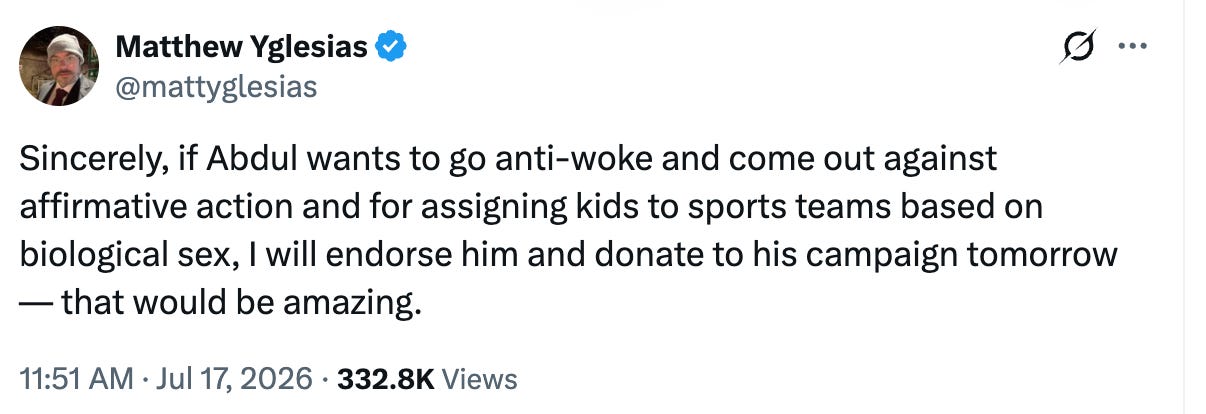
For instance, Yglesias has said he’d recommend that Michigan Democrats vote for Rep. Haley Stevens in the upcoming Senate primary because he disagrees with Abdul El-Sayed on the issues and “leftists are on average significantly worse electorally performers,” but a few days later, he glibly posted, “Sincerely, if Abdul wants to go anti-woke and come out against affirmative action and for assigning kids to sports teams based on biological sex, I will endorse him and donate to his campaign tomorrow — that would be amazing.”
This is a rather inconsistent position if Yglesias’s primary objective is simply winning elections. The Democratic establishment has weaponized race when boosting Stevens’ support among Black voters. Opposing affirmative action would hardly benefit El-Sayed or any Democrat in a contested primary. It’s not necessarily a major issue for the general election, unless the whole point is the vice signal that you don’t support “woke” issues.
Yglesias supposedly disagrees with El-Sayed’s “leftist” positions, so if he were truly willing to flip his support to El-Sayed over affirmative action and trans rights, that reveals a disturbing order to his overall priorities.
Of course, the challenge with rigid ideology is that you can look silly when discussing documented history. Last week, Yglesias wrote a piece about “how the center-left can come back in 2028.”
“[Political] science proves that you can win a Democratic primary by running to the center on select issues that would also help you beat [JD] Vance,” Yglesias posted on social media, “and I think decisively winning is the only thing that will put the intra-party insurgency to rest.
Note the photo illustration for this piece: It’s Bill Clinton and Al Gore at their peak Fleetwood Mac moment.
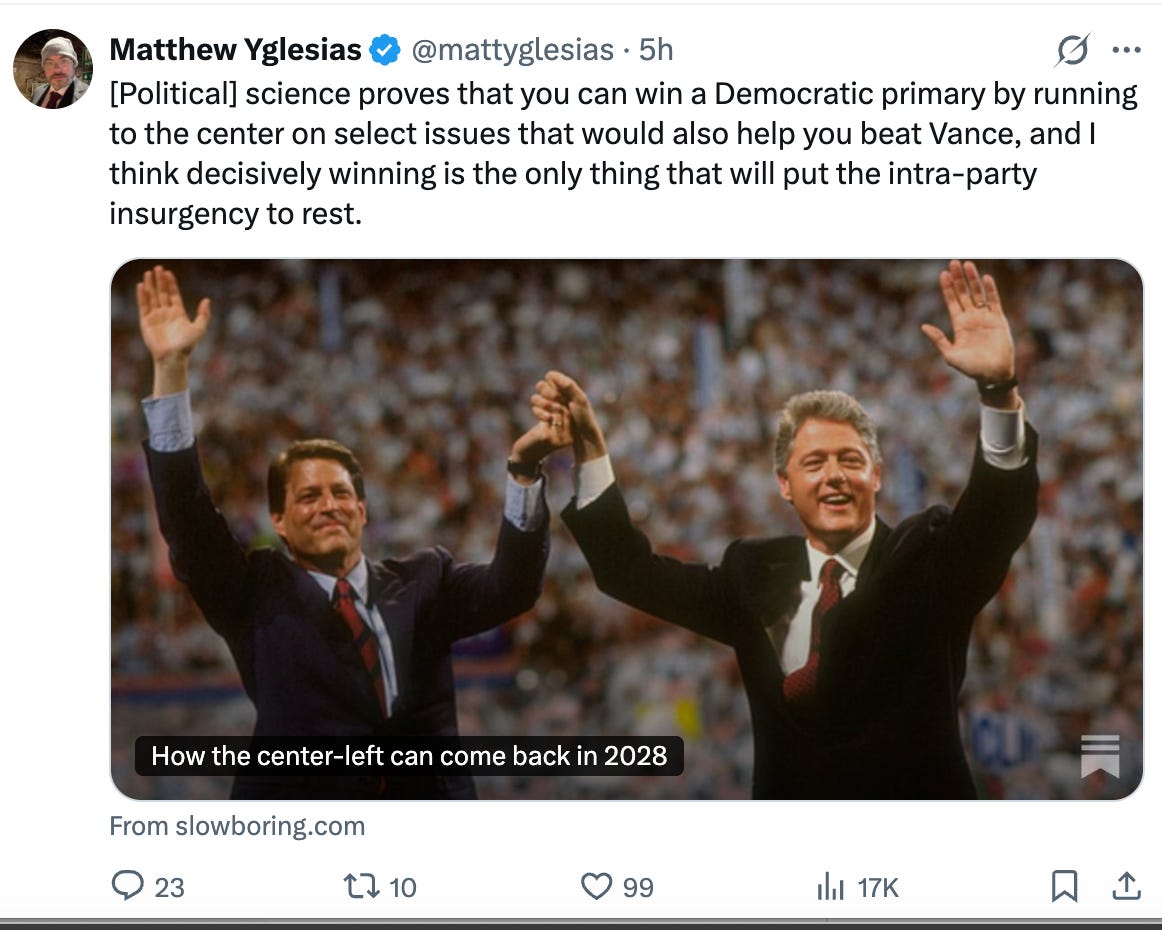

Conventional wisdom is that Clinton, a member of the centrist Democratic Leadership Conference, shifted the Democratic Party to the sensible center, rescuing the party from the political wilderness after more than a decade of liberals walking into electoral rakes. This is true to a point, but what Yglesias doesn’t seem to grasp is that Clinton didn’t win the 1992 Democratic primary or the general election against President George H.W. Bush on an overtly socially conservative platform. He certainly didn’t pick fights with the marginalized, as Yglesias recommends Democrats do with an almost pulling-the-wings-off-insects glee.
I voted for the first time in 1992 so I have clear memories of the Clinton/Gore campaign. First off, while Clinton/Gore were more conservative on some key issues than Mike Dukakis (e.g. the death penalty, welfare) they didn’t openly promote regressive views on culture. Yglesias isn’t just urging Democrats to shift right on certain cultural issues. He’s recommending that Democrats openly backtrack on previously held positions. Clinton never said during the 1992 campaign, “Well, Reagan and Bush kicked our asses so maybe we shouldn’t have interracial marriage after all!”
In fact, Yglesias argues that Democrats surrender on cultural issues in ways that Clinton never did against George H.W. Bush — even when Republicans hit him (and specifically Hillary Clinton) on “family values.” It’s not as if Hillary said, “OK, fine, I'll promise to only do traditional First Lady stuff.” She stood her ground. (Watch below.)
Interestingly, Clinton took several positions to the left of Dukakis on culture, specifically gay rights. According to a National Opinion Research Center poll in 1992, only 38 percent of Americans said they considered homosexuality an “acceptable alternative lifestyle,” compared to 57 percent of Americans who didn’t. Yglesias would have claimed that the data was clear and candidates who expressed open support for gay rights needlessly jeopardized their chances of winning elections. However, Clinton aggressively courted the gay community, even as the Republican platform opposed all civil rights law protections for gay people and same-sex marriages.
From the Washington Post:
[Clinton] released formal position papers on gay issues that essentially pledged him to virtually the entire mainstream gay political agenda. Among other steps, Clinton has pledged to sign an executive order ending the U.S. military policy discriminating against homosexuals, support legislation to amend federal civil rights laws to include sexual orientation, “appoint gays and lesbians to major positions” in his administration and launch a “Manhattan-type Project” to find a cure for AIDS.
But Clinton never really connected with the gay community until last May when he delivered an emotional speech at a gay political fund-raiser in Hollywood. In the speech, videotapes of which now circulate in the gay community and are repeatedly played at gay fund-raisers, Clinton tells his audience: “I have a vision and you’re a part of it.”
When Clinton signed the Defense of Marriage Act in 1996 — for which he later apologized, he claimed it was to stall momentum for a more sweeping same sex marriage ban (one likely to pass, considering the Supreme Court makeup at the time). You might reject that reasoning, but Yglesias and far-too-many elected Democratss have shown no concern for trans people when embracing anti-trans positions.
Clinton was hardly perfect — the 1994 crime bill and Glass-Steagall repeal weren’t exactly high points for liberalism — but he arguably maintained a winning liberal coalition because of his progressive position (for the time and even now) on prominent cultural issues. It also paid off for him politically: It wasn’t the cops and bankers who saved his ass during his impeachment debacle. It was the vulnerable groups who felt he’d been on their side. That’s the true politics of “popularism” in action.
Most, if not all, Democratic positions, are popular with most Americans. That includes positions taken by the DSA. However, too many Dems, especially establishment Dems, accept right wing framing on issues, especially cultural issues, so either defend their positions poorly, or whine about whatever marginalized group that the cons are whining about. Is it a messaging problem, a cowardice problem, or an honesty problem? The answer is "yes," to all three, for some establishment Dems - they suck at messaging, they lack a spine to stand up for what they really believe in, and they can't be honest about what they really believe.
For some Dems, it's a messaging problem. I'm not an expert on messaging, but step one would be to NOT accept right wing framing on anything, and to call both them out and the media, which accepts right framing as the norm. If those Dems could do that, if they have a spine and are honest about wanting healthcare for all, affordable housing, human rights for all - including the marginalized, and holding lawbreakers (especially those at the highest levels) accountable for their actions, they would do well in elections.
Those hacks you wrote about aren't leftists at all, they are right wingers, giving Dems bad advice.
"Center-left journalist Matt Yglesias has relentlessly pushed the Democratic Party to embrace socially conservative positions (specifically on trans rights, immigration, and even abortion) as the best way for the party to perform well in “red” states"
Which only works if you assume that blue people in red states are LESS blue than they are in blue states...As someone who lived most of his life in a red state (that has been turning blue over the past 20 years YAY Virginia!) that is utter crap
When you back away from standard democratic positions like gender equality, abortion rights, immigrant rights, you send a CLEAR 'fuck you' to blue dots in red states...you know, the dem voters who are quite 'literally' on the front lines...The democratic voters who are holding the fort while the centrists pontificate on what will or wont work in elections in red states.
So to the centrists...You NEED these democratic voters MUCH MORE than you need some theoretical never Trumper that may or may not actually exist, one that probably wouldn't vote for ANY dem in any case...