


When a majority of Americans decided to celebrate the country’s 250th anniversary with Donald Trump in the White House, the reasonable outcome was a disaster, which is a generous description of the Independence Day celebration that Trump ruined by making it all about himself.
Trump predictably used the 250th anniversary events as another excuse to enrich himself through blatant grifting, but he struggled to console himself on his bed of unmarked bills because the American people’s rejection of him was so public.
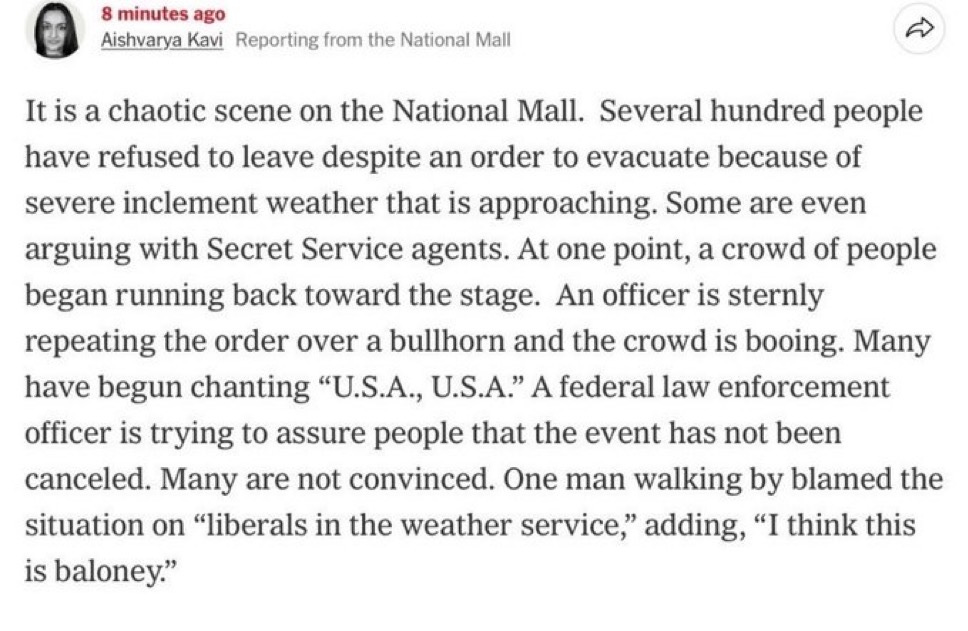
Turnout for Trump’s Fourth of July rally at the National Mall was dismal. You could blame the triple digit heat, but Washington D.C. is almost always hot, humid, and rat-infested during the summer. The reality is that only the truly MAGA-obsessed wanted to waste their time watching one of Trump’s tedious, grievance-filled hate fests.
The event itself was an unmitigated disaster. Storms delayed the start time until almost July 5. Thousands of people got stuck outside the gates because security was poorly coordinated so lines barely moved. Many people left in disgust. The cultists who remained were treated to Trump’s typical unhinged rant.
So, Trump ruined Independence Day, just as he’s actively ruining American independence itself. Americans aren’t in the mood to celebrate when almost 70 percent of them are less than thrilled with the nation’s current state, according to the Pew Research Center, and about 60 percent say that the country’s best years are behind it. A Gallup poll reveals that barely half of Americans are “extremely proud” or “very proud” to be an American. The last time that figure was so low was 2001, and it took a terrorist attack to kick-start Americans’ patriotic fervor and later xenophobic mania.
According to another Gallup poll, roughly 75 percent of Americans believe the Founding Fathers would be disappointed in how the country has turned out. That’s probably true, and while I’d like to think that Trump would prove the primary source for their disappointment, I doubt they’d be thrilled about my voting, owning property, and Mayflower wife.
This is all a stark contrast from the 200th anniversary celebration in 1976. Then the nation was fully hyped on bicentennial fever. Americans felt like celebrating. It also helped that M*A*S*H was on the air.
A June 1976 memo from Robert T. Hartmann, counselor to President Gerald Ford, regarding the bicentennial celebration speeches stands out in how much politics have changed, and how Trump specifically has diminished the office of the presidency:
All the drafts should be short, taut, and straightforward. While they of necessity deal with political and economic principles and institutions, there should be no campaign code words or partisan insinuations whatsoever. They should state the President's sincere convictions about America and its future in understandable and acceptable terms. Noble and profound thoughts can be expressed in direct and simple words, as Jefferson and Lincoln did. Any whiff of pomposity or pretentious elegance must be avoided. The President will be speaking for, as well as to, all the people of America. He will have to speak in their language, not that of poets or philosophers.
Obviously, Trump did not address Americans in the language of “poets and philosophers,” but his rally speech overflowed with his typically noxious polarizing rhetoric. There were no “campaign code words or partisan insinuations” only because Trump lacks all subtlety.

The United States’ 50th anniversary was recent enough that living signers of the Declaration of Independence were invited to attend the celebrations. This included former presidents Thomas Jefferson and John Adams, who were too ill to attend personally and both died within hours of each other. That’s still a better way to spend the Fourth of July than attending Trump’s Great American State Fair.
The 100th anniversary celebration came just a decade after the end of the Civil War. Ulysses S. Grant, who led the army that defeated the Confederacy, was the sitting president at the time. Reconstruction was still in effect, and the 13th, 14th, and 15th Amendments had made the nation objectively freer. It was a more hopeful time, specifically for the formerly enslaved, but much of this hope would prove short-lived.
The 150th anniversary in 1926 was considered a gigantic flop, even with everyone doing the Charleston. Organizers had predicted that 30 million people would visit the world’s fair in Philadelphia, but instead barely five million paid to attend. Philadelphia lost millions of dollars, which effectively bankrupt the city just a few years before the Great Depression.
The Bicentennial was more successful but that’s not to say that the nation’s mood was entirely sunshine and roses a couple years after Watergate. One of my favorite movies, Robert Altman’s epic Nashville, is a revealing snapshot of the period. If you’re never seen the film or haven’t watched it recently, I recommend revisiting it.
Lurking in the background is an unseen populist presidential candidate whose rhetoric is uncomfortably prophetic. Hal Phillip Walker runs under the fictional “Replacement Party” banner, and he attacks the establishment while insisting Americans mindlessly blame a corrupt “elite” for all their problems.
His van’s loudspeaker declares, “All of us are deeply involved in politics whether you know it or not — or like it or not.” This feels eerily like a threat, as it previews a modern reality we can’t escape.
The film climaxes with an act of senseless violence. Country singer Barbara Jean (Ronee Blakley) has achieved the fame and success that has come to define the American dream, but the pressure has caused her to publicly crack. A deranged loner shoots Barbara Jean during her performance at a rally for Walker. (Recent experience would indicate this might only improve his polling.)
Barbara Jean’s quickly carried off stage. We don’t know if she survives, but her injured duet partner Haven Hamilton (Henry Gibson), who’d previously sung the jingoistic anthem “200 Years,” hands the microphone to the perpetually disheveled Winifred (Barbara Harris), a struggling performer who seizes this moment to fulfill her own American dream. At first it seems like she’s signing herself but she steadily grows more confident.
The whole world is taking sides but it don’t worry me
Cause in my empire, life is sweet
Oh, just ask any bum you meet
Life may be a one-way street
But it don’t worry me
The choir joins her and the music swells, as she signs an anthem of nihilistic surrender. Now, more than 50 years later, I wish we can all find enough hope within us to worry about the world around us and, most of all, take a side.
For a guy who wants so desperately to be loved, Trump is simply incapable of doing anything to enable others to love him. He just can’t do anything other than needy asshole mode.
Imagine where a president had the self control to appear humble and gracious, and give a rousing speech that was nonpartisan. There’s precedent for this—Bush after 9/11, FDR after Pearl Harbor—but you can’t even imagine Trump pulling this off. He’s so consumed with hate and resentment and insecurity that he can only do things to get others to hate him, until all that’s left is a gross rump of thugs who only like him because the people they hate can’t stand him.
Imagine being so myopic and hateful and stupid to actually blame the weather on liberals. Listen, if we had that power a Cat 5 hurricane would have wiped out Mar A Lardo years ago.