


The classic Batman: The Animated Series is highly regarded for its complex villains. Their motivations were rarely as “bwah-ha-ha” one-dimensional as past Saturday morning cartoon bad guys or the current Trump administration. Writer Paul Dini re-imagined Mr. Freeze as a tragic figure, shattered like ice from grief and consumed by vengeance. The Mad Hatter was no longer a gimmick villain, obsessed with stealing people’s headwear, including Batman’s famed cowl. Instead, he was an entitled incel who couldn’t cope with reality so he sought refuge in a fantasy world.
The series also gave some of its villains an openly political dimension, one ripped from the headlines of the late 1980s and early 1990s. Selina Kyle, the Catwoman, is the first classic Batman villain to appear in the series. This was a deliberate scheduling choice intended to capitalize on Catwoman’s featured role in that summer’s Batman Returns. However, B:TAS’s Catwoman initially bears only a superficial resemblance to Michelle Pfeiffer’s famous version of the character. Pfeiffer’s Catwoman is a chaos agent whose single-minded quest for revenge against a man who wronged her ends in violence and death. In “The Cat And The Claw,” the first B:TAS episode to air, Selina Kyle (Adrienne Barbeau) is a seductive cat burglar but her motivation is less primal, perhaps even noble. She apparently steals (from the wealthy) to fund her animal rights activism. She first meets Bruce Wayne (Kevin Conroy) at a charity auction for animal preserves. (Watch below.)
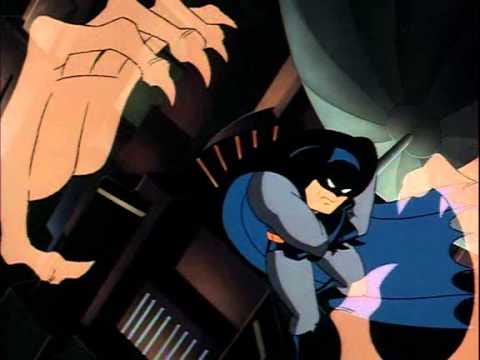
Written by Sean Catherine Derek and Laren Bright, “The Cat And The Claw” at times feels like a backdoor pilot for a potential Catwoman series. Catwoman isn’t really the story’s true antagonist. That’s the terrorist mastermind Red Claw, played with campy flair by future Captain Janeway Kate Mulgrew. Pre-9/11, “terrorist” villains weren’t ethnically or religiously coded. “Terrorists” on afternoon cartoon series were like Cobra from G.I. Joe, and Mulgrew’s performance as Red Claw reminds me of Morgan Lofting’s “Moose and Squirrel” accent as the Baroness. The irony is that the Twin Towers attack was very much a classic cartoon terrorist plot — they just didn’t ask for an absurd ransom first nor were they ultimately foiled by our heroes.
Catwoman arguably is the episode’s anti-hero, a foil to Batman’s traditional heroism. She wants to the stop a soulless corporation from building a resort on a mountain lion habitat. The corporation is in cahoots with Red Claw, who threatens to release a deadly plague if she doesn’t receive $10 billion in gold bullion. Terrorists in pre-9/11 media were all about capitalism.
In her follow-up episode, “Cat Scratch Fever,” also written by Sean Catherine Derek, Selina receives a very lenient probation for her past crimes. (Her own animal rights-loving fans show up at the courtroom to support her.) Once again, the true villain is another soulless corporation, Daggett Industries. Corrupt CEO Roland Daggett (Ed Asner) plans to infect stray cats and dogs with a highly contagious virus that’ll quickly spread through the city. Then his pharmaceutical business will make a fortune selling the antidote. This aired almost a year before The X-Files debuted, but it has a similar conspiratorial theme. Catwoman doesn’t steal anything in this episode. She helps save the day, but her redemption arc doesn’t last.

Poison Ivy, born Pamela Isley, was a straightforward, but quite curvaceous, femme fatale villain in the Batman comics before Batman: The Animated Series cemented her background as an environmental zealot or “eco-terrorist.” Radical environmental groups in the 1980s had made the news through attempts to stop perceived ecological and animal exploitation through economic sabotage and property destruction. B:TAS’s Catwoman might have stolen jewels to fund animal rights causes, but Poison Ivy didn’t pretend that she was committing “victimless crimes.”
In “Eternal Youth,” written by Beth Bornstein, Poison Ivy lures wealthy industrialists, whose companies she believes have ravaged the environment, to a health spa where she transforms them into living trees. The Twilight Zone-style twist here is that Ivy preys on her victims’ vanity, offering them “eternal youth” — the one thing money can’t actually buy, just rent — and delivering it to them in her own perverse way.
“You and your kind owe Mother Nature a big debt, and I will ensure you pay up,” Ivy tells one of her victims before forcibly casting them as one of those angry trees from The Wizard of Oz.
Batman’s Bond-villain adversary Ra’s al Ghul is also depicted on B:TAS as an eco-terrorist but on a global scale. In “The Demon’s Quest,” while driving through a Malaysian rainforest, Ra’s lectures Batman, who he knows is also billionaire Bruce Wayne.
RA’S: Look at it, detective. One of the last of the rain forests. The world depends upon its oxygen, yet the rich see only profit in its destruction. You, who belong to the over-class have much to answer for.
BATMAN: Bruce Wayne donates millions of dollars a year to preserve these forests.
RA’S: Which are being depleted at the rate of 120,000 acres a day. Does your money solve this problem? No! It will take more than wealth. It will take power, and I fear, ruthlessness. Humankind must be forced to serve the planet instead of its own appetites.
BATMAN: And you’re the one who’ll do the forcing?
RA’S: I am ... qualified, yes. But I may not have sufficient lifetimes left to me.
Although a 1982 Batman annual had hinted at this motivation when Ra’s says, “As you know, I have a vision of an Earth as clean and pure as a snow-swept mountain or the elemental reaches of space,” he was usually presented as an exotic world-conquering megalomaniac. Ra’s Al Ghul’s co-creator Denny O’Neil worked on the script for “The Demon’s Quest,” thus putting his stamp of approval on this interpretation of his character. It makes Ra’s a compelling contrast to Batman, as they both want to change the world for the better but their tactics make them polar opposites and sworn enemies. Christopher Nolan would take a different approach with Ra’s in Batman Begins. Nolan’s Ra’s is just as ruthless and contemptuous of humanity, but preserving the planet doesn’t drive him. He wants to stamp out crime and corruption, even if it means burning Gotham City to the ground and starting over again. It’s interesting that Nolan’s post-9/11 version of Ra’s is a terrorist who has no interest in ransoms, but he’s also distinctly right-wing coded rather than sharing any sentiments with Greta Thunberg.
Poison Ivy would regress into a more obvious femme fatale villain in the disastrous 1997 Batman And Robin movie. However, she’d maintain her “eco-terrorist” motivation in later TV adaptations, most recently in the wonderful Harley Quinn TV series.
Batman: The Animated Series “showrunner” Bruce Timm reportedly didn’t care for Catwoman as an animals right activist. He preferred the inscrutable jewel thief, and the series steadily shifted Selina in that direction, starting with the excellent “Catwalk.” She later proves a compelling foil for Barbara Gordon’s Batgirl and Dick Grayson’s Nightwing. By this point, she’s just a thief, who steals for the thrill and lives for the chase. Her final appearance is The New Batman Adventures episode “Cult of the Cat,” where she double-crosses and out-maneuvers everyone, including Batman himself. I confess that’s my platonic ideal for Catwoman, but the timing of the change mirrors a similar alteration in our politics. After all, today’s real-life supervillains are straight-up thieves and sadists. They have no higher goals. Unfortunately, they won’t go away when we turn off the TV.
You're calling the Clooney nippled Batman a disator? Come on, that was great fun! Stacked cast and all the camp in the world! Why so serious?
"When"? More like "While".
Don't tell me Enlo Musk and Pete "Little Adolf" Thiel aren't Bond villains.