


Mad Men, the critically acclaimed period drama that ended in 2015, seems to have infiltrated the algorithm lately. Clips of the series have popped up regularly in my social media feed, and I’m apparently not the only one: A colleague at a recent fundraiser mentioned that Mad Men clips on social media had inspired him to rewatch the series.
Perhaps that explains this post that appeared last week on Threads: Los Angeles Chef Alex Ramirez wrote, “I started rewatching Mad Men, and I have a theory that the show’s nostalgic portrayal of the 1960s contributed to the conditions that enabled the rise of MAGA. Walk with me on this.” (This goes on for a while.)
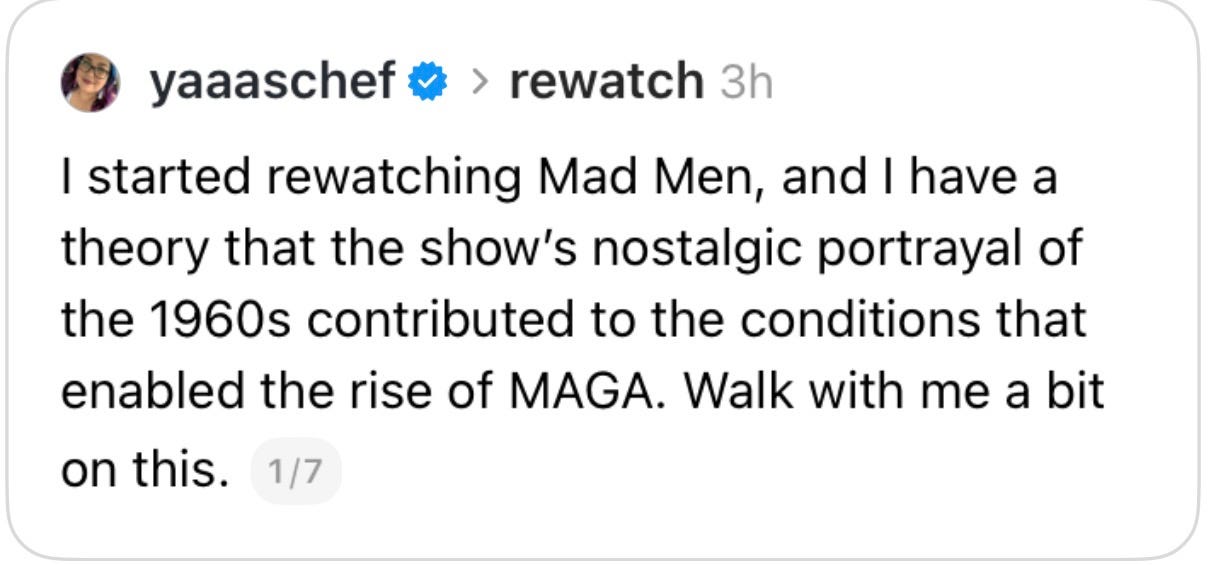
Obviously, Ramirez is a chef not a TV critic, and regardless, she’s welcome to her opinion, which you can read in full. However, the theory she posits is one I’ve seen expressed elsewhere, and it extends beyond “I don’t care for this program.” It makes an assertion about Mad Men’s impact that reality doesn’t support.
Although Mad Men briefly boasted an audience of 4.7 million at its peak, the series usually averaged less than 2 million viewers (and barely 1 million viewers in its first season). Around the same time, The Big Bang Theory was averaging 14 million viewers an episode, but I don’t think Sheldon and Leonard are responsible for Donald Trump’s presidency, either.
Mad Men’s audience was relatively affluent, college educated and urban — basically the demo for today’s Democratic Party, hardly MAGA. Over the past 20 years, there’s been a cultural bias toward treating TV shows with a small, highly educated, urban audience as major cultural touchstones. Their series finales receive the same coverage as the final episodes of M*A*S*H and Cheers without commanding anywhere near the same viewership.
Mad Men’s first two seasons aired at the end of George W. Bush’s presidency. A first season plot line involves the Sterling Cooper advertising agency working to elect Republican presidential candidate Richard Nixon. It’s 1960 not 1968, so they obviously fail. The series often depicts its characters, particularly the protagonist Don Draper (Jon Hamm), as on the wrong side of history. Most shows steeped in nostalgia almost always put their heroes ahead of an era’s moral curve, and if they lose a particular battle, their defeat is lessened with our knowledge that history will prove them right.
Yet, Draper wasn’t just a hired gun for the Nixon campaign. He genuinely believed in the candidate. He dismisses Democrat John F. Kennedy as “nouveau riche,” someone “who bought his way into Harvard” while Nixon came “from nothing. A self-made man, the Abe Lincoln of California, who was vice president of the United States six years after getting out of the Navy. Kennedy? I see a silver spoon. Nixon? I see myself.” (Watch below.)

You could read Don’s rebuke of JFK as an obvious hit at current President George W. Bush, whose family did likely buy his way into Harvard. Conversely, you could argue that Don’s open contempt for an American “elite,” which he expresses from the comfort of a Madison Avenue boardroom, reflects a certain hypocrisy that previews the later MAGA movement. Either way, that misses the core point about Don’s character: Despite his own superficial charm, slick good looks, and easy way with women, Don doesn’t identify with JFK, the Camelot president. Instead, he sees himself in Richard Nixon, the guy who bombed on TV repeatedly. Just 10 episodes into the series’s run and Mad Men has tipped its hand regarding Don’s fate. Like Nixon, he’s a tragic figure, whose drive and insatiable ambition will gain him everything he thought he wanted, only for him to lose it all because of his inescapably self-destructive nature.
Don would later side against popular history when he, along with most of Sterling Cooper, bet on Sonny Liston over Muhammad Ali in the fateful 1964 prize fight.
“He’s got a big mouth,” Don scoffs. “‘I’m the greatest.’ Not if you have to say it. Moo-hammad Ali. Liston just goes about his business, works methodically. Clay will dance and talk, throw a few until he’s wiped out.”
Don refusing to respect Ali’s name change is obviously ironic because “Don Draper” is a fiction, but Don also chooses to exist somewhat in the shadows, to not draw undue attention to himself. He thus can’t understand or appreciate why Ali would or what it means to Black Americans that Ali demands the spotlight he deserves.
It’s also hard to draw a line from this to MAGA. After all, Barack Obama was the president when the episode aired, and “No Drama” Obama was a leader who “goes about his business, works methodically.” Donald Trump is the attention-seeking showman but without Ali’s skill and commitment. He is only flash and self-aggrandizement.
I wouldn’t call Mad Men a “nostalgic” series. I think it’s revealing for those who do. The characters who are the most redeemable are women (and even they are deeply flawed) and the audience is meant to identify with their struggles in a white male dominated reality.
Mad Men is even less nostalgic than Goodfellas, which plays up the machismo culture until everything goes to hell. Don Draper is descending into a hell from the opening credits. I’ve seen Don compared to Jay Gatsby, which misses the mark. He’s certainly the best product he ever sold, but he lacks Gatsby’s willful ignorance and naïveté. If Gatsby “believed in the green light,” Don knows that it’s all a scam.
“What you call love was invented by guys like me, to sell nylons,” Don tells Rachel Menken, a client he’s wooing in every sense of the term. “You’re born alone and you die alone and this world just drops a bunch of rules on top of you to make you forget those facts. But I never forget. I’m living like there’s no tomorrow, because there isn't one.”
Self-important teenagers might think that’s cool, but they weren’t the show’s primary audience. In another, later scene, when Draper aggressively pitches a client, he insists that happiness is unattainable … and that’s the point.
“You’re happy because you’re successful — for now,” Draper says. “But what is happiness? It’s a moment before you need more happiness. I won’t settle for 50 percent of anything. I want 100 percent. You’re happy with you’re agency? You’re not happy with anything. You don’t want most of it. You want all of it, and I won’t stop until you get all of it.” (Watch below.)
Sure, maybe advertising executives might show this clip out of context at a corporate retreat — sort of like how MBA classes have shown the Alec Baldwin speech from Glengarry Glen Ross, but privileged men missing the point isn’t what “enabled the rise of MAGA.” The societal cancer was too widespread.
I’d argue that shows such as Bridgerton, Miss Scarlet and The Duke, or more recently The Other Bennet Sister — all of which I enjoy — promote a more dangerous nostalgia about the past. The period’s intrinsic classism, racism, and sexism are easily overcome if someone is exceptional enough. Worse, most societal prejudices are completely ignored. People of color are seemingly welcomed in “high society.” Mad Men presents the 1960s for what they were, including the casual bigotry and sexism that coincided with JFK’s Camelot. Sure, MAGA might prefer those past conditions to a more inclusive future, but the series wasn’t catering to them.
Yes! I always laughed at people who thought Draper was some hero rather than a sad tragic out of touch guy. Same with the “fuck you pay me” goodfellas fans. Did they not watch the whole movie?
Well, you are talking to a person who found the comforting fiction of "West Wing" intolerable, and I blamed it and Alan Sorkin in part for the American political docility that permitted the re-election of Bush moron son,GW, on a virulently homophobic platform. I found "Mad Men" infuriatingly unwatchable as I LIVED though that era and it was horrific for women. HORRIFIC. (Full disclosure: I also LOATHED the movie "Diner" - despite it's extraordinary ensemble of actors - for it's completely fucked up view of women - in many shots the female characters don't even have heads! Something can be "well done" - and still REPELLENT. In fact I think a well-done thing that makes unspeakable things "attractive" or "palatable" is doubly compromised. Make of me what you will.) Mad Men didn't make Trump Trump. But the fucking awful 50s, 60s and 70s did. And I am leery of ANYTHING that makes those decades "cool". They most decidedly were not, just as the Reagan Reality Show 80s were NOT.
And I hope no one sane thinks Regency England or Turn of the Century New York "society" were ever racially diverse. Gilded Age and Bridgerton, in particular, are fantastical, empty calorie, jewel tone and pastel, modern day classist, "cake and icing" romance novel soap opera confections that ask us to imagine "what if" the respective British and American "aristocracies" had been more racially diverse? Well, if any ot that had been real, perhaps the world today would be a fucking better place run by all those non-White caramel- and moccachino-colored great-great grandchild descendants of massive unearned wealth and privilege. "What if", in-fucking-deed!
(Yeah, I am completely UP MY NOSE about this stuff. Fight me.)