


California state Sen. Scott Wiener, who’s running to replace Nancy Pelosi in Congress, was chased out of San Francisco’s annual Trans March last Friday. Wiener, who’s gay, has a solid record of supporting trans rights — although even if he didn’t and had just taken a wrong turn through Dolores Park, that wouldn’t justify strangers verbally abusing him in a civilized society.
The head of the small mob who berated Wiener is a man named Dimitry Yakoushkin, who was so proud of his work that he filmed the encounter and posted it on social media, where shame continues to wither and die. (Watch below and cringe.)
“Scott, do you have anything to say? How could you do this to San Francisco?” Yakoushkin shouted, as if the two were on a first name basis. “You do not belong here anymore, Scott. I want to support someone who’s so positive on trans rights, but you’re a piece of shit on Gaza.”
What’s bizarre here is that Wiener is not in fact a “piece of shit on Gaza,” and again, even if he were, that wouldn’t excuse this repulsive behavior. Wiener has opposed Israel’s military actions in Gaza and stated during a recent interview, “We all have eyes and we see the absolute devastation and catastrophic death toll in Gaza inflicted by the Israeli government, and we all have ears and we hear the genocidal statements by certain senior members of the Israeli government.”
“To me, the Israeli government has tried to destroy Gaza and to push Palestinians out, and that qualifies as a genocide,” Wiener said.
That apparently wasn’t good enough for the protesters, because Wiener had previously been reluctant to describe Israel’s actions in Gaza as a “genocide.” As George Michael once said, “That’s what you get for changing your mind.”

Watching this obnoxious mob accuse Wiener of having “Zionist handlers,” it’s clear that gross anti-Semitism was fueling the torches and pitchforks. Wiener was told, “You stopped being queer the moment you started supporting Israel, you piece of shit!” This was no longer about Gaza or the Israeli government’s actual offenses. These particular radicals won’t tolerate even mild support for a U.S. ally. Friends can criticize each other, but enemies aren’t interested in a respectful dialogue.
“They were so physically and verbally aggressive that it was impossible for me to safely remain in the park,” Wiener said in the statement.
“I have no objection whatsoever to anyone disagreeing with me, opposing me, or protesting me. All of that is core to democracy,” Wiener added. “But when opposition and disagreement transition to harassment, including cornering me, touching me, or trying to physically bully me out of a public event, that crosses a line.”
Activists from both the far-right and far-left too often reject persuasion as a form of political advocacy. Instead, it’s brute force — usually verbal but increasingly bordering on the physical. It’s hardly constructive, but rather its own form of rhetorical “fight club,” where nothing was solved when the fight was over but nothing mattered — aside from pious self-satisfaction.
This brings me to the new Supergirl movie, which has just crashed and burned at the box office. People have offered many theories for why the film bombed — the common “superhero fatigue” argument or the reductive “men hate movies with strong women leads.” Neither is entirely true. The upcoming Spider-Man: Brand New Day is set to break records, and despite some vocal incel complaints about the film, men are actually the majority of the audience who showed up for Supergirl. It’s more likely that you can’t expect that women will turn out in larger numbers for a superhero movie simply because it has a woman lead. Just like you can’t expect that men would have turned out in larger numbers for The Devil Wears Prada 2 if there had been more explosions.
I bring this up because I shared some thoughts about Supergirl’s performance on Threads. Again, we’re talking about a movie, not the war in Iran. I personally thought it was odd for DC to follow up James Gunn’s successful Superman movie with Supergirl. Their power sets are identical and the ways Supergirl differentiates itself from Superman also makes it slightly less relatable (it’s mostly set in outer space, rather than a fantastic yet recognizable version of Earth). Both Black Panther and Tom Holland’s Spider-Man first played major supporting roles in Captain America: Civil War before their solo films. Ant-Man (2015) and Doctor Strange (2016) starred Paul Rudd and Benedict Cumberbatch, respectively, each of whom were bigger names than Supergirl’s Milly Alcock, who only appears in a brief cameo at the end of Superman.
I noted in my Threads post that in her Superman cameo, Alcock’s Supergirl comes across as what others had described “drunk sorority girl.” (I even put that in quotes to indicate it wasn’t my own description.) This felt like a different approach, almost a different character, than what we saw in the Supergirl trailers and ultimately the film itself. This Supergirl is someone dealing with significant trauma, so her drinking seems more like a coping mechanism than a young person having a good time. I suggested — again an idle thought expressed online — that the “drunk sorority girl” approach might have landed better in a summer blockbuster.
This resulted in a comical level of outrage and accusations of “misogyny” on my part. I must only want to see women who are “drunk sorority girls.” (I think there is also a revealing liberal bias to “drunk sorority girls,” as I know many women who were in sororities in college and attended their share of keggers. They were still bright, driven women. It was just college.)
One response to my post was a perfectly sane and rational, “Go fuck yourself, misogynist pig.” This was not some random basement dweller but Chanda Prescod-Weinstein, an associate professor of physics and core faculty member in Women’s and Gender Studies at the University of New Hampshire. This is how she interacts with strangers online.
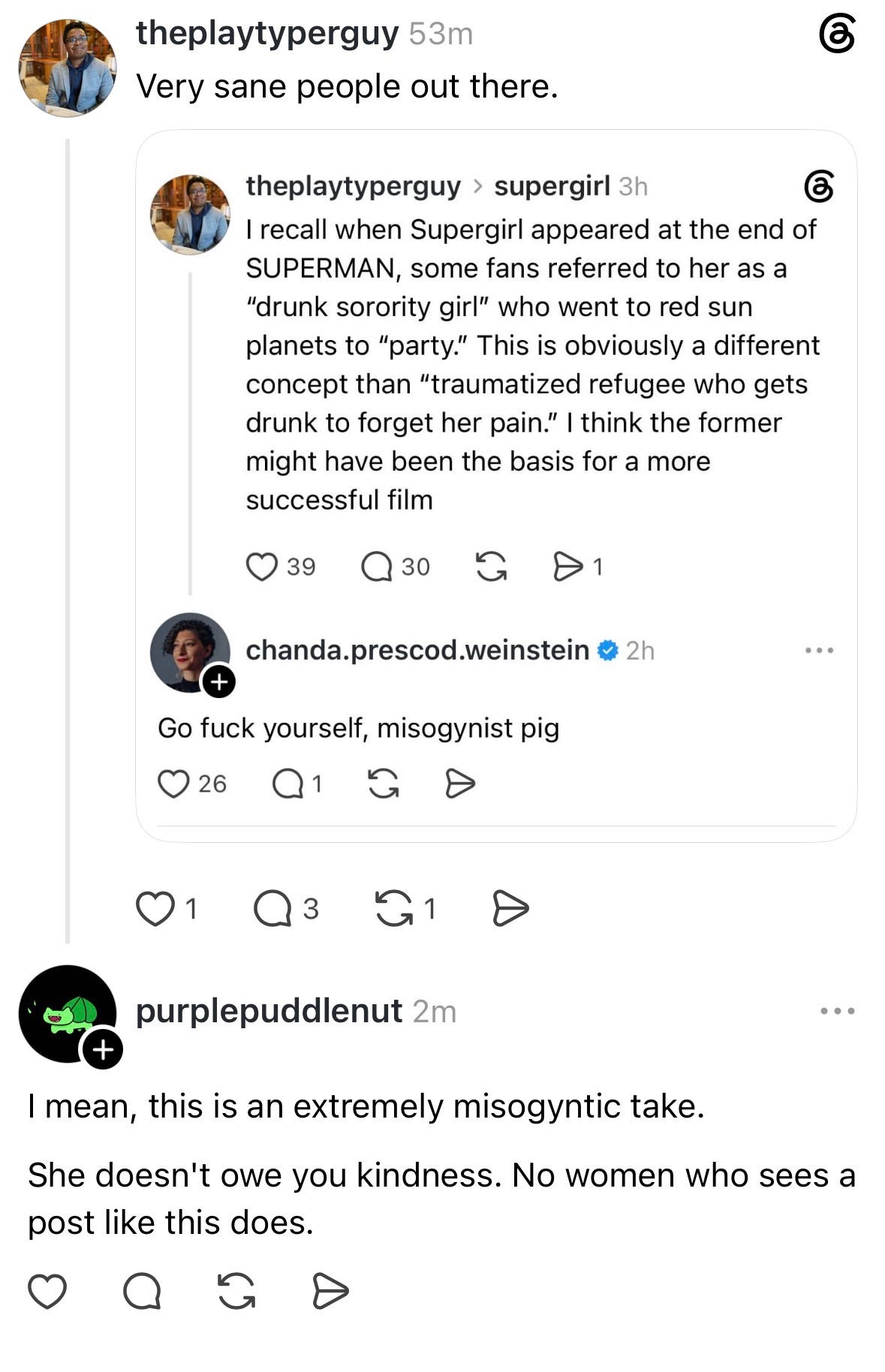
Another very stable person insisted that my post about a superhero movie was “an extremely misogyntic (sic) take. She doesn’t owe you kindness. No women who sees a post like this does.”
Of course, I don’t feel as if anyone owes me kindness. I’m more concerned about the mental health of people who scream invectives at strangers online. I know this is the internet but as Ta-Nehisi Coates observed, sometimes silence is an option. If someone expresses an opinion you don’t like, you are free to disagree and move on. However, if you can’t politely disagree with someone’s opinion about Supergirl, how can you hope to effectively engage with people who disagree with you about Israel and Gaza? The answer, of course, is that they aren’t interested in true engagement, just reflexive insults and demonization, even of actual allies, as we saw with Scott Wiener. This twisted world view contends that “if you disagree with me, you are a bad person” and bad people aren’t owed kindness, civility, or understanding.

I’ve been guilty of arguing that “social media is not real life,” and the toxic sentiments shared online, along with the abusive dogpiling, are what happens when otherwise decent people communicate in an anonymous environment. Unfortunately, how people behave online these days is a direct reflection of how they behave publicly. They’re not hiding behind online handles anymore. They’re unleashing their worst selves out into the world, and it’s dangerous.
I'm scared of where we are all heading. A while back, before twitter became a nazi bar, I had a rando tell me he would gladly shoot me because I had a different opinion from (presumably) him. I point blank asked him if he was really willing to shoot a fellow American over politics and he answered yes. A few days ago, I saw Raskin and Lawler get into a shouting match in Congress and my first thought was "we are almost at the point of someone getting beat by a cane". I have thoughts about Israel, and I don't think it's antisemitic to point out that as a nation, it is very bad, pretty much an apartheid state and I try not to vote for anybody who continues to support it. I don't think they are our ally in any sense of the word. If someone wants to call me names for that, whatever, I guess. But if you start getting physical, that's a whole different ballgame.
As far as Supergirl goes, we didn't go see it because A) movie tickets have become stupid expensive and B) I heard it was dark and murky to hide the bad visual effects. I do see your point that drunk sorority girl might be more fun and lighthearted, especially for a summer superhero movie, than a deeply troubled young woman, but I'm not sure that should end with "go fuck yourself, misogynistic pig".
But it's not just online, people have lost civility in the real world. I see so much absolutely rude ass behavior out there every fucking day now. People have stopped considering other people completely. "Greed is good" and "I got mine" have replaced "be kind" and "do unto others". I have no clue how we turn this shit around or if its even still possible.
What a lovely synthesis of two distinct threads.
I believe this exact phenomenon has left us as a culture wide-open to manipulation, particularly by well-funded state disinformation campaigns that stretch back to the first Trump campaign (and across more than a decade of EU elections). And we seem to lack curiousity or introspection into how we've been manipulated through our divisions. This is an old story: hate *is* violence, and it's self-defeating and self-perpetuating, while choosing non-violence is both hard and brave.
Parenthetically, my wife was not keen on her girls' night viewing of Supergirl. Quote: I wouldn't have been as disappointed if I hadn't expected better (based on writing and directing from previous Superman movie).