


Star Trek is consistently progressive about race but rarely confrontational. Its utopian future usually examines race through metaphor, with alien races standing in for nationalities and ethnicities (sometimes with an unfortunate essentialist implication). Actual racial differences were mostly ignored — it rarely mattered to the story that Uhura, Geordi, or Guinan were Black. Religious differences were minimized and certainly never a source of conflict.
This changed 35 years ago with the introduction of Ensign Ro Laren (Michelle Forbes) in Star Trek: The Next Generation’s creatively titled fifth season episode, “Ensign Ro.” Ro Laren is Bajoran, a race that had suffered under the brutal occupation of their homeworld by the Cardassians. This occupation didn’t end peacefully or through approved methods of warfare. The Bajoran resistance used guerrilla tactics against the Cardassians that eventually forced them to withdraw. We’d perhaps reflexively label the Bajoran resistance “terrorists.”
Occupied Bajorans were subject to forced labor while Cardassians strip-mined their home and conducted a relentless campaign of genocide against them. (And despite what John Fetterman argues, just because the Cardassians took their time, that didn’t make it any less of a genocide.) Once the Bajorans had finally (and violently) forced Cardassians off their homeland, they struggled to rebuild what little was left.
The Federation didn’t actually free the Bajorans, despite having been involved in a prolonged conflict with the Cardassian Union. Captain Jean-Luc Picard (Patrick Stewart) grimly describes the condition the Cardassians have left Bajor after their occupation: “I read about the achievements of the ancient Bajoran civilization in my fifth-grade reader. They were architects and artists, builders and philosophers when Humans were not yet standing erect. Now I see how history has rewarded them.” Note that Picard was aware of Bajor as a child, so it’s not as if the Federation was ignorant of the Cardassian occupation. It just took a Federation First approach to Bajor’s suffering. (Watch below.)
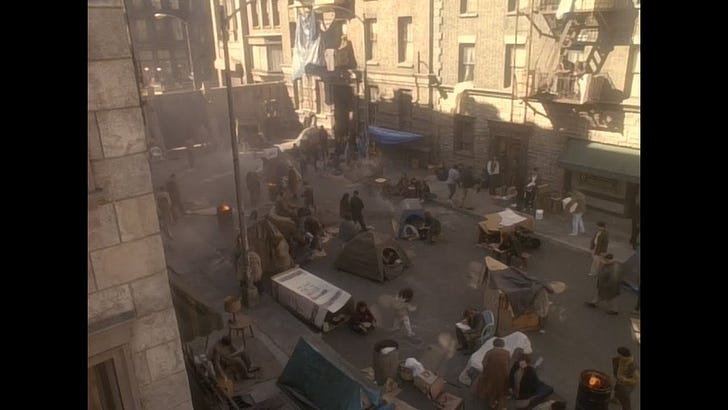
Star Trek: The Next Generation Executive Producer Rick Berman reportedly stated that the real-world inspiration for the Bajorans were “the Kurds, the Palestinians, the Jews in the ‘40s, the boat people from Haiti--unfortunately, the homeless and terrorism are a problem [in every age.]”
Others have compared the Bajorans to Black South Africans under apartheid, which had not yet ended in 1991. After all, Nelson Mandela was smeared as “dangerous terrorist leading a communist revolution” after the South African government. Mandela wasn’t even removed from U.S terror watch lists until just before his 90th birthday in 2013 (not sure how closely you need to watch someone in their 90s). Of course, the Federation maintained a cautious relationship with Cardassians. It’s not as if the Federation let a wealthy Cardassian businessman buy his way into its government.
Pro-Israel audiences have objected to the suggestion that Bajorans are like Palestinians, as that would cast Israel as the Cardassian oppressors, and Cardassians are often compared to Nazis. I personally think the Cardassian/Nazi analogue is too pat and minimizes the complexity of the Cardassian/Bajor relationship, as brilliantly depicted on Star Trek: Deep Space Nine.
In the sixth season episode “Waltz,” Cardassian military officer Gul Dukat (Marc Alaimo) offers a familiar justification for the Bajoran genocide: “On and on it went, year after blood-soaked year,” Dukat says. “Time and again I would reach out with an open hand of friendship, and time and again they would slap it away.” Yet, as his subordinate Damar replies, “The Bajorans understand a clenched fist, not an open hand.”
Dukat insists that the Bajoran resistance is wholly responsible for his brutality, as he is simply defending his own people from terrorists: “I ordered two hundred members of the resistance rounded up and executed. Two hundred lives for two hundred lives. That’s justice, not malevolence. Justice.”
Later, Dukat drops the mask and confesses to Captain Benjamin Sisko (Avery Brooks) how much he loathes Bajorans.
DUKAT: I hated everything about them! Their superstitions, and their cries for sympathy, their treachery and their lies. Their smug superiority and their stiff-necked obstinacy. Their earrings, and their broken, wrinkled noses!
SISKO: You should have killed them all, hm?
DUKAT: Yes! Yes! That’s right, isn’t it? I knew it! I’ve always known it! I should’ve killed every last one of them! I should’ve turned their planet into a graveyard the likes of which the galaxy had never seen! I should have killed them all. (Watch below.)
What’s so interesting about Ro Laren is that she exposes racial biases among our own beloved Enterprise crew. Normally, the heroes are depicted as above prejudice but in “Ensign Ro,” we see the extents of their vaunted liberalism.
When Ensign Ro beams onto the Enterprise, Commander Riker (Jonathan Frakes) orders her to remove the Bajoran earring she’s wearing as it violates Starfleet uniform code. However, the earring isn’t merely ornamental jewelry but a symbol of Bajoran religious belief. Riker’s rigidity on this point is inconsistent, as Lt. Worf (Michael Dorn) wears a ceremonial Klingon sash over his uniform, so this is very specific religion discrimination.
Later, Captain Picard misidentifies Ro as “Ensign Laren,” but Bajoran custom puts the family name first and the individual name second. Picard quickly apologizes, claiming he “didn’t know,” despite his childhood familiarity with Bajor.
“No, there’s no reason you should,” Ro ruefully admits. “It’s an old custom — most Bajora today accept the distortion of their names in order to assimilate … I do not.” Ro has put the smackdown on mandatory cultural assimilation and boldly corrected her own superior’s cultural ignorance. She’s not going to endure even the slightest “microaggression” for the sake of comity. By the way, this aired in October 1991. Around that time, there was an episode of Law & Order when Exec. ADA Ben Stone (Michael Moriarty) tells Paul Robinette (Richard Brooks) that he’ll have to decide if he’s “lawyer who was Black or a Black man who was a lawyer.” Ro has already decided that she will not subsume her heritage in furtherance of her career. There’s a gut-wrenching scene when she shares with Picard a traumatic experience from her childhood that helped define who she is.
RO: You see, Captain, when I was seven years old I was given a piece of sugar candy and I was led by a Cardassian into a room where my father was sitting. And he looked at me with eyes I'd never seen. The Cardassian began to ask him questions, and during the next two hours, as I was forced to watch, my father was tortured until he died. And I remember feeling so ashamed of him as he begged for mercy. I was ashamed of him for being weak. I was ashamed of being Bajoran. Later I began to understand how misguided those feelings were. And yet somehow, they have remained a part of me. I don't want to be ashamed of my heritage any longer, Captain. I serve the Federation. But I am Bajoran.
The Bajoran resistance had Federation enemies, as well. Admiral Kennelly (Cliff Potts) secretly plotted with Cardassians to murder Bajoran “terrorists.” His personal contempt for Bajorans blinded him to the fact that he was being duped. After Picard foils the massacre with Ro’s help, he invites her to join the Enterprise full-time: “I think you’ve got a great deal to learn from Starfleet,” Picard says, and Ro responds, “I always thought Starfleet had a lot to learn from me, Captain.” She accepts his offer but on her own terms — she puts on her Bajoran earring. She’ll serve the Federation, but she’ll always remain Bajoran.
This is yet another great bit of media meta-analysis and a ton of food for thought.
Meanwhile on this planet, I noticed at the checkout, a collector's edition of TV Guide commemorating Star Trek's 60th anniversary. It says in big letters, The Captains, exclusive interviews with Shatner, Stewart, Mulgrew and Mount. Pictured are three captains, guess who didn't make the cover?