


It’s not unusual to see self-proclaimed “common sense” Democrats publicly lamenting that their party has lost its way: “Can you believe that 30 years after Bill Clinton or almost 20 years after Barack Obama, Democrats are nominating radical socialists?” This amuses me because I’m middle-aged enough to remember when both Clinton and Obama were condemned as radicals who would ruin America as we (well, not me personally, but much whiter people) knew it.
In Bill Clinton’s case, there were early concerns that he was primarily “an artificial creation by the press” who wasn’t fully vetted — yes, that should sound familiar. A January 1992 Time magazine piece asked, “Is Bill Clinton for real?”
Journalistic pundits are constitutionally incapable of confessing that they have no idea what will happen in a presidential race; they are irresistibly driven to impose some sort of structure on the most shapeless contest. Last year many were looking for someone to cast as the principal rival to presumed front-runner Mario Cuomo. They came up with Clinton partly because he seemed the perfect foil to a Northern Big Government liberal: a Southerner who took many moderate stands — on education and welfare reform, for example — and talked constantly about the “responsibility” of people who receive government benefits to do something in return.
Then, too, many journalists had repeated until it became conventional wisdom the idea that the Democrats have lost five of the past six presidential elections largely because they had become identified as a party of the poor, blacks, labor unionists, radical feminists and other special interests. Supposedly they could win again only if they chose a candidate moderate enough to win back middle-class voters, especially Southern whites.
After humiliating Democratic losses in 1984 and 1988, center-left/moderate Democrats believed Clinton offered a more “electable” path for the party — although there were those pesky adultery rumors. (Check out this ad that claims Clinton bravely “stood up to the tabloids and false attacks and shown real character.”)
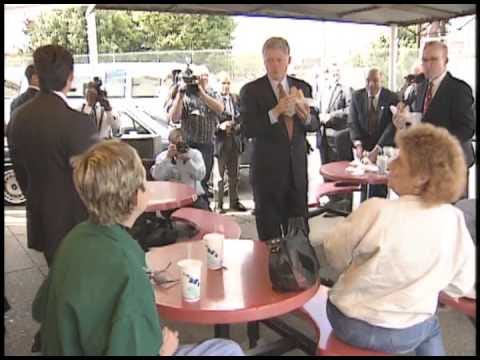
Clinton’s opponents attacked his character, suggesting he was a draft-dodging hippie compared to war hero President George H. W. Bush. This wasn’t just Republicans. Even prior to clinching the presidential nominations, Democrats had expressed serious concerns about his character. “Rarely if ever have party voters approached their choice with so many misgivings,” George J. Church wrote in Time. “Only 50% of New York Democrats questioned as they left primary voting booths said Clinton had the honesty to be President; 46% thought he did not. That was only a bit higher than the proportion expressing qualms in exit polls in earlier primaries.”
Predictably, though, Clinton’s many character flaws were less a drag on his campaign than public reaction to his wife, who you might recall is Hillary Clinton.
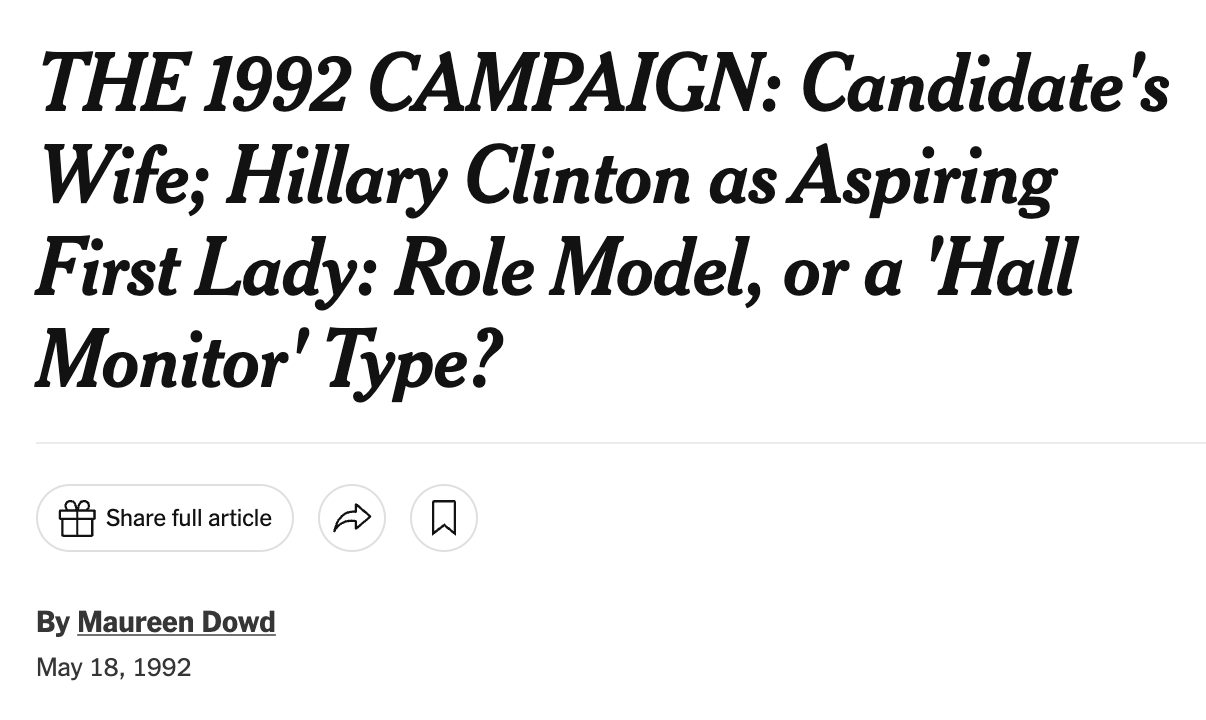
“[Hillary Clinton] has become a paradigm of the over-structured super-mom,” New York Times columnist Maureen Dowd wrote in May 1992. “A recent New Yorker cartoon showed a woman asking a salesclerk for a jacket and saying, ‘Nothing too Hillary.’”
Even among women who are Mrs. Clinton’s natural constituents, there is criticism about what they call “the Hillary situation.” Some leading Democratic women privately worry that, while Mrs. Bush may be the last of the First Ladies who have never worked outside the home, the public is still skittish about the idea of a First Lady who is more involved in substance than ceremony.
These critics say that the Clintons may have pushed too hard on the concept of an unprecedented partnership in the White House, and suggest that they should wait until after the election to break precedents.
It’s hard to overstate just how “radical” Hillary Clinton was viewed in 1992. Republicans took aim at her position on children’s rights. Noted bigot Pat Buchanan claimed at the Republican National Convention that Hillary believed “12-year-olds should have a right to sue their parents,” and that she had “compared marriage and the family as institutions to slavery and life on an Indian reservation.”
Hillary Clinton attempted to counter her supposed “radical left wing” image by insisting that she was actually “conservative, not liberal” on some key issues, including the death penalty and parental notification for abortion. She’d later observe, “I sometimes think that I didn’t leave the Republican Party, as much as it left me.” This pleased no one.

Conservatives accused Hillary Clinton of promoting Marxist ideology with her 1996 book It Takes a Village: And Other Lessons Children Teach Us. They tried to link her to left-wing community organizer Saul D. Alinsky. David Brock called Clinton “Alinsky’s daughter” in his 1996 biography The Seduction of Hillary Clinton. (They are no actually related.) The late Barbara Olson took this to an absurd level in her 1999 book, Hell to Pay: The Unfolding Story of Hillary Rodham Clinton, where she opened each chapter with an Alinsky quote. Olson argued that the Clintons had buried her college thesis about Alinksy because she “does not want the American people to know the extent to which she internalized and assimilated the beliefs and methods of Saul Alinsky.”
Although the young Hillary Rodham criticized Alinsky’s “anachronistic” tactics, she praised him overall: “Much of what Alinsky professes does not sound ‘radical.’ His are the words used in our schools and churches, by our parents and their friends, by our peers. The difference is that Alinsky really believes in them and recognizes the necessity of changing the present structures of our lives in order to realize them.”
Bill and Hillary Clinton weren’t radicals who burned their draft cards and bras as college students in the 1960s but neither were they rigid traditionalists who studiously avoided any position that could damage a future political career. Today’s center-left moderates might prefer candidates who kept their heads down and avoided any potential controversy in college, but that doesn’t describe the Clintons.

Yet, it was entirely predictable that less than a decade after the Clintons left the White House, Hillary Clinton’s presidential campaign also tried to paint Barack Obama as an unelectable lightweight candidate who was “unvetted.” In February, when the Clinton campaign discovered there might be something to this Obama guy, chief strategist Mark Penn issued a press release detailing all the reasons Clinton was more “electable” than Obama. The tune should sound very familiar.
So how much do independent voters know about Barack Obama, his voting record and his past positions? Even less than Democrats know. For example, he recently told voters in Idaho that he favors the Second Amendment - but he didn't mention that, in the past, he supported a complete ban on all handguns. If he were the nominee, the Republican attack machine would have immediately rolled out his full record - and his independent Idaho support would have evaporated. So far, the Republicans have been laying low. Sen. Obama has never faced a credible Republican opponent or the Republican attack machine, so voters are taking a chance that his current poll numbers will hold up after the Republicans get going.
During a primary debate, Hillary Clinton suggested a questionable link between Obama and William Ayers of the Weathermen. She suggested their past meetings were part of a “larger set of concerns about how we’re going to run again John McCain.”
In April 2008, Clinton seized on Obama’s controversial comment suggesting that George W. Bush’s crappy economy had made working-class voters “bitter.” (She’d later raise that “bitter” with a “deplorable” in 2016.)
“I was taken aback by the demeaning remarks Sen. Obama made about people in small-town America,” she said. “Sen. Obama’s remarks are elitist and they are out of touch. They are not reflective of the values and beliefs of Americans. Certainly not the Americans that I know.”
The whole “Black voters are the base of the party” mantra kicked in with the 2016 primary but in 2008, when Hillary Clinton lost Black voters decisively to Obama, she and her surrogates questioned Obama’s general election viability with white voters.
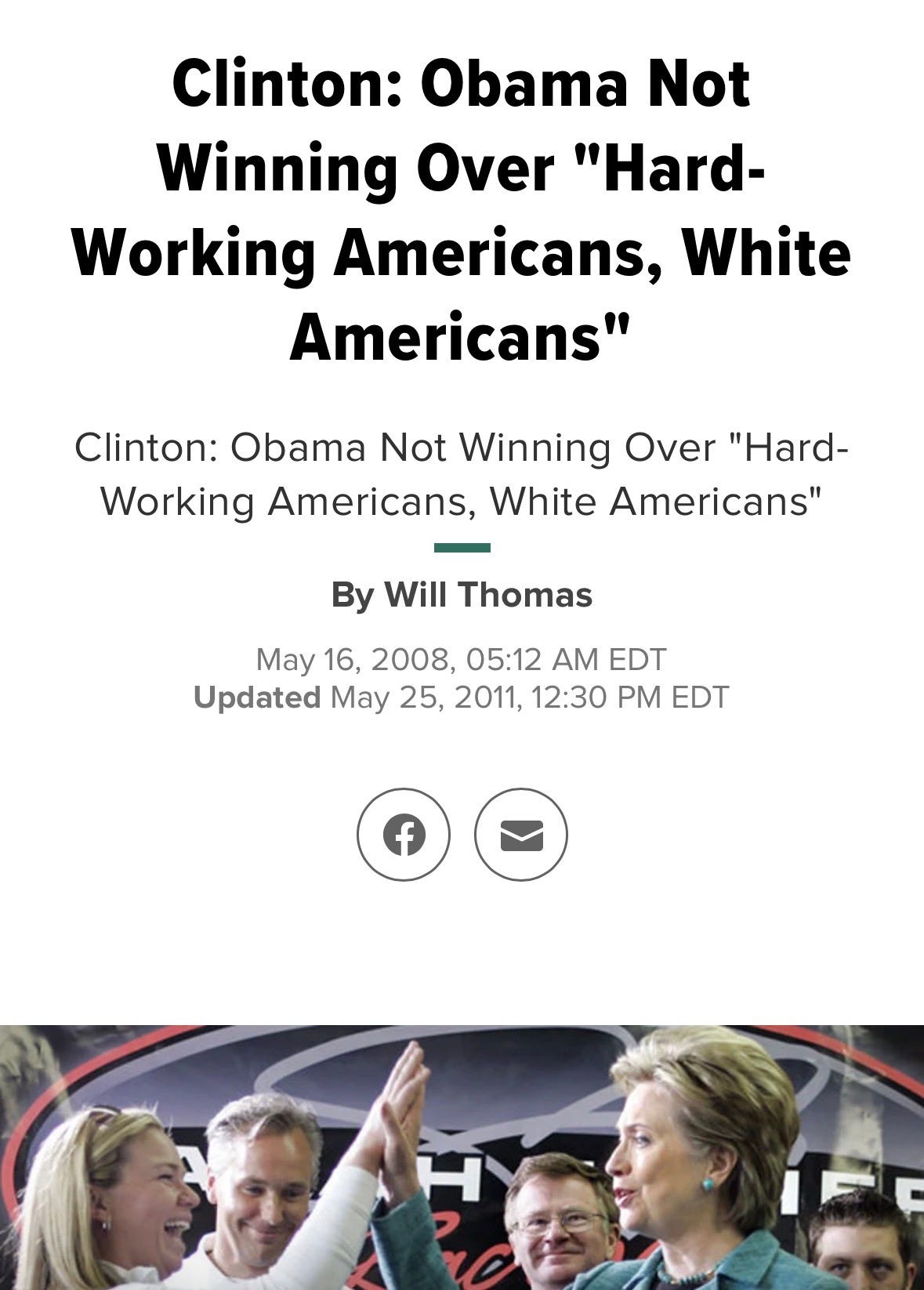
“I have a much broader base to build a winning coalition on,” Hillary Clinton told USA Today in May 2008, when Obama had all but locked up the nomination. Clinton eagerly pointed to an AP article “that found how Sen. Obama’s support among working, hard-working Americans, white Americans, is weakening again, and how whites in both states who had not completed college were supporting me.”
Self-described “common sense, pragmatic” Democrats have been questioning the electability of other Democrats for decades now, and they’ve consistently been proven wrong. The candidates who defy convention, who reject the past, are the ones who succeed.
I imagine a lot of the foothold "centrist" Democrats have (though I argue there are far fewer of them now as the party has demonstrably moved leftward) is because in American political science there's extreme focus upon rural/small town 'blue collar' workers. It's also a great dynamic to cast against urban, diversity-loving liberal. We're always meant to lionize blue collar workers only; this is also part of the long-term project to demonize people who went to college...especially those in the humanities.
This is why even though James Carville isn't really relevant when it comes to policy that Democrats advance, he's still going to get booked on shows. Because he's really one of the last of his kind and that works out well for ownership in mass media (who want Democrats to argue for Republican positions). This also helps for controversy points as it's easy to say Bill Clinton especially is a very bad man, and as Carville has the Clinton stink he also makes for a perfect foil to book on shows. I suspect this is part of why people constantly book Donna Brazile too.
The Democratic Party is definitely moving left, and that's a trend that has continued as the party loses seats in unreconstructed territory, so it'll be an urban coastal rump party due to the way the U.S. is organized.
God, I hate that “hardworking” cliche as much as I hate the “kitchen table” cliche. Whenever someone refers to hardworking Americans around the kitchen table, I know they’ve traded their critical thinking skills for a skull full of mush. Meanwhile, from what I’ve seen, Mamdami is the most skillful politician of his generation. It’s a shame he can’t be our president. Republicans have pushed the Overton window so far to the right, any sensible use of government for the people
is decried as communist.