


David Crowley is the Democratic nominee for Wisconsin governor. This was hardly an “upset” victory, even though polls showed Francesca Hong leading Crowley by as much as 20 points. Polls are often misleading, especially when they are only superficially reported. For instance, although Hong had a significant lead in polls, the number of undecideds was large enough for Crowley to make a “comeback.” Hong won 39.4 percent of the vote last Tuesday, which was pretty consistent with her polling average. After Mandela Barnes dropped out, Crowley consolidated his share of the vote, along with most undecideds.
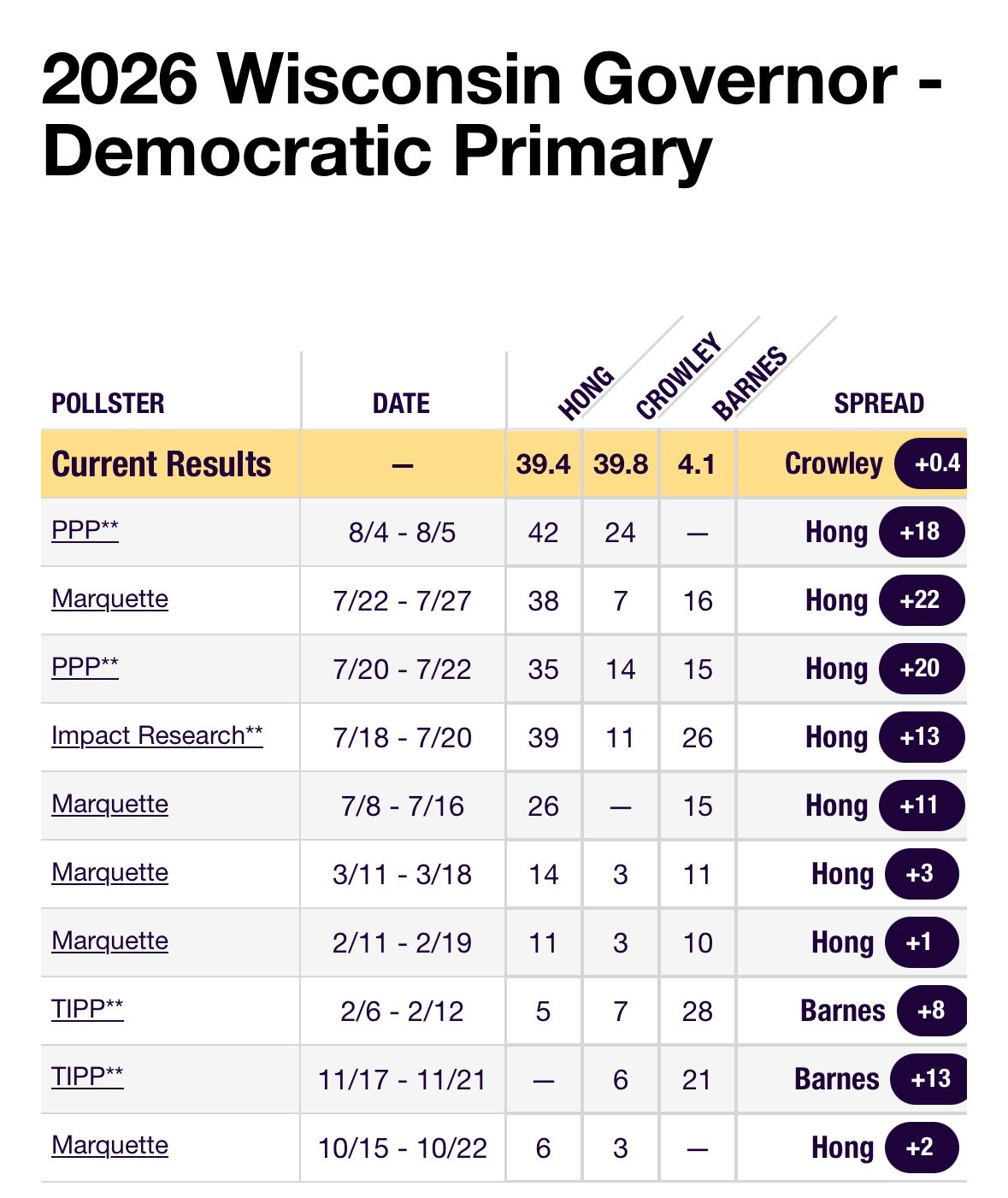
Even in Hong’s best poll, she hadn’t reached 50 percent, so the non-DSA vote was more than enough for Crowley to win. This misreading of polling is hardly new. Back in 2016, Democrats were so convinced that Hillary Clinton would curb stomp Donald Trump that they openly scoffed at any suggestion that Trump could break the “Blue Wall,” and when Trump narrowly won the Electoral College, most liberals lamented that the polls had been wrong. This wasn’t the case.
In Pennsylvania, Clinton had Real Clear Polling average lead of 2.1 points. In Michigan, it was 3.6 points, and in Wisconsin, her polling average lead was 6.5 points. Were the pollsters all drunk? No, the problem was that we looked at the polling lead rather than the polling numbers themselves. In Pennsylvania, Clinton averaged 46.8 percent to Trump’s 44.7. In Michigan, Clinton was at 47 percent to Trump’s 43.4, and in Wisconsin, Clinton’s average was 46.8 percent to Trump 40.3. You’re all smart people or at least have access to a calculator app, so you’ve noticed that none of these numbers add up to 100 percent.
In Pennsylvania, Clinton’s actual performance on Election Day was 47.46 percent (slightly above her average). In Michigan, it was 47.27 (again just above her average), and in Wisconsin, she finished with 46.45 (just slightly below her average). She lost all those states because Trump over performed his own polling averages, but like with David Crowley’s “comeback,” this was not a polling “miss.” It was always possible, as Nate Silver argued at the time to much liberal frustration.
“The electoral math is less solid for Clinton than it was for [President Barack] Obama four years ago,” Silver told George Stephanopoulos in 2016. Clinton supporters online were openly annoyed that Silver had rated Obama’s chances of victory against Mitt Romney much higher than he had Clinton’s chances of defeating Trump, a diseased maniac. This wasn’t gender bias or outright Clinton hatred. Obama’s polling average in key swing states was closer to the magic number of 50 percent: In Pennsylvania, Obama’s average was 49.4 to Romney’s 45.6. In Michigan, he was at 49.5 percent to Romney’s 45.5, and in Wisconsin — the home of Romney’s running mate, Paul Ryan — Obama was at 50.4 to Romney’s 46.2. A bullish case for Romney always depended on an actual polling miss, and the Romney campaign’s own heavily skewed internal polling had him winning Florida and Virginia, along with other key swing states. However, the bullish case for Trump in 2016 simply required that a surge of undecided voters break his way. This happened not just in 2016 but 2020 and 2024, as well.
Silver cautioned in 2016, “If Clinton were to beat her polls by three points, you see something we call a borderline landslide. But if it goes the other way ... all of a sudden Trump could very easily win the Electoral College.”
That was the dilemma for Democrats in the aftermath of Trump’s first catastrophic victory. They believed a Clinton landslide was what the polls clearly promised, when that outcome would’ve been just as much an “upset” as Trump’s actual victory.
This happened again in 2020 when Democrats thought the polls predicted a Joe Bien landslide victory. Instead, he narrowly won the Electoral College after a few nail-biting days. Once again, late deciders broke heavily toward Trump. In 2020, 11 percent of the electorate — a disturbingly large number — didn’t make up their minds until October or later, and Trump won this dithering demographic by 16 points. Late deciders were 16 percent of the electorate in 2024, and they broke for Trump 57 percent to Harris’s 39 percent. (Harris campaign manager David Plouffe claimed on social media the Friday before the election that late-deciding voters were “breaking by double digits” for Harris. Perhaps he was looking at the same data as Romney’s 2012 campaign. Campaigns should really stop hiring False Hope Polling Inc.)
It’s understandable that most Americans misread polls. Not everyone’s a statistician. The media doesn’t help the situation when they run stories with headlines such as “Francesca Hong opens up 22-point lead in Wisconsin.” There’s a big difference between leading a race with 62 percent of the vote to your opponent’s 38 percent, leading with just 38 percent, even if your closest rival is lagging behind at 16 percent.
Too often prediction market accounts online are treated as actual news. Last week, on Election Day, Kalshi Politics declared that the Wisconsin Democratic governor nominee odds were 95 percent for Francesca Hong and just five percent for David Crowley.
Someone winning with just five percent odds isn’t impossible. However, no objective reading of the data would’ve put Crowley’s odds that low. This was not a race where Hong was averaging 50 percent or more and the surveyed voters said there was little chance they’d change their minds. No, about 34 percent of primary voters were undecided. That’s not a settled race, and the odds that Crowley — who had the endorsement of siting Gov. Tony Evers — would flip a critical mass of undecideds in the final hours of race were much greater than five percent. Hong was always the true dark horse candidate, but that reality doesn’t suit the prevailing narrative.
That’s why we shouldn’t take too much comfort in our candidate having any lead where they’re not breaking 50% in a two way race—and a corollary to that is the hyperventilating over a candidate we oppose having awful approval ratings (eg “look, McConnell is at 40% approval in deep red Kentucky! Donate to our liberal college professor opponent who can win over the 60% who do not approve!”). It’s worth delving into WHY those swingers don’t approve (turns out a lot of conservatives hated Mitch McConnell for not being nasty enough to Democrats and sure won’t vote for Professor Woke).
Have Democrats put much thought into why so many late breaking undecideds broke for Trump? Might be useful analysis, more so than focus grouping egg price messaging.
Now it will come time for FUD to be thrown about Crowley as we pivot to the general. The job is not done, and everything we've seen shows that it *matters* when Democrats are in office.
But of course, people need an excuse...any tiny one will do...to vote for the unreconstructed party. So let's make sure that we have the best chance of victory and everyone go vote!