


Marvel announced its new X-Men movie cast last week, and of course, Sadie Sink is starring as Jean Grey, fresh off her amazing performance in Spider-Man: Brand New Day. Adam Driver revealed he’s playing X-Men foe, Mr. Sinister, who was a big deal in the 1980s when I started reading the title. He even appeared in a 1994 Chef Boyardee commercial, when he attempts to turn the X-Men into pasta — a step up in quality for Chef Boyardee. (Watch below.)
Fans had speculated that Driver might play the MCU’s Magneto, after Ian McKellan’s likely farewell performance in Avengers: Doomsday. This has led to debate about Magneto’s backstory. In the comics and the 2000 movie, it was established that Magneto was a Holocaust survivor. Obviously, the Holocaust was more than 80 years ago, but there are any number of ways to explain why Magneto is still alive and vibrant in 2026. One of the X-Men can literally control the weather. However, I think Magneto will probably have a very different backstory when he appears in the MCU.
Magneto is a Jewish Holocaust survivor who is also a supervillain terrorist who believes he’s a member of a master race. That is a level of irony I think Marvel will want to actively avoid in today’s heated politics. You can imagine the accusations of anti-semitism, most vocally from people who never read the comics and assume that this is a pro-Palestinian, leftist smear from “woke” Hollywood.

In 2000, the average viewer wasn’t as tuned into the Israel-Palestinian conflict. Magneto as a Holocaust survivor read as a straightforward metaphor for mutants as a minority group society feared and oppressed. Yet, it was always more complex than this in the comics.
For instance, in Uncanny X-Men No. 150, Magneto demands that the world’s leaders cede total political control to him or he’ll destroy the Earth. (Like Luigi Mangione, this makes him a stochastic terrorist, not a man of the people.) The X-Men, as usual, set out to stop him, but this time, they have new recruit Kitty Pryde, who like Magneto is Jewish. When Magneto almost kills Kitty, he breaks down in horror and delivers a classic “What have I done? What have I become?” monologue. (Read below.)
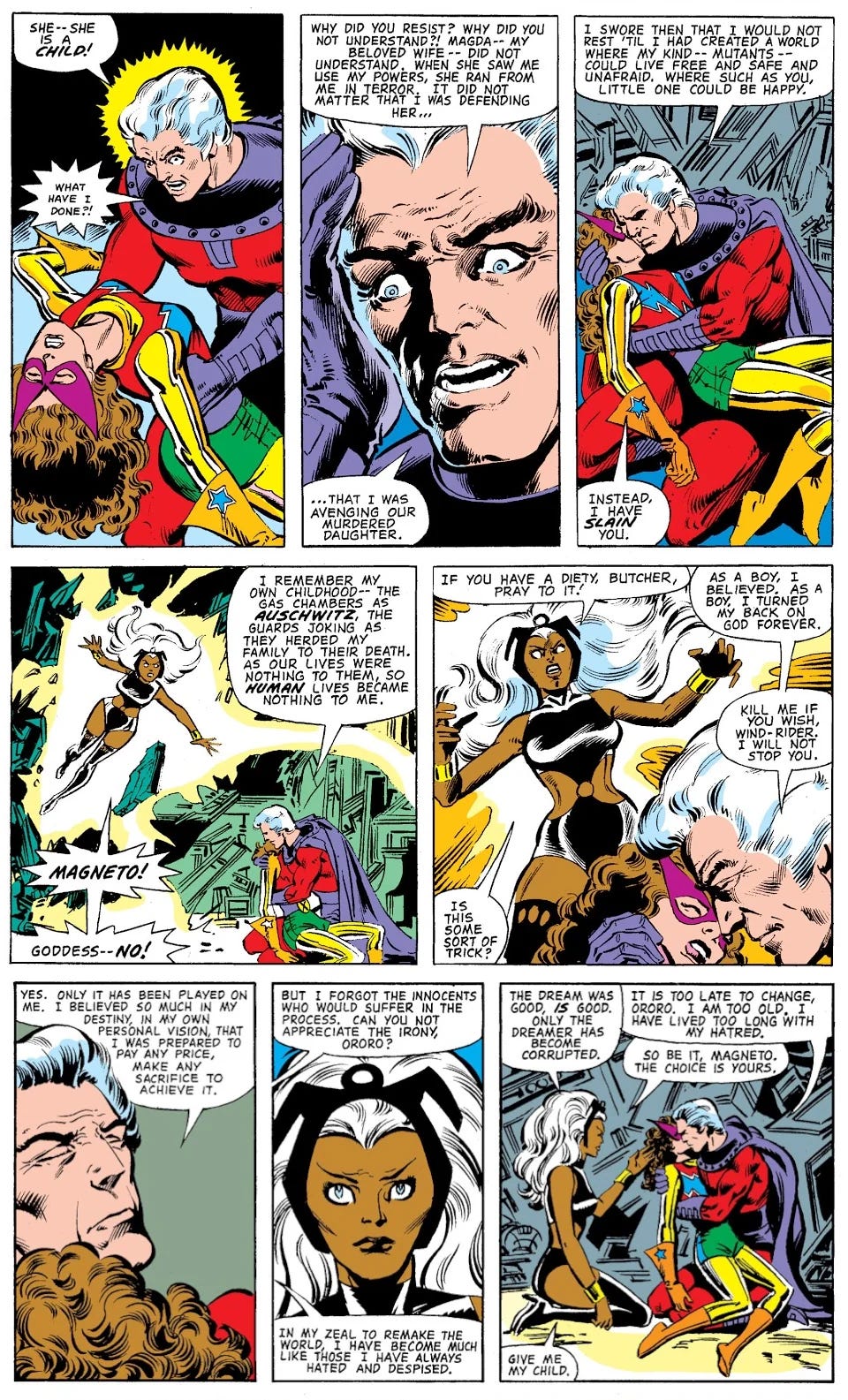
“Why did you resist?” Magneto asks the unconscious 13-year-old girl. “Why did you not understand? Magda — my beloved wife — did not understand when she saw me use my powers. She ran from me in terror. It did not matter that I was defending her.”
He goes on: “I swore then that I would not rest ‘til I had created a world where my kind — mutants — could live free and safe and unafraid, where such as you little one could be happy.”
Of course, Magneto and his Brotherhood of Evil Mutants — including my beloved Scarlet Witch — had previously invaded a South American country and terrorized the populace into submission with a goose-stepping army. Granted, they were an illusion, but Magneto was leaning into fear. Scarlet Witch asks her father (yeah, that’s complicated), “But is it necessary to plant such fear in the hearts of the people, Magneto?” and he responds, “Of course! Humans are like sheep! They respond to certain stimuli — and FEAR is one of the most potent.”
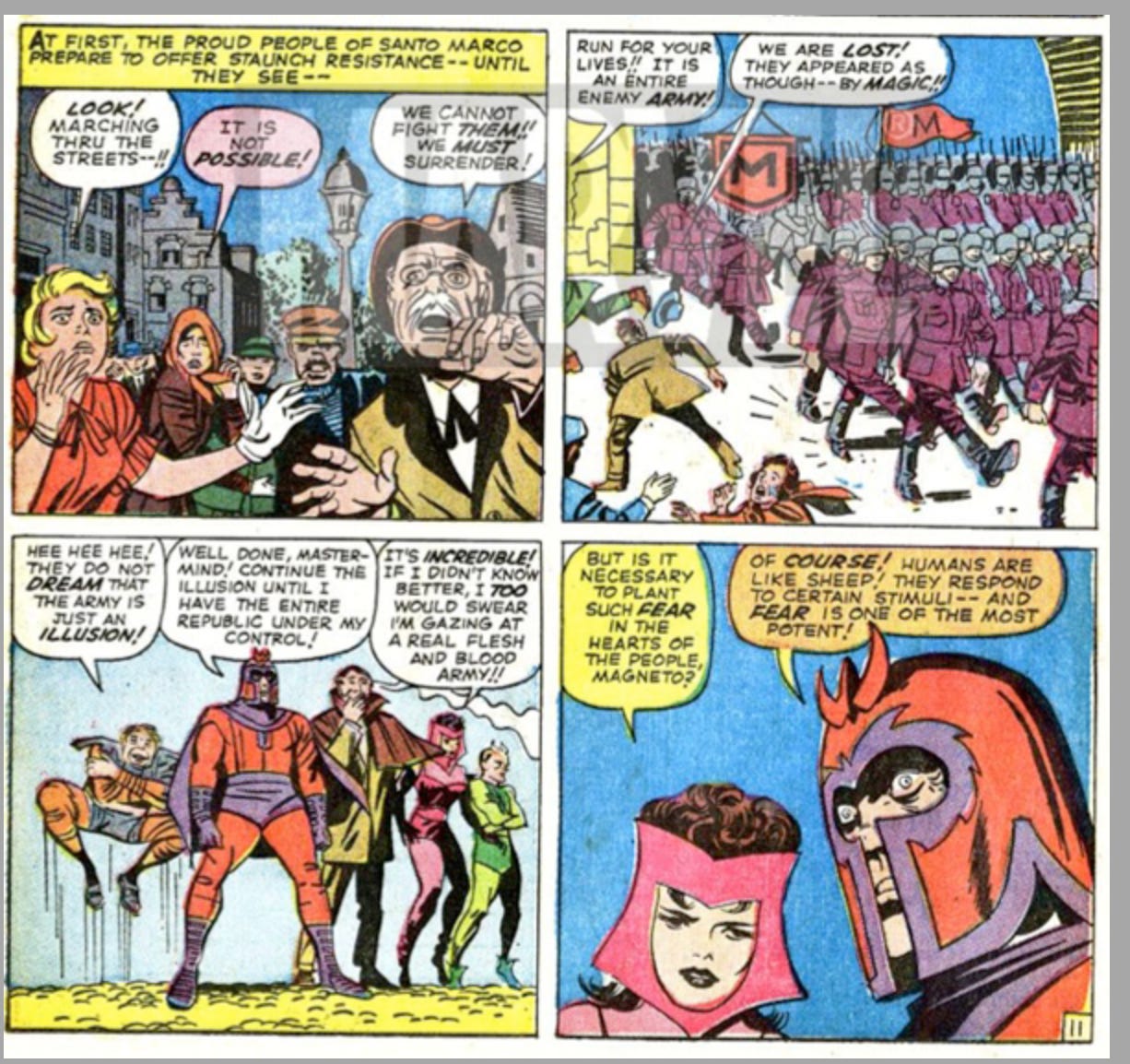
X-Men co-creators Stan Lee and Jack Kirby were both Jewish, and they clearly depicted Magneto as a racial supremacist with a jones for genocide. He was not “defending” himself against humanity. He actively sought to oppress them. Chris Claremont, who’s also Jewish, introduced the version of Magneto most fans know. Claremont claimed that his inspiration was Israeli Prime Minister Menachem Begin. Prior to Israel’s creation as a Jewish state, Begin was the leader of the Zionist militant group Irgun, which bombed the British administrative headquarters for Mandatory Palestine in Jerusalem in 1946 and attacked the Deir Yassin village in 1948, killing 107 Palestinian Arab villagers, including women and children. He later shared a Nobel Prize with Anwar Sadat, so I guess Donald Trump shouldn’t give up on that particular dream.
Claremont’s Magneto believed Xavier’s X-Men were submissive fools in the face of human oppression. His perspective is uncomfortably similar to people like Jonathan Greenblatt from the ADL, who’s stated that pro-Israel Jews won’t be anything like the supposed “Jews of trembling knees.” Thus, Magneto’s moral epiphany comes when his fanaticism almost kills a fellow Jew, a mutant who belonged to a team he’d long held in contempt.
Claremont directly links Magneto’s villainy to his tragic past: “I remember my own childhood — the gas chambers at Auschwitz, the guards joking as they herded my family to their death, as our lives were nothing to them, so human lives became nothing to me … In my zeal to remake the world, I have become much like those I have always hated and despised.”
Thus, the abused became the abuser … no, that would not be received well today.
The core conflict between Magneto and X-Men leader Charles Xavier is that Xavier believes humans and mutants can co-exist (a peaceful solution involving perhaps two states) and Magneto believes humans can never be trusted, are overall inferior, and mutants should rule over them. So, no, I doubt the Marvel Cinematic Universe will make its new Magneto a Jewish Holocaust survivor, especially since audiences might view Claremont’s “freedom fighter” version of Magneto very differently in 2028.
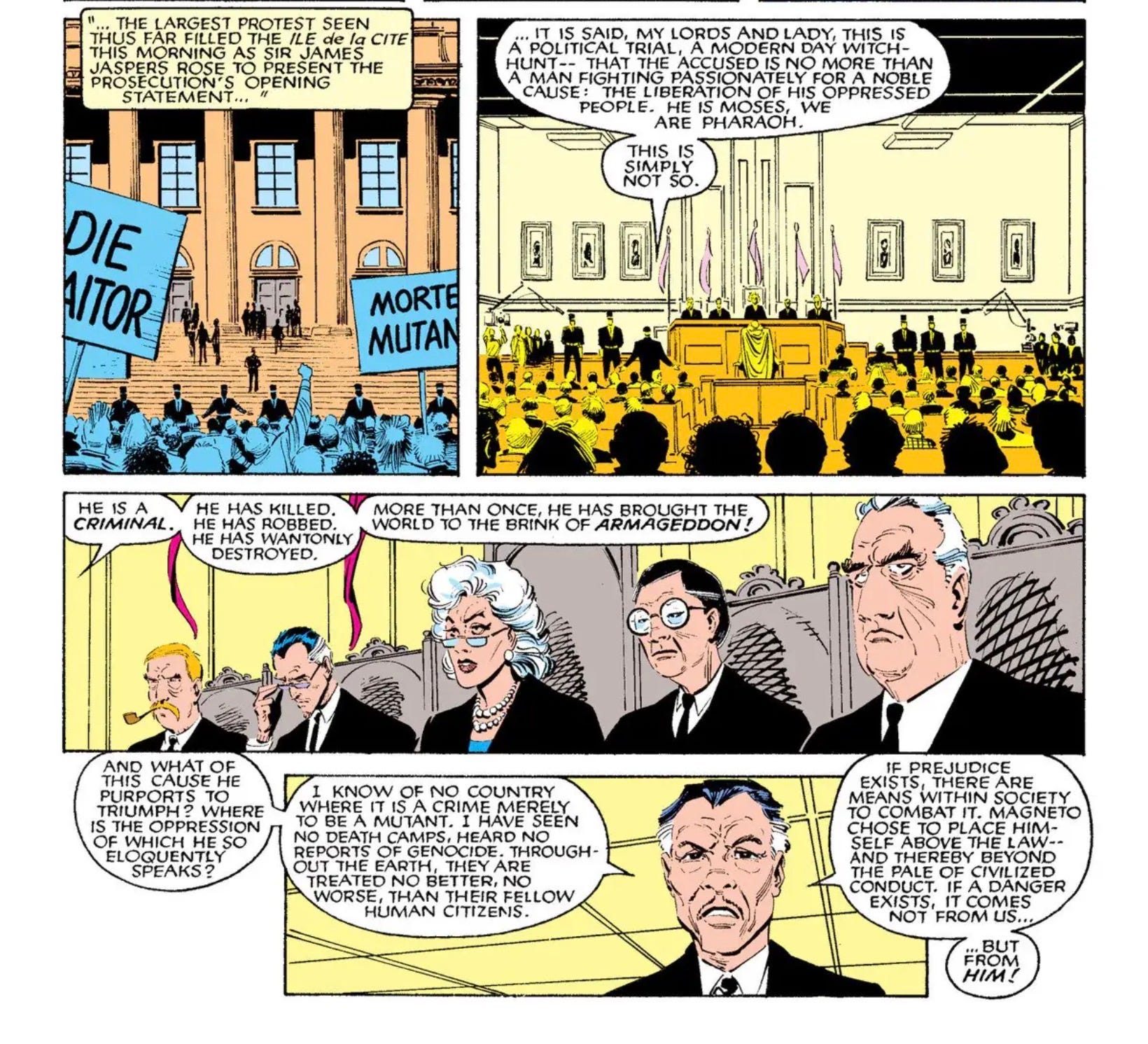
When placed on trial in X-Men No. 200, the prosecution declares in its opening statement, “It is said … that the accused is no more than a man fighting passionately for a noble cause: the liberation of his oppressed people … This is simply not so. He is a criminal. He has killed. He has robbed. He has wantonly destroyed. More than once, he has brought the world to the brink of Armageddon. And what of this cause he purports to triumph? Where is the oppression of which he so eloquently speaks? I know of no country where it is a crime merely to be a mutant. I have seen no death camps, heard no reports of genocide.”
Yes, Magneto’s prosecutors scoffs at the very idea of a mutant “genocide,” even as giant robots hunt them down. The Sentinels are just humanity asserting its right to exist. Marvel won’t risk depicting a sympathetic Magneto who also reads like a Hamas terrorist.
You might argue Magneto’s heritage is critical to the character, but I’d remind you that the comic-book Scarlet Witch is half-Jewish and half-Romani. Marvel didn’t consider that relevant, as Elizabeth Olsen’s Wanda Maximoff comes from the fictional nation Sokovia, where everyone’s vaguely European accent comes and goes.
The MCU has studiously avoided any real world political references — especially those involving other nations, as the international market is particularly lucrative for comic book films. Captain America: The First Avenger (2011) scrubs the Red Skull’s Nazi background. Johann Schmidt (Hugo Weaving) is the leader of Hydra, a fictional terrorist organization that has infiltrated the Nazis. He’s not personally a Nazi, and white supremacy is not his primary motivation. He even tells Captain America: “I have seen the future, Captain. There are no flags.” Conversely, the comic book Skull used Hydra to further Nazism. That was the flag he’d plant in the very heart of a free society.
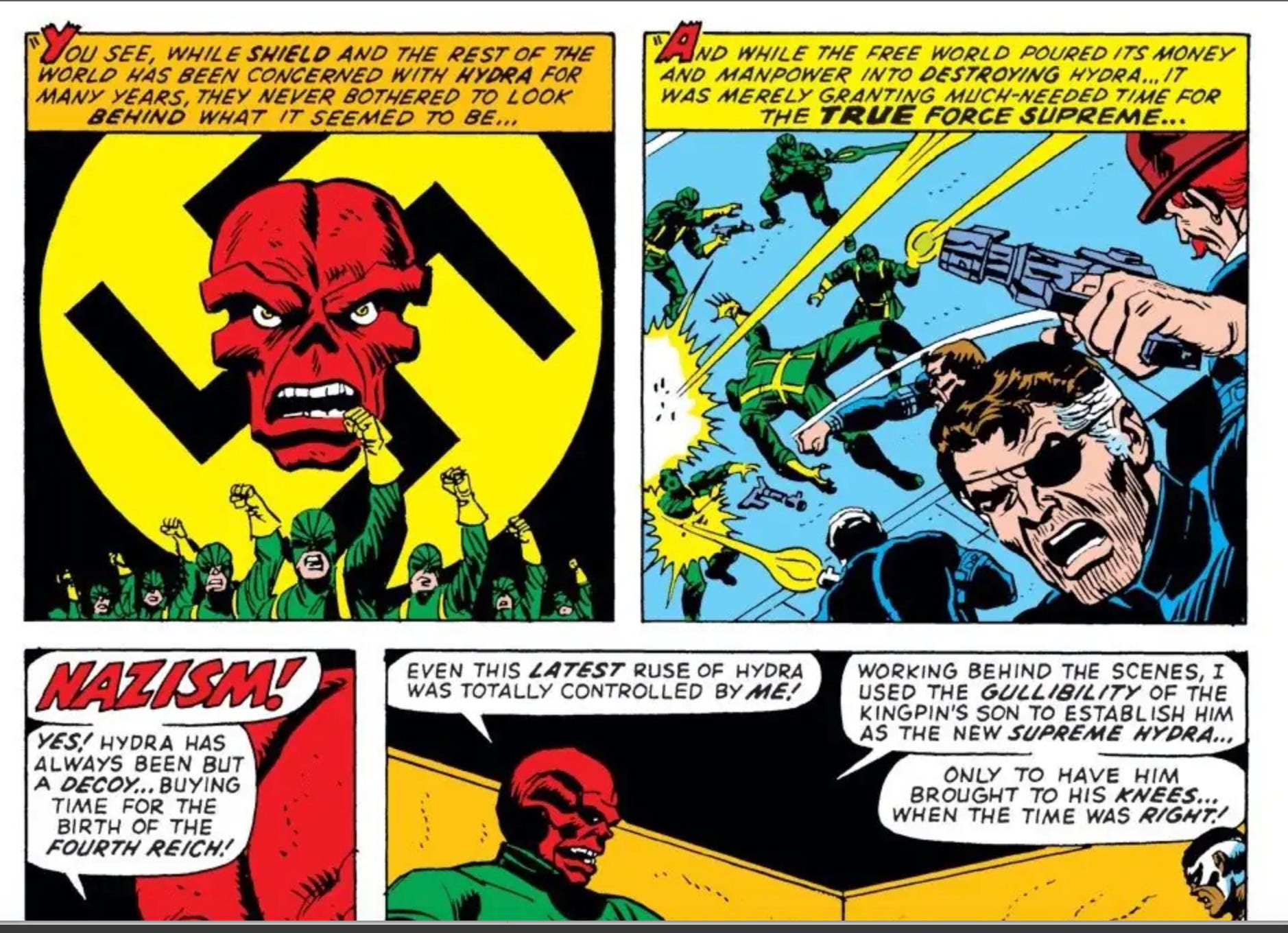
Marvel probably (correctly) assumes that a German-accented Nazi villain who wants to establish a “Fourth Reich” won’t play well in Europe. The MCU would later reimagine Baron Zemo (Daniel Brühl) as a Sokovian nobleman without his comic book Nazi ties. He’s quickly established as a white supremacist in his first appearance (Captain America No. 168) when he tells Sam Wilson, “So, Black man, you sneaked up on me from behind. Precisely the kind of tactics I should have expected from your kind.” However, MCU Zemo bonds with Sam (Anthony Mackie) over Marvin Gaye.
This isn’t restricted to villains, either. The Israeli superhero Sabra is significantly altered for her MCU debut in Captain America: Brave New World. A former Black Widow assassin, Ruth Bat-Seraph (Shira Haas) is no longer a Mossad agent who wears a costume that prominently displays elements of the Israeli flag. Instead, she works for the U.S. government.
So, when Ian McKellan’s Magneto appears in Avengers: Doomsday, it wouldn’t shock me if there are no direct references to his backstory. These are very different times, and the next Magneto will probably reflect them, for good or for ill.
Man…I wish I could like this post several times! This a conversation that needs to happen BEFORE we get to Magneto. Especially as I just read, right before, someone making a case FOR Zionism using the X-Men )and getting some crucial facts wrong).
This is a very interesting analysis. I had no idea (or completely forgot) about the existence of Mr. Sinister.
One thing your work shows me...there are a lot of surprising layers in comic books...even for the time they were made.