


The news that Sir Patrick Stewart has died shook the world on Thursday. There was something about the actor that felt eternal, and it’s true that his work will continue to inspire and provide comfort for us all.
A classically trained stage actor, Stewart gained international stardom in his late 40s when he was cast as Captain Jean-Luc Picard in Star Trek: The Next Generation. Now, it’s easy to take the series’s success for granted, but when it premiered in 1987, it could have easily fizzled out and vanished into obscurity, like so many attempts at capitalizing on Boomer nostalgia for the 1960s (e.g. The Munsters Today, The New Leave It To Beaver, as well as The Twilight Zone and Mission: Impossible reboots).
Star Trek: The Next Generation famously had a rocky start. Its first two seasons are, charitably speaking, uneven. Although, my wife and I have started rewatching the series as a family with our 12-year-old son, who was hooked from the start. Even at its lowest point in those early years, Stewart stood out as Jean-Luc Picard, who was French but maintained Stewart’s English accent. (The future is not Francophile.) Picard as a character is the ultimate counter argument to any current whining from the usual suspects that modern Star Trek has gotten too “woke.”
Patrick Stewart as Jean-Luc Picard, captain of the famed Enterprise, was a daring statement for American television in 1987. Picard wasn’t Rambo, Terminator, or even John McClane. (Although he nonetheless looked great in a speedo, if you remember the episode “Captain’s Holiday.”) He was educated (he read actual physical books), cultured (Picard shared Stewart’s love of theatre), a leader who resolved challenges through diplomacy rather than brute strength. (Picard was an archaeologist, as well, reinforcing that space travel was for him a way to expand his knowledge of other civilizations and cultures, not just subdue them.) As captain, Picard set an example that connected with and nurtured the best instincts of his crew.
Stewart made you believe, as Picard did, that humanity could “outgrow its infancy.” The trickster Q (John de Lancie) once joked that he visited the Enterprise simply to hear Picard’s speeches, but that’s why I tuned in every week. Picard was a role model who didn’t puff out his chest and try to prove himself through brute force. He constantly demonstrated the humility at the core of true wisdom. Even after a sinister alien race erased the Enterprise crew’s memory and tried to trick an amnesiac Picard to wipe out their enemies for them, he held firm: “I do not fire on defenseless people.” If he forgot everything else, Jean-Luc Picard remembered that. (Watch below.)
The PlayTyperGuy is supported by paid subscribers. Please become one!

Patrick Stewart did become a middle-aged action hero in a fashion when The Next Generation made the leap from TV to feature films. In 1996’s First Contact, Picard fights the Borg with guns blazing and not the phaser variety. Yet, there’s still vulnerability at the core of his performance.
“I will not sacrifice the Enterprise,” Picard tells Lily Sloane (Alfre Woodard), who’s compared him to the doomed Captain Ahab. “We've made too many compromises already; too many retreats. They invade our space and we fall back. They assimilate entire worlds and we fall back. Not again. The line must be drawn here! This far, no further! And I will make them pay for what they've done!”
The Borg had personally violated Picard, and his rage is understandable. However, Picard eventually realizes that revenge has clouded his judgment. He doesn’t just “kick ass.” (Watch below.)
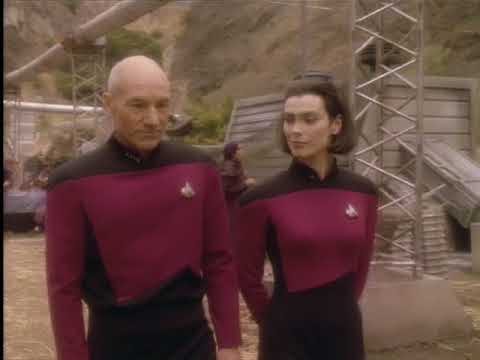
In 1998’s followup feature Star Trek: Insurrection, Picard remains a moral beacon. The supposedly noble Federation seriously considers forcibly relocating 600 people and plundering their planet’s resources. When Captain Picard (Patrick Stewart) protests, his superior stresses how they’re “only” moving 600 people.
“How many people does it take, Admiral, before it becomes wrong?” Picard demands. “A thousand? Fifty thousand? A million? How many people does it take, Admiral?”
In 1988’s “The Measure of a Man,” Picard passionately defends the android Data’s (Brent Spiner) rights as an individual — a “culture of one” — in 1988’s “The Measure of a Man, and in 1990’s “The Offspring,” he bravely risks his carer to prevent a Starfleet admiral from seizing custody of Data’s child: “There are times, sir, when men of good conscience cannot blindly follow orders. You acknowledge their sentience but ignore their personal liberties and freedom. Order a man to turn his child over to the state? Not while I am his captain.”
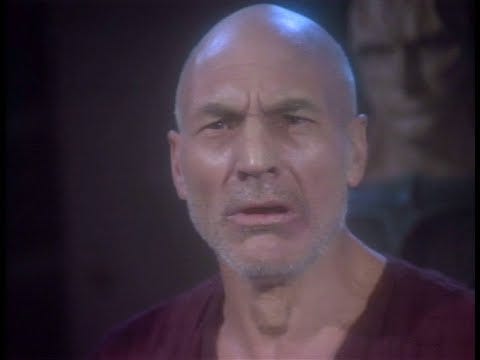
When cadet Wesley Crusher (Wil Wheaton) hides the truth about a Starfleet Academy accident to avoid personal accountability, Picard confronts him in a heartrending scene.
“The first duty of every Starfleet officer is to the truth, whether it’s scientific truth or historical truth or personal truth!” Picard says. “It is the guiding principle on which Starfleet is based, and if you can’t find it within yourself to stand up and tell the truth about what happened, you don’t deserve to wear that uniform.”
Watching this 35 years ago as a teenager, I was as devastated as Wesley, because nothing felt worse than letting down Picard.
Yet Stewart made Picard relatable to those of us stuck in a pre-warp reality. In 1993’s “Tapestry,” perhaps my favorite TNG episode, we learn that Picard struggles with regret. He believe he was too arrogant, too impulsive in his youth, and when Q offers him the chance to go back in time and “self-correct” what he considers irredeemable flaws, he does so without question. However, he returns to a present where he’s no longer captain of the Enterprise. He’s now a nondescript, unimpressive officer. He realizes that a life spent playing it safe is one where he never benefits from the lessons of youth. He begs Q send him back to repair the timeline, knowing that the result could mean his death. “I would rather die as the man I was ... than live the life I just saw.” Young Picard had gotten into a bar fight with some violent aliens, one of whom stabbed him through the heart (the reason why Picard has a fancy artificial one). Young Picard laughed in shock, but older Picard now laughs in gratitude for the life he’s regained. I can never watch Stewart in that scene without tearing up. (Watch below.)
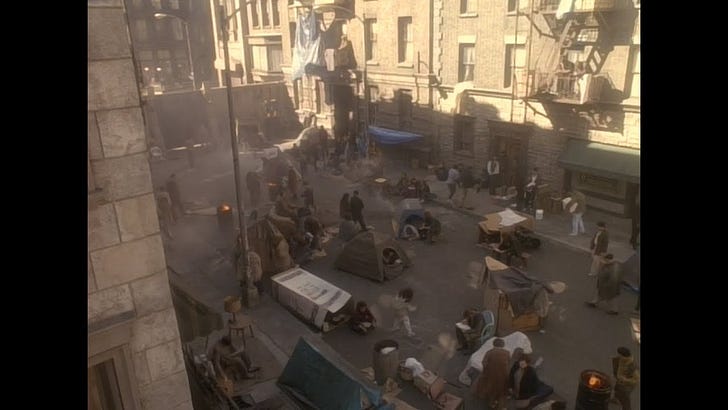
Picard’s unyielding morality would form the foundation for the 2021 Star Trek: Picard series: Retired Admiral Picard has left Starfleet but not quietly. He resigned in protest because he believed the Federation abandoned its principles when it refused to rescue Romulan refugees and even banned all synthetic life based on the actions of a rogue few. Damn right that should feel like a searing commentary on current events.
In a 2017 interview, Stewart openly expressed his concerns about Donald Trump and presciently observed: “Everyone knows that sometimes a failing politician, what he needs is a war. I’m scared.” But Stewart never surrendered to the baser aspects of fear. In Star Trek: Picard’s first season finale, during one of his classic speeches, Picard warns that “fear is an incompetent teacher.” (Watch below.)
Stewart’s final appearance will likely be in December’s Avengers: Doomsday, where he reprises his role as Charles Xavier, leader of the X-Men. It’s his second most well-known role — arguably his most well-known, depending on who you ask. Xavier in the comics was younger and not English, but Stewart was still dream casting in 2000’s X-Men (director redacted). Along with his friend Ian McKellan as Magneto, Stewart delivered a commanding performance, providing a necessary gravitas to the film.
Stewart was a member of the Royal Shakespeare Company, but he never treated his most famous roles in sci-fi and superhero media as “slumming” or just a hefty paycheck between stage performances. He was just as committed playing Macbeth, which I had the honor of witnessing in New York in 2008, as he was playing Picard and Professor X. Frankly, I thought the genre roles offered him the opportunity to bring the Bard’s philosophical explorations of the human condition to TV and film. A story with truly epic stakes brought out the best in Stewart.
Stewart was also a masterful comedic actor. For two decades, he voiced CIA Deputy Director Avery Bullock on Seth Macfarlane’s American Dad series, and he was consistently hilarious. Stewart’s guest appearance in Ricky Gervais’s Extras remains on the funniest bits I’ve ever seen. He also had scene-stealing comedic roles on Frasier and the 1995 movie Jeffrey, based on the Paul Rudnick play.
Patrick Stewart died after what his family described as “a brief and poignant journey” with Alzheimer’s disease and Lewy body dementia. He might have called this the “undiscovered country,” one that sought to silence that irreplaceable voice, even before his final bow.
Walter Koenig, who played Chekov on the original Star Trek, died on Sunday, but it’s not just been a terrible week for Star Trek fans. The world’s supply of joy and decency has diminished greatly, and if we’ve learned anything over the past decade, it’s that such precious resources are not so easily replenished.
We’ll miss you, Sir Patrick, but let’s remember what Picard said in 1994’s Star Trek: Generations:
Someone once told me that time was a predator that stalked us all our lives. But I rather believe than time is a companion who goes with us on the journey, and reminds us to cherish every moment because they'll never come again. What we leave behind is not as important how we lived. After all, Number One, we're only mortal.
Such a beautiful tribute to this giant of a human(itarian) and the best of his craft! Thank you so very much! 🥺💥🫂
Thank you for this loving tribute to a great man, who was a great actor.