


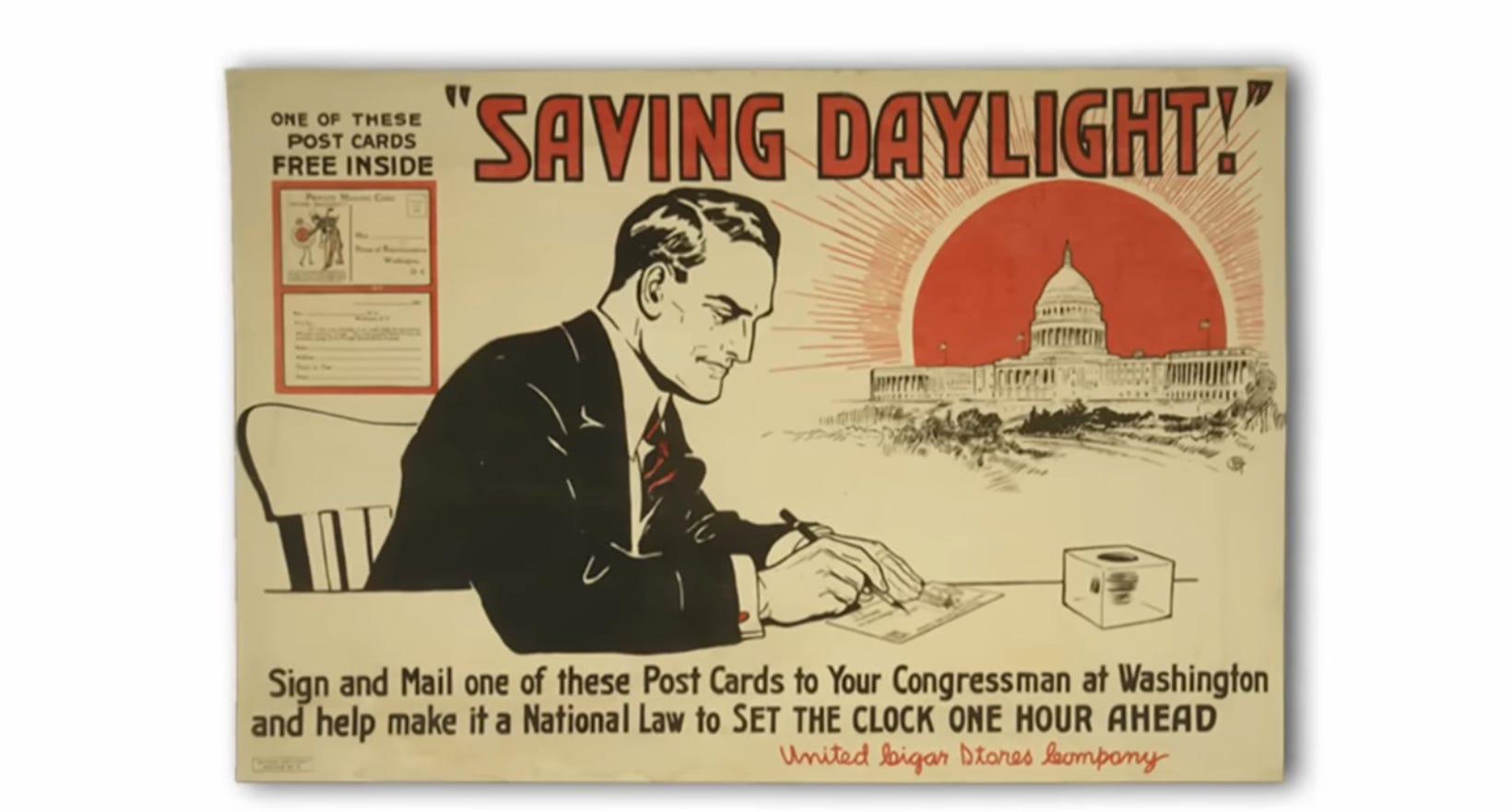
This weekend, Americans will submit ourselves to the forced jet lag known as “daylight saving time.” The name is misleading, even if you don’t incorrectly call it “daylight savings time.” You’re not “saving” daylight. You’re stealing daylight from the morning so you can have extra sunshine in the evening, and the longterm effects are far worse than having to change all your clocks.
Studies have shown that screwing with our natural biological clocks is not ideal. Dr. Trang VoPham, an assistant professor of epidemiology at Fred Hutch, warned an interview last year, “The increase in light in the evening leads to later bedtimes, more sleep disruption, ultimately less sleep, as well as a misalignment between our circadian system, or in other words, our internal biological clock, and our daily schedules.”
It’s especially an issue for regions where the sun naturally sets later in the day, like Seattle or Portland, Oregon. It’s darker longer in the mornings, when people are leaving for work or taking their kids to school. This also puts the lie to the “DST saves electricity” argument, as you arguably turn on even more lights in the morning when getting ready for the day than when you’re winding down at night.
Here in Portland, sunset will shift an hour to just after 7 p.m. My wife and I can have a drink out on the patio after dinner, except it’s early March and too cold. I’m not taking out the outdoor furniture cushions until early June at my most optimistic. Meanwhile, sunrise has now shifted an hour ahead to 7:31 a.m. That’s not the surprise twist in a devil with the Devil. It’s just math. The past week, daylight has greeted me in the morning, but Monday, it’s once again “time to make the doughnuts.”
The United States introduced daylight saving time on March 31, 1918 as a fuel-saving measure, which it would repeat during World War II. Unfortunately, I’ve seen no evidence that daylight saving time has made Americans more effective at fighting Nazis today or even noticing their existence.
Businesses have long appreciate the extra hour of daylight shopping. Sporting events and other outdoor functions could start later, which boosted attendance. The Uniform Time Act of 1966 adopted what seemed like a reasonable compromise: Daylight saving time started at 2 a.m. on the last Sunday in April and ended on the last Sunday in October. (Waiting until late April to “spring forward” means sunrise is no later than 6 a.m. in Portland.)
During an energy crisis in 1973, President Richard Nixon signed into a law a bill that briefly made daylight saving time permanent. The logic reportedly was that “setting clocks ahead one hour could reduce nighttime electrical use and shave about 2 percent off the nation’s demand for energy.”
This clearly wasn’t thought out well. Not long after the law took effect in 1974, eight children in Florida were involved in predawn car accidents while walking to school. Parents — well, mostly mothers as it was the 1970s — driving their kids to school because it was no longer safe for them to walk didn’t actually help save energy.
“Daylight Disaster Time,” as a clever TV commentator described it, didn’t last a year before Congress restored standard time in fall 1974, a few months after Nixon resigned. The events were not related.
The lesson from this blatant failure didn’t last. Daylight saving time keeps getting longer. It was extended to seven months in 1986 and eight months in 2005 when the candy industry successfully lobbied for an extension to include Halloween so they could increase profits.
The Senate tried once again to make daylight saving time permanent in 2023 with passage of the Sunshine Protection Act (another typically misleading name for legislation). Then-Senator Marco Rubio was one of the co-sponsors and he claimed that “many studies have shown that making DST permanent could benefit the economy and the country.” Rubio also suggested delaying the start of school under permanent daylight saving time. Kids wouldn’t have to walk to school with raccoons while dodging cars, and they could sleep later, which is what their growing bodies actually prefer.
Permanent daylight saving time has an appeal for many people beyond avoiding the hassle of changing your clocks. You’d also eliminate the twice-a-year jet lag and resulting loss in productivity.
However, as Beth Malow, a professor of neurology and pediatrics at Vanderbilt University, told Scientific American in 2020, daylight saving time is a fundamental “misalignment of your biological rhythms, or circadian rhythms, for eight months out of the year.” That just doesn’t sound good.
She said:
What’s more of an issue is: you almost have a chronic circadian misalignment—or things are just off-kilter for eight months of the year. That’s how I would look at it. When you’re in standard time, the sun at noon is, in most places, right above your head—you’re really aligned. When you’re in your daylight saving time for eight months of the year, you’re an hour off, and you're getting not enough light in the morning and too much light at night. And that gets worse as the summer approaches—as the days get longer, and you’re getting light into the evening, when your body should be getting less light so that it can get ready for bed. In the morning, as we start getting into the fall, it gets darker when you’re in daylight saving time.
Let’s just go back to standard time, please.
Donald Trump had proclaimed an end to daylight saving time in 2024, but unlike his overtly evil policies, he’s seemingly reticent to make such a polarizing change.
“It’s something I can do,” Trump blathered, “but a lot of people like it one way, a lot of people like it the other way, it’s very even, and usually I find when that’s the case, what else do we have to do?”
This sounds like how Trump justifies his illegal attack on Iran.
Anyway, while you rub the sleep out of your eyes, please consider taking advantage of my “Daylight Disaster Time” subscription sale — 40 percent off the usual annual paid subscriber rate. That’s just $30 a year. Thanks to all who have upgraded to paid subscriber status recently.
This week, I discussed the Texas Democratic Senate primary with Midland County criminal defense attorney and political pundit Sara Spector.

You probably noticed that there’s no public urination in the utopian Star Trek future. (There’s no sex in the champagne room, either.)
I interviewed author Patricia Martin about her new book Will the Future Like You? Reflections on the Age of Hyper-reinvention. This is where I once again ask that you hop over to YouTube and subscribe to my channel. It’s free!
Hillary Clinton was never a “warmonger,” and Donald Trump was never a man of “peace.” This was always a stupid narrative.

That’s it for this week. I’ll see you Monday, after you’ve spent the weekend changing all the clocks in your house.
Ah yes, good old "Spring Back and Fall Forward" or whatever it is...or as we call it here in AZ: "Another month of no one remembering what the hell time it is everywhere else in the country"
AZ noped out of DST in 1967, because jaysus, NO ONE wants sunset not happening until 9 PM in the desert summertime!
I have never understood why this is such a big deal twice a year. I like an extra hour before the sun goes down. It's a nice external reminder that winter is winding down. Yes, I don't sleep quite as well for a day or so, but it's a small price to pay. So, for me, it's fine. The endless complaints about it are more tiresome.