


Doomed golden ticket “winner” Veruca Salt from Charlie and the Chocolate Factory and the famous 1971 film Willy Wonka & the Chocolate Factory (Charlie had a bad agent) is an objectively terrible person — entitled, imperious, and downright sociopathic. However, what if you only believe this because the patriarchy has brainwashed you?
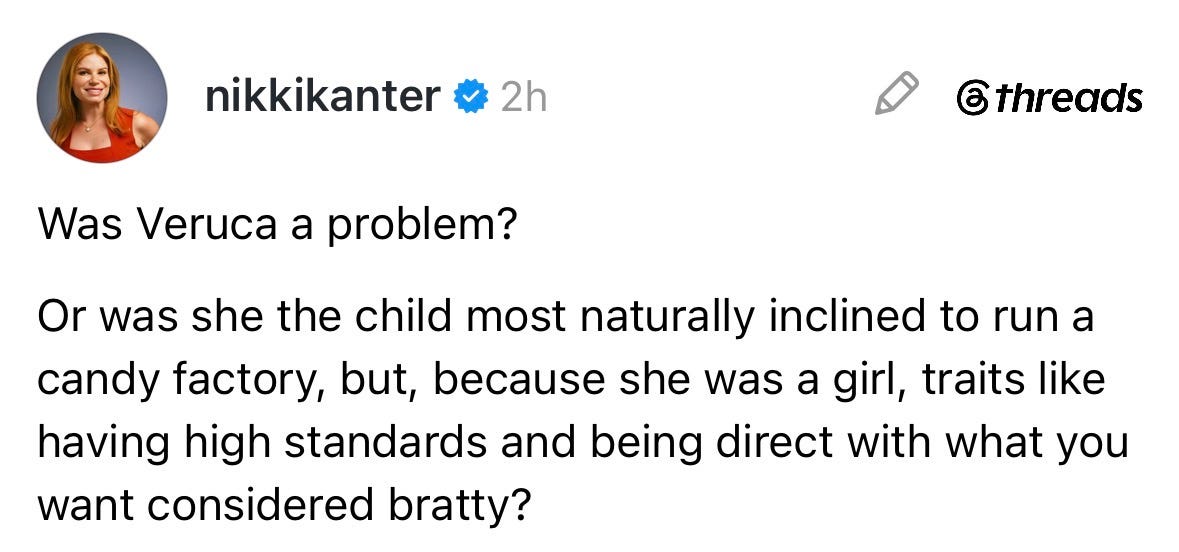
I was doing my best to avoid further “ice coffee” discourse when I came upon this post on Threads from Nikki Kanter, an actual real person, who describes herself as both an “entrepreneur” and a “good friend with a bad attitude.” She writes, “Was Veruca a problem? Or was she the child most naturally inclined to run a candy factory, but, because she was a girl, traits like having high standards and being direct with what you want (are) considered bratty?”
The PlayTyperGuy is supported by paid subscribers. Please become one!

Veruca Salt is terrible, regardless of her gender. There are few if any male characters in fiction with her similar personality who are celebrated rather than visited by three spirits. Yes, people too often quote Gordon Gekko’s “Greed Is Good” speech as if he’s making a valid point, and while Michael Douglas is always compelling to watch, it’s clear that his Wall Street character is a bad guy, who is ultimately punished for his crimes.
Maybe Kanter’s entrepreneural endeavors don’t give her much time to rewatch old movies, but in Willy Wonka & the Chocolate Factory, like the book, Veruca Salt (Julie Dawn Cole) is a shameless cheat. She uses her father’s wealth to “rig” the Golden Ticket contest, which is intended as a game of chance. The workers at her father’s peanut shelling factory are ordered to unwrap thousands of Wonka bars he’s purchased until they find a golden ticket. (Watch below.)
When Veruca berates her father because his workers haven’t found the golden ticket soon enough for her, she’s not demonstrating “high standards.” She simply lacks patient and self-control.
VERUCA: I wanted to be the first to find the golden ticket, Daddy.
MR. SALT: I know, angel. We’re doing the best we can. I’ve got every girl in the bleeding staff hunting for ya.
VERUCA: All right, where is it? Why haven’t they found it?
MR. SALT: Veruca, sweetheart, I’m not a magician! Give me time!
VERUCA: I want it now! What’s the matter with those twerps down there?
MR. SALT: For five days now the entire flippin’ factory’s been on the job. They haven’t shelled a peanut in there since Monday. They’ve been shelling flaming chocolate bars from dawn to dusk.
VERUCA: Make ’em work nights!
We’ve not yet reached either the “Willy Wonka” or the “Chocolate Factory” portions of this movie and we’ve seen conclusive proof that Veruca is not “the child most naturally inclined to run a chocolate factory,” because Veruca is a monster, which is a non-gendered description for someone who behaves monstrously. She has zero empathy for her father’s employees, who she doesn’t even see as human, merely as extensions of her will.
Kanter argues in a follow-up post that of “all the kids, [Veruca] was the one most likely to take the lead and expect results.” This is not what we see in the film. Veruca tells her father she wants “to be the first to find the golden ticket” but she’s contributed absolutely nothing to the search. She’s not on the floor unwrapping chocolate bars in solidarity with the workers. Instead, she’s sitting on her behind and asking her father to make the people she calls “twerps” work nights on her behalf for the reward of keeping their jobs.
Mr. Salt (Roy Kinnear) offers the worker who finds a golden ticket a “one pound bonus,” which is slightly less than 20 pounds in today’s money. That’s not a “bonus.” It’s a tip. It’s also a compelling commentary on “work for hire” employment practices. Yes, Mr. Salt puts up the capital for the chocolate bars, but he can’t realize their true worth — certainly not what he values — without his staff’s hard work. Yet, he’s not willing to offer the “lucky” employee who finds the golden ticket compensation that’s significant to the achievement.
Worse, Veruca Salt desires the golden ticket primarily for its status. She wants to “win,” but she doesn’t actually seem that interested in Willy Wonka’s famous factory. She’s rude and dismissive during Wonka’s personal child-murdering tour, and she only really perks up orders her father to “buy” her an Oompa Loompa: “Hey, Daddy, I want an Oompa Loompa! I want you to get me an Oompa Loompa right away!” She doesn’t want the Oompa Loompas to make chocolate for her. She wants her slaves as a personal acquisition, one she’ll likely tire of and forget like everything else her father has gotten for her.
Veruca’s big number, “I Want It Now,” is not a straightforward villain song. Veruca’s relationship with the world and its inhabitants is eerily similar to Donald Trump’s. That’s not a good thing. (Watch below.)
“I want the world,” Veruca sings. “I want the whole world. I want to lock it all up in my pocket. It’s my bar of chocolate. Give it to me now.” She doesn’t want to enjoy or savor the chocolate she compares to the world. She simply wants to possess it.
She goes on: “I want today. I want tomorrow. I want to wear ‘em like braids in my hair. And I don't want to share ‘em!” This reads like a Stephen Miller-written speech.
Once Veruca goes down the hatch, the Oompa Loompas perform their Veruca-inspired “Reason You Suck” song. They don’t actually blame Veruca for her flaws or suggest they’d like her better if she were Michael Douglas. No, they firmly state, “Blaming the kids is a lie and a shame. You know exactly who’s to blame — the mother and the father.”
Veruca Salt’s father would insist that he acted out of love and devotion to his daughter. He wanted to protect her and make her happy, but he actually didn’t love her enough to set boundaries, to risk losing her immediate affection, which was always fleeting because its inspiration was hollow. Politically speaking, liberals could stand to learn from the Oompa Loompas’ warning.
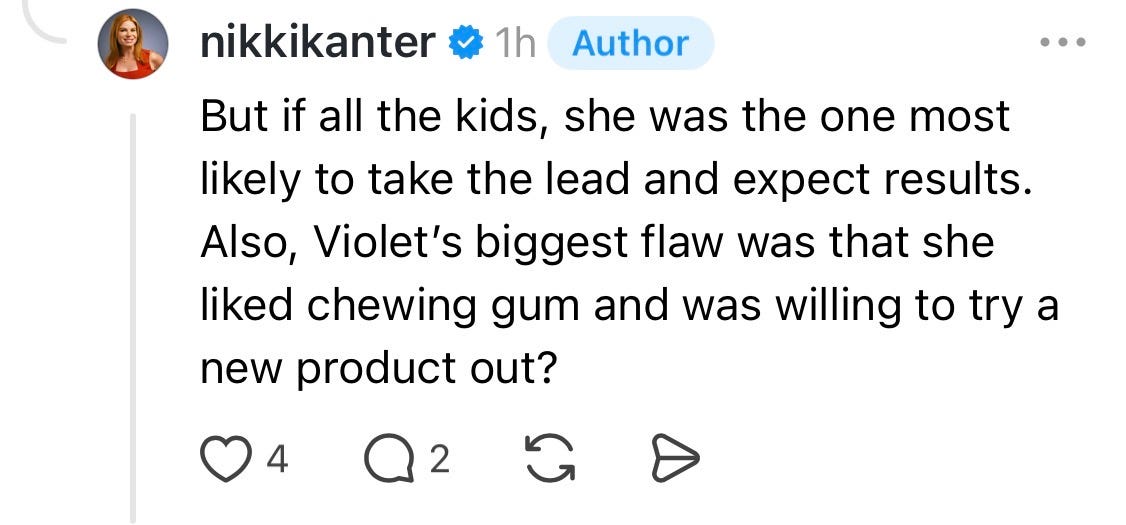
Kanter also defends Violet Beauregarde (Denise Nickerson from Dark Shadows) who turns into a giant blueberry after consuming experimental gum. Kanter laments, “Violet’s biggest flaw was that she liked chewing gum and was willing to try a new product out?” There’s nothing wrong with chewing gum, but as the Oompa Loompas point out, doing so ceaselessly as Violet does is “repulsive revolting and wrong.” Violet’s fatal flaw is poor impulse control. She doesn’t listen to those who know better. When Wonka shows off his “three-course dinner gum,” he specifically warns everyone that “he hasn’t got it quite right yet.” Violet ignores him and takes the gum anyway. He repeats his warning: “I wouldn’t do that. I really wouldn’t.” She chews the gum anyway and that’s why she’s a giant blueberry with limited career options.
It’s possible that Kanter hasn’t seen Willy Wonka in a long while, but if so, it’s revealing that her big takeaway was that Veruca was willful captain of industry and Violet was merely inquisitive. She missed the whole point, but maybe the Oompa Loompas can clear it up for her with an encore performance.
The point is all of the kids who are spoiled have...spoiled. It is the one engaging in life, working hard who is the winner.
Of course, that isn't how it works in capitalism, is it? The argument that any of these children are actually just stories of success in our world, favored by wealth, nepotism, and lack of empathy, rings tragically true.
Violet at one point told Veruca to "can it, you twit!," so at least had that one redeeming quality. Also, since Denise Nickerson, as you noted, was on "Dark Shadows," I have a fondness for her portrayal of Violet. There is nothing redeeming about Veruca, and she reminds me more of trump than anyone else in all of literature, the movies, and TV.