


When I was in middle school, two albums I listened to quite often were the Beastie Boys’ Licensed to Ill and Run-DMC’s Raising Hell. My classmate Bo had dubbed them onto a cassette tape for me — one side was labeled “Licensed to Ill” and the other was “Raising …” (This was South Carolina, so he didn’t write the word “Hell.”) Bo and I had bonded over a mutual love of Thundercats (and shared adolescent confusion over Cheetara). We didn’t see each other outside of school, of course, because Bo’s step-father didn’t like Black people in his home. He wasn’t a Klan member or anything. This was just South Carolina in 1986.
It’s why those two albums were so important. White kids had started getting into rap with the Beastie Boys, and Black kids had started jamming to rap songs that sampled classic rock. Raising Hell was the first multi-platinum hip-hop album — white kids were definitely listening, and its biggest hit was Run-DMC’s cover of Aerosmith’s “Walk This Way.”
The collaboration was revolutionary. Run-DMC’s Joseph Simmons and Darryl McDaniels used to freestyle over the first few seconds of “Walk This Way” on a loop — Joey Kramer’s funky drum beat before Mr. Joe Perry’s classic guitar riff. They’d never heard the full song or even knew who Aerosmith were. When Run-DMC’s producer Rick Rubin suggested covering the song, Simmons and McDaniels were initially skeptical, dismissing the lyrics as “hillbilly gibberish.” Run-DMC’s DJ Jam Master Jay saw the potential, so eventually Simmons and McDaniels came around. That “hillbilly gibberish” had a flow.
Steven Tyler re-recorded his vocals for the collaboration, and Perry delivered a scorching bass track with a bass he borrowed from one of the Beastie Boys. Perry brings it home with a solo that’s almost half the length of the song. (Enjoy below.)
Run-DMC didn’t plan to release “Walk This Way” as a single, but it exploded on urban (read: “Black”) and rock (read: “White”) radio stations. It was a crossover smash, and different from such past collaborations by Paul McCartney and Stevie Wonder, Paul McCartney and Michael Jackson, or Paul McCartney and Ella Fitzgerald (the last one didn’t happen but it would’ve been awesome). Rap was still new and sneered upon, even by some of the stars of “urban” radio, but Walk This Way” showed how similar rap and rock truly were. Any separation on radio and in life was artificial and unnecessary.
“Walk This Way” led to Aerosmith’s late 1980s comeback. I was a big fan of their 1989 album Pump, especially the hit single “Love In An Elevator.” “Good morning, Mr. Tyler.” A pre-Clueless Alicia Silverstone appeared in three videos for singles from Aerosmith’s 1993 album Get A Grip — “Cryin',” “Amazing,” and “Crazy.” This was back when you watched MTV for the videos. I didn’t have MTV in 1986, but I’d stay up late to watch Friday Night Videos for the chance to catch the “Walk This Way” video. I loved the part when Steven Tyler starts dancing with Run-DMC. It offered me a glimpse into a world where race didn’t matter, just the beat. That’s still the direction where I hope we all can walk. (Watch what probably pissed off the early MAGAs.)
It’s almost February so that means it’s time for our Valentin’s subscription deal. Become a paid subscriber for 40 percent off the usual annual rate. That means you can show you love for this newsletter for just $30 a year. Thanks to all who have upgraded to paid subscriber status recently.
This week, I wrote about how Alex Pretti stood up to Nazis, and we should do the same.
Alex Pretti Didn't Surrender To The Nazis. Neither Should You.

ICE agents executed another American citizen in Minneapolis on Saturday. While recording ICE activities with his phone and directing traffic, Alex Pretti, 37, tried to help a woman who ICE agents had assaulted. He was pepper-sprayed and a half-dozen masked cowards wrestled him to the ground. Then he was shot at point blank range in the back. After remov…
I also reviewed the new series Wonder Man for the AV Club
Wonder Man can at times feel like the Netflix Marvel series from a decade ago, which seemed to exist in their own separate realities from the more bombastic MCU of the movies. This is perhaps not the show for anyone interested in traditional frenzied battles between costumed characters. Of course, fans are admittedly hard to please: Depending on who you ask, heavy continuity in Marvel shows and films can make each installment feel less accessible to new audiences, who must wade through hours of homework to understand what’s happening. Other fans complain that the series in particular feel disconnected from any larger narrative and introduce characters and plot points that never pay off.
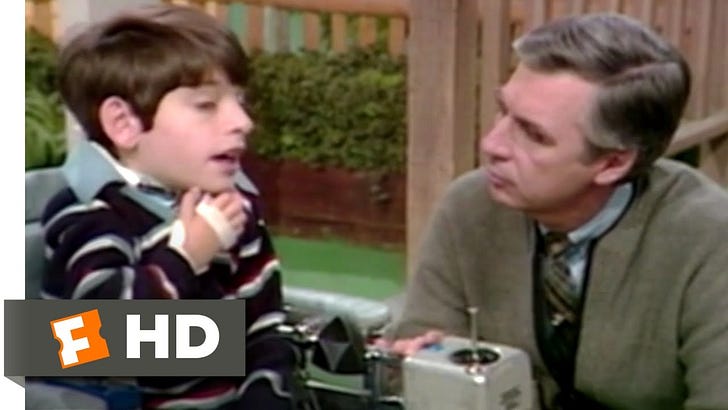
Meghan McCain, who I believe is related to former Sen. John McCain, suggested that Mr. Rogers was apolitical. She knows as much about Mr. Rogers as she does about anything else.
I still don’t know what Gavin Newsom stands for.

My hero Alan Alda turns 90.

Over at Public Notice, I argue why “Abolish ICE” is not a radical position anymore. It’s the only rational one.

I had a great discussion with theatre artists Jessica Wallenfels and Teal Sherer. This is when I ask you to head over to my YouTube channel and hit the “subscribe” button. I’d love to have as many subscribers there as I do here.
That’s it for this week. See you on Monday.
Rap, before it was called so has been around all sorts of genres. Country has a certain kind of song which is really talk-sung which usually tells a complicated story.
Here’s Johnny Cash rapping in 1969.
https://youtu.be/WOHPuY88Ry4?si=_Vxs85485VOy6L5O
Fantastic piece. That detail about Run-DMC initially calling Aerosmith's lyrics "hillbilly gibberish" but Jam Master Jay seeing the potential is so telling. Sometimes the bridge-builders aren't th emost obvious people in the room. I grew up around music that crossed genres without even knowing it was suppposed to be radical, and that's exactly the world this collaboration helped create.