


Democratic Socialists of America Co-chair Megan Romer received bipartisan rebuke last week when she confirmed during a Fox News interview that she supports abolishing the Senate. Republicans, and their prize recruit John Fetterman, seized on her remarks, while many Democrats, including South Carolina Senate candidate Dr. Annie Andrews and failed Ohio Senate candidate Tim Ryan, described Romer’s positions as “anti-American” and fundamentally un-democratic.
A collective freak out over defunding the police or amnesty for illegal immigrants is one thing, but it’s interesting to see even Democrats defend the Senate, a 200-year-old restricted country club.
John Fetterman might not respect his country club’s dress code but he now passionately defends its kookier rules. He wrote in a Washington Post op-ed last week that he was wrong when he’d previously supported eliminating the Senate filibuster. That wasn’t an offhand comment he made during his 2022 Senate campaign. He specifically presented himself as a Democrat who’d end the filibuster, unlike Joe Manchin and Kyrsten Sinema.
Fetterman wrote in 2021, “If Senators Manchin or Sinema are your ideal Senators, then I am *not* your candidate.” He flat-out said, “If you what you think our democracy needs in this pivotal moment is a candidate who’s going to get compliments from Mitch McConnell and his sedition-curious GOP, then I am quite simply not your guy.”

Fetterman’s self-serving “explanation” for betraying his former supporters is like someone publishing an op-ed detailing why they cheated on their spouse. No one’s interested. Fetterman doesn’t offer any new insights, just recycled institution-humping from one of Joe Manchin’s tedious floor speeches and op-eds on the topic. “The filibuster is a critical bulwark against a fill-in-the-blank government with new laws, deregulation or procedures of its choosing… we cannot become a smaller version of the House of Representatives.”
Fetterman says all this without actually stating “why.” Members of the Senate Country Club love sneering at their younger siblings in the House of Representatives, but the Senate is no less partisan than the House. It’s just less representative of the public.
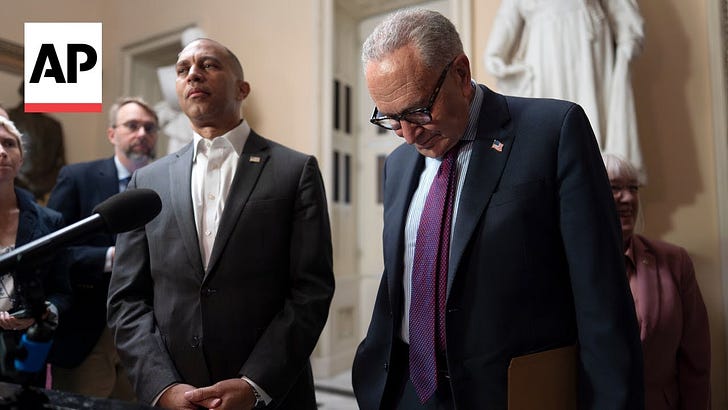
Ben Sasse, a former Republican senator from Nebraska, is at least consistent in his continued support for the filibuster. (Unlike Fetterman, it’s possible Sasse has a core set of beliefs greater than his own self-aggrandizement.) He wrote in the Wall Street Journal, “The upper house is built for the long view, with six-year terms that encourage a deliberative trustee model of representation. Senators owe their states both judgment and conscience.”
This is an adorable sentiment to express about a legislative body that includes Tommy Tuberville. Yes, Tuberville’s retiring but it’s not because everyone agreed that he was an offense to the institution. Sasse, however, was effectively chased out of the Senate when he voted to convict Donald Trump in his second annual impeachment trial. Notice that Republican senators twice failed to remove Trump for obvious crimes because they were too worried about maintaining their country club membership.
The six-year terms are supposed to make senators less susceptible to political pressure, but that’s not actually true in practice. Senators still have to start thinking about raising money for their next election almost immediately after they’ve won their current one. There’s also little evidence that they feel freer to defy donors and party leaders until election year. Donors, party leaders, and yes those pesky voters have memories long enough to recall how their senators voted.
The Senate has proven a disaster for democracy, and like the current Supreme Court, it openly serves right-wing interests and exists almost entirely as an unmovable obstacle for any remotely liberal agenda. If you want to build some bridges, maybe the Senate will let you — and senators can pat themselves on the back at the country club gym — but if you’d like to protect voting rights for Black people or preserve bodily autonomy for women, the Senate is not going to help.

The Senate functions as the ultimate hope squelcher. The Republican senators from states the size of my patio can kill legislation regardless of how popular it is. Thus, the Senate in its current form makes serial liars of the Democrats who promise bold action during every election cycle and then promptly fail once in office, all while Republicans point and laugh.
Case in point: Democratic House Leader Hakeem Jeffries declared at a recent campaign event: “We’re going to crack down on corrupt price gouging. We’re going to clean up the mess at the United States Supreme Court. And we’re going to ban the president, vice president, and members of Congress from trading stocks. We have 100 days, America.” (Watch below.)
I won’t dispute Jeffries’ math: There are roughly 100 days until the midterm elections. However, I do question his suggestion that Democrats can do anything that he lists with the current Senate. If Democrats flip the chamber, they won’t have 60 votes and the filibuster would prevent them from doing anything significant without the support of at least nine Republicans, which won’t happen. This is the ultimate in “head-bashing-against-a-wall” political masochism.
Perhaps that’s why even center-left journalist Jonathan Chait concedes that the DSA might be on to something about the Senate. He wrote in The Atlantic, “… on this particular idea, the maniacs have a point. The Senate is a vestigial deformity upon the Constitution whose elimination, unlikely though it might be, would rank among the great democratic advances in American history.”
Chait correctly notes that the founders we all celebrate (especially the ones who appeared in Hamilton) did not set out to create a Senate that openly sneers at democracy. James Madison and Alexander Hamilton were forced to compromise with founders such as Gunning Bedford Jr. from Delaware, who isn’t even in Hamilton but nonetheless threatened to walk away from the nascent republic if smaller states like his didn’t have disproportionate representation in the Senate. Madison submitted but he wasn’t happy about it.
Madison explained, “A government founded on principles more consonant to the wishes of the larger States, is not likely to be obtained from the smaller States. The only option, then, for the former, lies between the proposed government and a government still more objectionable. Under this alternative, the advice of prudence must be to embrace the lesser evil.”
Merely because the Founders had to cut a deal to achieve an imperfect outcome does not bind the citizenry to abide by it for eternity. Other compromises the Founders made—such as protecting slavery—have long since fallen by the wayside. But the Senate, rather than viewed by posterity as the necessary evil that Madison recognized it to be, has been sacralized.
The Senate is compromised democracy. It is not the end state. We can still work toward a more perfect union, if we truly let the people’s voices matter. The country club is long due for an overhaul.
It gives elderly retirees a place to hang out?
Fetterman wrote in 2021, “If Senators Manchin or Sinema are your ideal Senators, then I am *not* your candidate.”
Fucking lying fuck!
Years ago on another website, someone proposed abolishing the Senate. At first, I was shocked. But as I thought about it, it totally makes sense. As one of 40 million Californians, I should have the same representation as everybody else in this country. Why should Wyoming have 6x more representation with their 500k than my county of three million? I'm down with abolishing the Senate and defunding the police.