


William Shatner turns 95 on Sunday. His legacy is extensive. He starred in two classic episode of The Twilight Zone — most memorably, “Nightmare at 20,000 Feet” or “there’s something on the wing!” Decades later, he was Denny Crane — the mentally declining but still boisterous law firm partner in Boston Legal. But, of course, he’s most well known for his legendary performance as Captain James T. Kirk from the original Star Trek and the first six installments of the film series.
In the classic series, Kirk is the young maverick captain who considers “risk” his business. There’s seemingly no challenge he can’t resolve within a single episode’s run time. I’ve never joined the bandwagon that mocks Shatner’s acting style. Yes, his distinctive phrasing and enunciation is easily parodied, but his voice was its own unique special effect. It made you believe — not just in starships and phasers set to stun but that humanity could shed the self-imposed shackles that grounded us and reach the stars. (Watch below.)
The film series began a decade after Star Trek’s last episode (the awful “Turnabout Intruder”). Kirk had entered middle age and was initially less sure of himself. He receives reading glasses as a 50th birthday present in Star Trek II: The Wrath of Khan. For obvious reasons, I relate most to Kirk at this stage of his life.
The Wrath of Khan remains my favorite Star Trek film, specifically because it defines Kirk’s heroism so clearly. He’s larger than life but yet fallible, with real human flaws and regrets. The entire film’s plot hinges on an error he’d made in his youth. The young James Kirk is as much the film’s antagonist as Ricardo Montalban’s Khan, and the older, wiser Kirk confronts them both.
The key scene for me in Wrath of Khan when Lt. Saavik (Kirstie Alley) asks Kirk how he passed the Kobayashi Maru test, when a cadet commands a starship in a simulation that puts them in a “no-win scenario.” Kirk reveals that he “reprogrammed the simulation so it was possible to rescue the ship.” Saavik is shocked, and Kirk’s newly discovered son, David, is appalled: “He cheated.”
“I changed the conditions of the test,” Kirk explains. “Got a commendation for original thinking. I don’t like to lose.”
“Then you never faced that situation … faced death,” Saavik says.
“I don’t believe in the no-win scenario,” Kirk insists. (Watch below.)
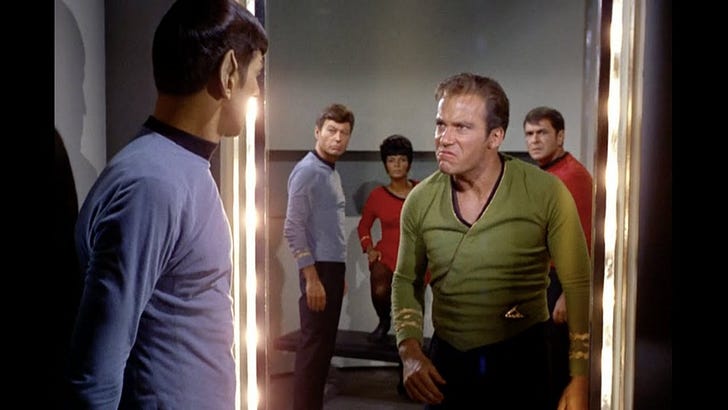
This might seem like hyperbole. Earlier, Kirk told Saavik that “a no-win situation is a possibility every commander may face. Has that never occurred to you? And how we deal with death is at least as important as how we deal with life.”
However, “I don’t believe in the no-win scenario” is exactly how Kirk approaches life. He doesn’t accept death as inevitable, an enemy waiting for him in the distance that he can’t defeat.
A popular interpretation is that Kirk learns in Wrath of Khan to accept the no-win scenario. You can’t outwit death. Spock makes the ultimate sacrifice for the crew, and Kirk must watch his friend die. (“Ship … out of danger?” always chokes me up.) However, Spock proves that death itself is not defeat, only the fear of death. (Watch below and weep.)
The third Star Trek film, The Search for Spock, was criticized for effectively undoing Spock’s death, as if Kirk was once again an arrogant cadet who reprogramed the simulation so he could win. I think that’s unfair. At the end of Wrath of Khan, Kirk tells McCoy that he feels “young.” Kirk’s rejuvenated spirit allows him to risk everything for merely the chance to save both Spock and McCoy. When stealing the Enterprise for his long shot mission, he’s warned that if he goes through this, he’ll “never sit in the captain’s chair.” The fear of professional death doesn’t hinder him. Later, he loses the son he never truly knew and the ship that has given him purpose.
“My God, Bones,” Kirk laments, “What have I done?”
“What you had to do. What you always do. Turn death into a fighting chance to live.”
Back on Vulcan, where McCoy and Spock are restored, Spock’s father Sarek thanks Kirk for everything he’s done.
“What I have done, I had to do,” Kirk replies.
“But at what cost?” Sarek wonders. “Your ship. Your son.”
Kirk is silent for just two seconds before responding, but Shatner conveys so much within that brief pause. He’d been running on adrenaline and impulse (power) but now he finally confronts the choices he’s made — not just recently but for his entire life — and he understands.
“If I hadn’t tried,” Kirk says, “the cost would have been my soul.” (Watch below and weep some more.)
Accepting the “no-win scenario” is to give up, which Kirk will never do as long as he draws breath. Neither should we. Happy birthday, Mr. Shatner.
It’s Spring Break here in Portland, Oregon, so I’m spending next week with the family. We’re doing a staycation of sorts where we venture outside our Northeast Portland neighborhood — brunch somewhere on Hawthorne, then a trip to OMSI, maybe midweek afternoon cocktail That’s the benefit of working for yourself, and I appreciate your ongoing support.
If you haven’t already, please consider taking advantage of my “Spring Break” subscription sale — 40 percent off the usual annual paid subscriber rate. That’s just $30 a year. Thanks to all who have upgraded to paid subscriber status recently.
Previously on The Play Typer Guy:
John Cornyn changed his mind about the filibuster as soon as it stood in the way of legislation Republicans actually wanted to pass. Meanwhile, Joe Manchin remains the Senate’s all-time chump.

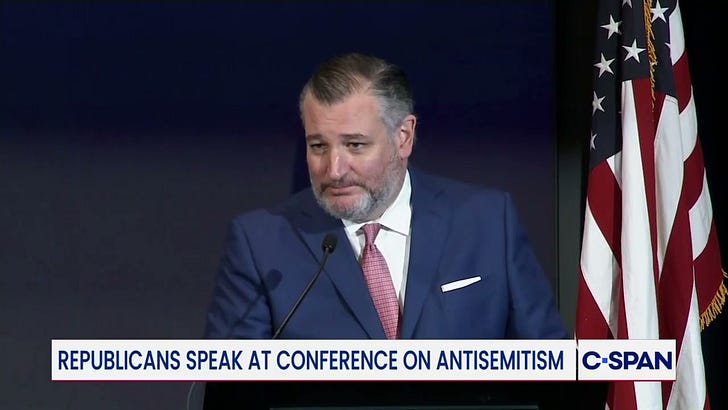
Ted Cruz ripped Tucker Carlson a new one at an antisemitism symposium for Republicans who are in denial about the current state of their party. I anticipate Cruz surrendering to Carlson as easily as he tried to flee Texas during a snow storm.
Donald Trump continues crashing out. The question is whether he takes the civilized world with him.

I delved into why centrists are so afraid of Alexandria Ocasio-Cortez, who isn’t even Virginia Woolf.

That’s it for this week. I’ll see you Monday.
So I WASN'T the only teenage boy who lost it at Spock's death scene...Good to know. I remember how it REALLY affected me
Nice to find another Trekkie. 100 percent agree re Shatner and Kirk!