


Spider-Man: Brand New Day kept the film’s major villain secret during its marketing campaign. Keith David’s narration in the first full trailer had some fans speculating he’d play Spidey’s comic book foe the Jackal, and Sadie Sink’s casting inspired online debates about her identity. (Sink’s press interviews were so masterfully evasive she could have a career in politics.)
Now that the movie’s out, we know that Keith David isn’t the Jackal, who was a goofy villain anyway, and while Sadie Sink’s identity was hardly a surprise, she’s not the Big Bad either — more the major antagonist who advances the plot. The film’s actual villain is both a twist reveal and also a very relevant political commentary. Fortunately, the Elon Musk brigade is so busy whining about The Odyssey they’ve seemingly ignored the blatant “wokeness” in the other summer blockbuster starring Tom Holland, Zendaya, and Jon Bernthal. Obviously, I will now discuss the plot in detail, so consider this a spoiler warning.

Sadie Sink plays mutant telepath Jean Grey (a founding member of the X-Men but at this point in her lie just a very troubled teen), who’s used her mental powers to break into Department of Damage Control (DODC) buildings in search of something called “V-Max.” Spider-Man (Tom Holland) works with DODC director Bill Metzger (Tramell Tillman) to stop these attacks on federal property, as Metzger tells him that their “enemy” is a dangerous criminal and an active threat to innocent people. His MAGA-style propaganda is only partly true.
However, while Jean’s actions are undeniably criminal, her motivations are not two-dimensionally “bwa-ha-ha.” A flashback later reveals that Metzger and the DODC abducted Jean’s sister Sara (Olivia Booth-Ford) so they could experiment on her and exploit her powers. Jean believes “V-Max” holds the answer to where the DODC is holding Sarah, but tragically, that’s not the case.
Spider-Man ultimately empathizes and sides with Jean. He maintains his own moral position (no killing, not even the worst people) while appealing to her humanity. He sees her as worth saving, and he rejects Metzger’s world view — even if his perhaps naive faith in the government enabled Metzger’s evil actions.
This past year, we’ve seen ICE brutalize innocent people and execute citizens. They conduct themselves like the shadowy government from a 1990s X-Files episode, except they now operate in broad daylight, without even the pretense of accountability. The black vans that pulled into a public park and dragged away Sarah as she went to buy ice cream recall the very real images of ICE swarming into communities and seizing people assumed to be “illegal.” Just like a terrified Jean, their families have no idea what happened to them. They are transported to different facilities across the country, as if the primary goal is to keep them separated from their loved ones. Someone with Jean’s powers only exists in a fantasy world, but it’s not fantastic to imagine her doing whatever it takes to find her sister. Society’s laws have abandoned her. They are just another tool in Metzger’s arsenal.
That real-world context is perhaps why it is so satisfying to see Spider-Man whooping the behinds of Damage Control’s ICE agent stands in when he shows up to rescue Jean.

Spider-Man: Brand New Day is an interesting contrast to a 2025 episode of Doctor Who, “The Interstellar Song Contest,” which was criticized for its depiction of a genocide victim (Freddie Fox) as a terrorist who plans to commit genocide on an even greater level. He wants to kill three trillion people as revenge for what he’s suffered. This is the extremist’s view of political extremism. It suggests that anyone who takes extreme measures to stop genocide actually wants to commit their own genocide — thus framing the ongoing genocide as proactive self-defense. It’s a far too familiar argument.
“The Interstellar Song Contest” doesn’t humanize the genocide victim or show how he was violently radicalized. He’s simply presented as a soulless monster without even a real name. (He’s just called “Kid.”) The story doesn’t have a Bill Metzger, so the genocide victim remains the sole villain for the Doctor (Ncuti Gatwa) to vanquish with uncharacteristic violence. Ironically, the way Spider-Man “defeats” Jean feels more like the Doctor than this. (Watch below.)
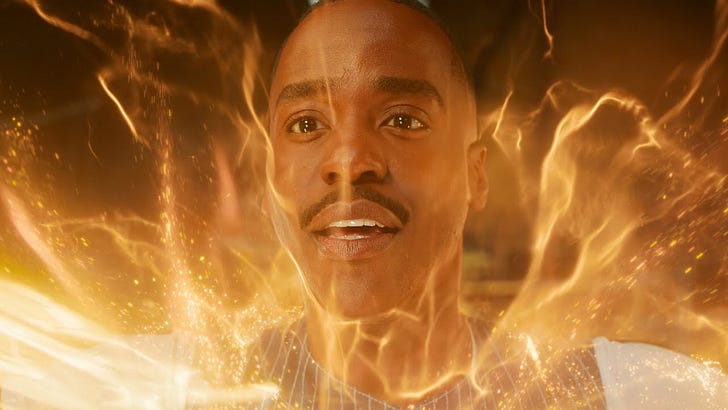
“I have met so many versions of you, Kid,” the Doctor says, “and revenge is just an excuse. Because your cold, filthy heart just likes to kill.” I can understand the Doctor’s fury, though he’s shown more compassion for his fellow Time Lord, the Master, who’s tortured his friends and murdered countless people. His “master” plans are frequently genocidal, but the Doctor still tries to reason with him. Yet, “The Interstellar Song Contest” deliberately paints Kid — a victim of genocide — as incapable of reason and unworthy of compassion. This is a persistent theme among genocide defenders — the targets aren’t actually victims and certainly aren’t innocent, and those who take violent action do so not because they feel they have no other choice but because they “just like to kill.”
Kid is placed into custody vowing vengeance against the Doctor, whose smug satisfaction in his temporary triumph ignores how he’s further radicalized his enemy, which will inevitably lead to more violence. Spider-Man prevents Jean from potentially killing millions of New Yorkers, but he also saves her. This is a better way, and it’s a lesson Peter Parker learned from his Aunt May (Marissa Tomei), whose tombstone reads, “When you help someone, you help everyone.”
In Spider-Man: Brand New Day, Jean Grey commits terrorist acts in her pursuit. That’s never presented as the right thing to do, even if we can empathize with her motives. Some fans have questioned whether Grey is “too evil” in the movie, but this misses the point that Jean isn’t actually evil. She’s emotionally damaged, but she doesn’t take pleasure in what she does. I respect the film for not pulling its punches and minimizing Jean’s actions, which are inexcusable regardless of her motivation. She repeatedly violates people’s bodily autonomy — ruining a man’s life in the process — and in one devastating scene commits what we’d rightly consider sexual assault. Yet, her actions don’t exist in a vacuum.
There are no good or perfect victims, and it benefits the powerful oppressors when we demand sainthood from the oppressed. Damaged people lash out, make bad choices borne from trauma and grief. Leveraging that as a rationale for continued oppression is, of course, just what people like Bill Metzger will do to mutants in the Marvel Cinematic Universe. Unfortunately, that strategy does not exist only in fantasy. It’s employed far too often in our own.
So I really liked the movie but as soon as they said the name Jean Grey I said "oh no" to myself (I stayed spoiler free). The Uncanny X-Men were MY comic book. I still have boxes of them in a closet. I'm glad she wasn't the actual villain in the end but my heart sank. I'm still mad after what the MCU did to Wanda in that terrible Doctor Strange movie. They made a mother looking for her children into the villian on Mother's Day, WTF? And now Jean Grey. They made two strong female superheroes into villains, maybe there's a bit of misogyny there. And to nerd out a bit, are we just making things up out of whole cloth in the MCU now? Jean was a telepath who later developed telekinesis, later still became one with the Phoenix force and only then, maybe she could do all the body inhabiting stuff but not as a teenager. She needed Prof X to teach her how to quiet the voices. Probably an alternate earth thing.
If your only weapon is head-assed sadopopulism, then everything has to be a culture war. Every last thing. Practicality, fun, all of it goes out of the window because the most important thing is that the Libs must be owned, the *others* must be isolated. So if any popular media even makes a *hint* of inclusivity, it must be destroyed.